

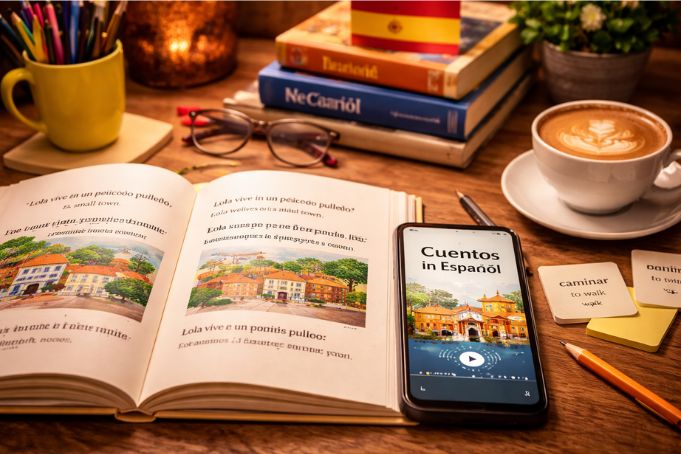
Learning a new language often starts with excitement — and quickly turns into frustration. Grammar charts feel endless, vocabulary lists blur together, and speaking confidence stays stubbornly low. That’s where stories quietly change everything. When you Learn Spanish by Reading Stories, your brain absorbs the language naturally, almost the way it did with your first language.
Instead of forcing words into memory, stories invite you in. You follow characters, emotions, and situations — and Spanish becomes something you experience, not just study. Over time, fluency doesn’t feel chased. It builds.
Why Stories Work Better Than Traditional Methods
Most traditional learning systems focus on rules first and meaning later. Stories flip that order. They deliver meaning immediately, then allow structure to sink in gradually. This mirrors how humans naturally learn language.
According to cognitive research shared by Harvard University, contextual learning significantly improves long-term retention because the brain links language with emotion and narrative rather than isolated facts (harvard.edu). Stories create mental hooks — and those hooks matter.
Stories Keep Your Brain Engaged
When you read a story, your brain doesn’t sit passively. It predicts outcomes, imagines scenes, and connects emotions. That engagement increases attention span — something flashcards simply can’t compete with.
- Vocabulary appears naturally within context
- Sentence patterns repeat without boredom
- Meaning becomes clear even before translation
You’re not memorizing Spanish — you’re understanding it.
Also Read: How Language Learning Helps with Emotional Vocabulary
How Reading Builds Fluency Faster
Fluency isn’t about knowing every word. It’s about recognizing patterns quickly and responding without hesitation. Stories train exactly that skill.
As you read regularly, certain structures start to feel familiar. Phrases repeat. Verb tenses begin to “sound right.” This is subconscious fluency forming — the kind that textbooks rarely deliver.
The Power of Repetition Without Boredom
Repetition is essential, but forced repetition drains motivation. Stories solve this problem beautifully.
- Common verbs reappear across different scenes
- Grammar shows up naturally instead of being explained
- New words stick because they’re tied to events
You might read the same structure ten times — without even realizing it.
Combining Reading With Listening Accelerates Results
Reading alone builds understanding. Listening builds instinct. When learners pair stories with audio, progress often accelerates dramatically.
This is why many learners complement reading with platforms offering Spanish Lessons Online. When you hear native pronunciation while following written stories, pronunciation, rhythm, and comprehension develop together.
The U.S. Department of Education notes that multimodal learning — combining reading and listening — strengthens language processing speed and confidence (ed.gov).
Why Beginners Benefit the Most
Beginners often believe they must “learn more first” before reading. In reality, simple stories are often the best starting point.
Easy stories use controlled vocabulary and short sentences. They allow learners to succeed early — and success builds momentum.
- You stop translating every word
- You begin understanding full ideas
- Your confidence grows quietly but steadily
That confidence is what keeps learners consistent — and consistency is what builds fluency.
Making Stories Part of Your Daily Routine
You don’t need hours per day. Even 15–20 minutes of story reading can create measurable progress over time.
Many learners read one short story in the morning or before bed. Others reread familiar stories multiple times, noticing new details with each pass. Both approaches work — because the key is exposure, not perfection.
Small Habits That Add Up
- Read without translating every sentence
- Focus on understanding the idea
- Revisit stories you already know
Fluency doesn’t arrive suddenly. It quietly accumulates — page by page.
FAQs
Is reading stories enough to learn Spanish?
Reading stories builds strong comprehension and vocabulary. When combined with listening and light speaking practice, it becomes a powerful foundation for fluency.
Should beginners read with translation?
Yes, especially early on. English support reduces frustration and helps learners stay engaged while gradually relying less on translation.
How long before I see improvement?
Many learners notice better comprehension within a few weeks, especially when reading consistently for short daily sessions.
Are stories better than grammar study?
Stories don’t replace grammar entirely, but they make grammar intuitive — often before learners consciously study rules.
Final Thoughts
When you learn Spanish through stories, progress feels natural rather than forced. You stop chasing fluency and start building it quietly — sentence by sentence, scene by scene. Stories turn learning into experience, and experience is what languages are truly made of.
If you’ve struggled with traditional methods, reading stories may be the shift your Spanish journey has been waiting for.
Also Read: Spanish Fluency for Busy Lives
Blog Development Credits
This blog was a team effort fueled by smart ideas. Dual Language Stories picked the topic. Most content was crafted using tools like ChatGPT and Google Gemini.