

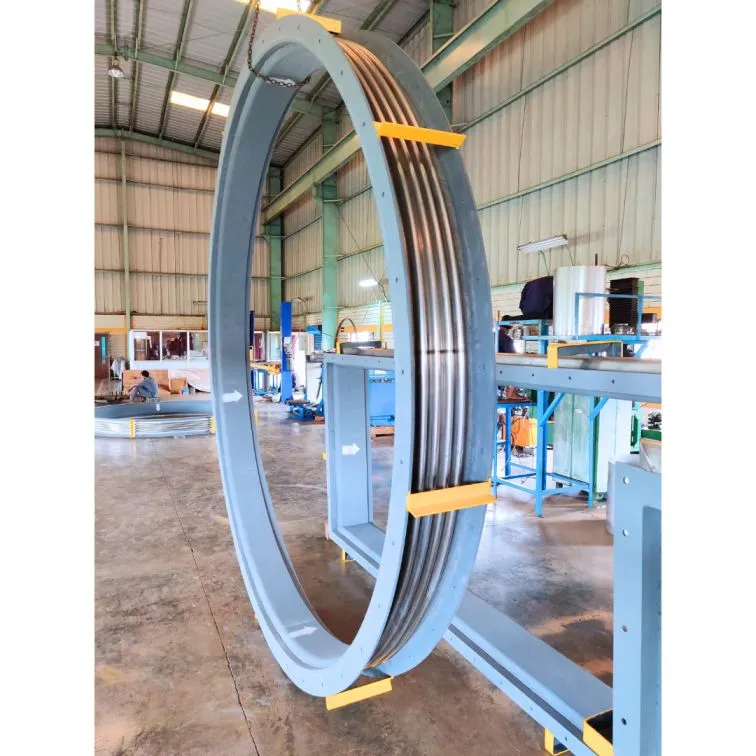
Ever wondered why some piping systems age gracefully while others crack, leak, or demand constant repairs? The answer often hides inside a deceptively simple component—the bellows. In Indian industrial settings, where temperature swings, pressure variations, and space constraints collide, bellows design for axial movement is less about theory and more about foresight.
From refineries in Gujarat to power plants in Odisha, axial expansion joints quietly absorb thermal expansion that would otherwise punish pipelines and equipment. But designing the bellows inside these joints is where real engineering judgment comes into play.
Why Bellows Design Matters More Than You Think?
Bellows are flexible metal elements, but flexibility without control is a recipe for fatigue failure. In India, many systems operate continuously under high temperatures, aggressive media, and fluctuating loads. A bellows that looks fine on paper may fail early if its design ignores local operating realities.
According to guidance from the ASME, most expansion joint failures trace back to incorrect design assumptions rather than material defects. That insight rings especially true in Indian projects, where design margins are often trimmed to manage costs.
Key Bellows Design Considerations for Axial Movement
1. Expected Axial Travel (Not Just the Average)
Designing only for “normal” expansion is risky. Indian pipelines often see unexpected thermal spikes during startups, shutdowns, or monsoon-driven ambient changes.
- Account for maximum possible axial movement, not just steady-state values.
- Include installation tolerances and misalignment allowances.
- Factor in future capacity upgrades, which are common in Indian plants.
2. Pressure Rating and Stability
Internal pressure tries to stretch the bellows like a balloon. If the convolution geometry isn’t right, instability follows. Standards published by efunda.com note that excessive pressure-induced thrust is a leading cause of bellows deformation.
For high-pressure applications—think petrochemical or fertilizer plants—designers often pair axial expansion joints with properly engineered tie rods or anchors to control thrust loads.
3. Convolution Geometry: Where Art Meets Math
Number of convolutions, pitch, depth—these aren’t arbitrary choices. More convolutions mean greater flexibility but also higher stress concentration if poorly designed.
In practice, experienced Indian fabricators often balance fewer convolutions with slightly thicker plies to improve fatigue life under dusty, high-vibration conditions.
Material Selection in Indian Operating Conditions
Material choice is rarely just about corrosion charts. It’s also about availability, fabrication skill, and lifecycle cost.
- Stainless Steel (SS 304/316): Common in food processing, pharma, and HVAC.
- Inconel & Hastelloy: Used selectively for high-temperature or corrosive services.
- Multi-ply Bellows: Preferred for longer fatigue life and improved safety margins.
Midway through most designs, engineers arrive at the heart of the system—the axial expansion bellows itself. This is where material, geometry, and movement finally converge.
Fatigue Life: Designing for the Long Haul
A bellows may move only a few millimetres per cycle, but over years, that adds up to millions of cycles. Data referenced by NIST.gov shows that cyclic stress, even at low amplitudes, can dramatically shorten metal life if not properly accounted for.
In Indian continuous-process industries, conservative fatigue design isn’t overengineering—it’s survival.
Installation Reality vs. Design Assumptions
Here’s an uncomfortable truth: even a perfect design can fail if installation conditions are ignored. Site constraints, uneven supports, and rushed commissioning are common challenges across Indian industrial projects.
- Design bellows to tolerate minor angular misalignment.
- Specify clear installation guidelines.
- Plan for inspection access—often overlooked but critical.
FAQs
1. What is the main function of bellows in axial expansion joints?
Bellows absorb axial thermal movement in piping systems, preventing stress transfer to pipes, pumps, and connected equipment.
2. How do Indian climate conditions affect bellows design?
Wide temperature variations, humidity, and dust exposure require designs with higher fatigue margins and corrosion-resistant materials.
3. Are multi-ply bellows better than single-ply?
In most industrial applications, yes. Multi-ply bellows offer better flexibility, redundancy, and fatigue life.
4. How often should axial expansion joints be inspected?
Annual inspections are typical, but high-cycle or high-temperature systems may need more frequent checks.
Final Thoughts
Bellows design for axial expansion joints isn’t just a checklist exercise—it’s a balance of physics, experience, and real-world judgment. In India’s demanding industrial landscape, thoughtful bellows design quietly protects investments, improves safety, and keeps plants running without drama.
Full Audio: Listen Here