

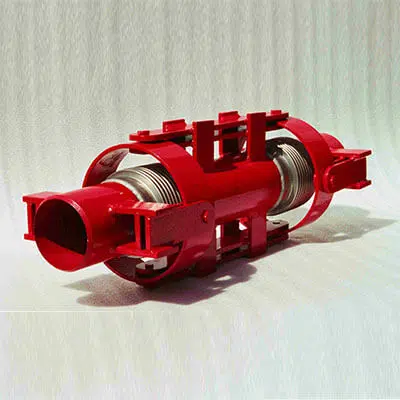
Ever wondered how pipelines, exhaust systems, or machinery handle multi-directional motion without warping or breaking? The answer often lies in gimbal bellows. These ingeniously engineered components allow structures to absorb movements in multiple directions while maintaining integrity—crucial for industries across India that face thermal expansion, vibration, and pressure fluctuations.
What Are Gimbal Bellows?
At its core, a gimbal bellow is a flexible, accordion-like joint designed to accommodate angular movement in pipelines or mechanical systems. Unlike regular expansion joints, gimbal bellows employ a pivoting frame, or gimbal, which distributes stress evenly and allows for controlled rotation along multiple axes. Imagine holding a flexible straw and twisting it gently; the straw bends without tearing. That’s essentially how gimbal bellows function, but on an industrial scale.
Key Features That Make Them Essential
- Multi-Directional Flexibility: Capable of handling angular, lateral, and axial movement simultaneously.
- Stress Distribution: The gimbal design prevents excessive pressure on any single point, reducing fatigue and failure.
- Durability: Constructed from high-grade stainless steel or specialized alloys to withstand harsh environments.
- Leak-Free Operation: Properly installed bellows maintain a secure seal, critical in chemical, power, or oil & gas industries.
How Gimbal Expansion Joints Work?
Midway through a pipeline or a complex mechanical system, gimbal expansion joints allow sections to pivot around a central axis. The gimbal’s hinges enable angular movement without transmitting torsion to the connected piping. This is especially vital in Indian industrial hubs like Pune or Gujarat, where thermal cycles in manufacturing plants can induce expansion and contraction that regular joints can’t handle.
Applications Across Industries
The versatility of gimbal bellows is remarkable. Some common applications include:
- Power Plants: To accommodate thermal expansion in steam pipelines.
- Chemical Plants: Ensuring safe movement in corrosive or high-pressure systems.
- Marine Engineering: Handling multi-directional motion in ship exhaust or ballast systems.
- HVAC Systems: Absorbing vibrations in heating and cooling networks.
For more insights on how specific industries match the right joints with operational demands, check out Industries and Joints: The Best Match Made in Engineering.
Material Considerations for Longevity
Choosing the right material is crucial. Gimbal bellows are commonly made of:
- Stainless Steel: Offers high corrosion resistance and is ideal for Indian coastal regions prone to humidity.
- Alloys: Used for high-temperature or chemically aggressive environments.
- Protective Coatings: Optional coatings enhance durability against abrasion or external weathering.
Each material choice affects flexibility, pressure tolerance, and lifespan—factors engineers must carefully evaluate during design and installation.
FAQs About Gimbal Bellows
1. What is the primary advantage of gimbal bellows over standard expansion joints?
Gimbal bellows allow multi-directional motion without transferring torsion or stress to the connected piping, ensuring longevity and safety.
2. Can gimbal bellows handle high-pressure systems?
Yes, when constructed with high-grade stainless steel or specialized alloys, gimbal bellows are suitable for high-pressure and high-temperature environments.
3. Where are gimbal bellows commonly used in India?
They are widely used in power plants, chemical plants, marine applications, and HVAC systems across industrial regions like Maharashtra, Gujarat, and Tamil Nadu.
4. How do I maintain gimbal bellows for long-term performance?
Regular inspection for wear, corrosion, or misalignment is essential. Lubricating hinges and replacing worn gaskets ensures optimal performance.
Final Thoughts
In an industrial landscape that demands both precision and resilience, gimbal bellows stand out as an elegant solution. Their unique ability to absorb multi-directional motion while maintaining structural integrity makes them indispensable across sectors in India. For engineers and facility managers, investing in quality gimbal expansion joints is not just a choice—it’s a commitment to safety, efficiency, and longevity.
Full Audio: Listen Here