
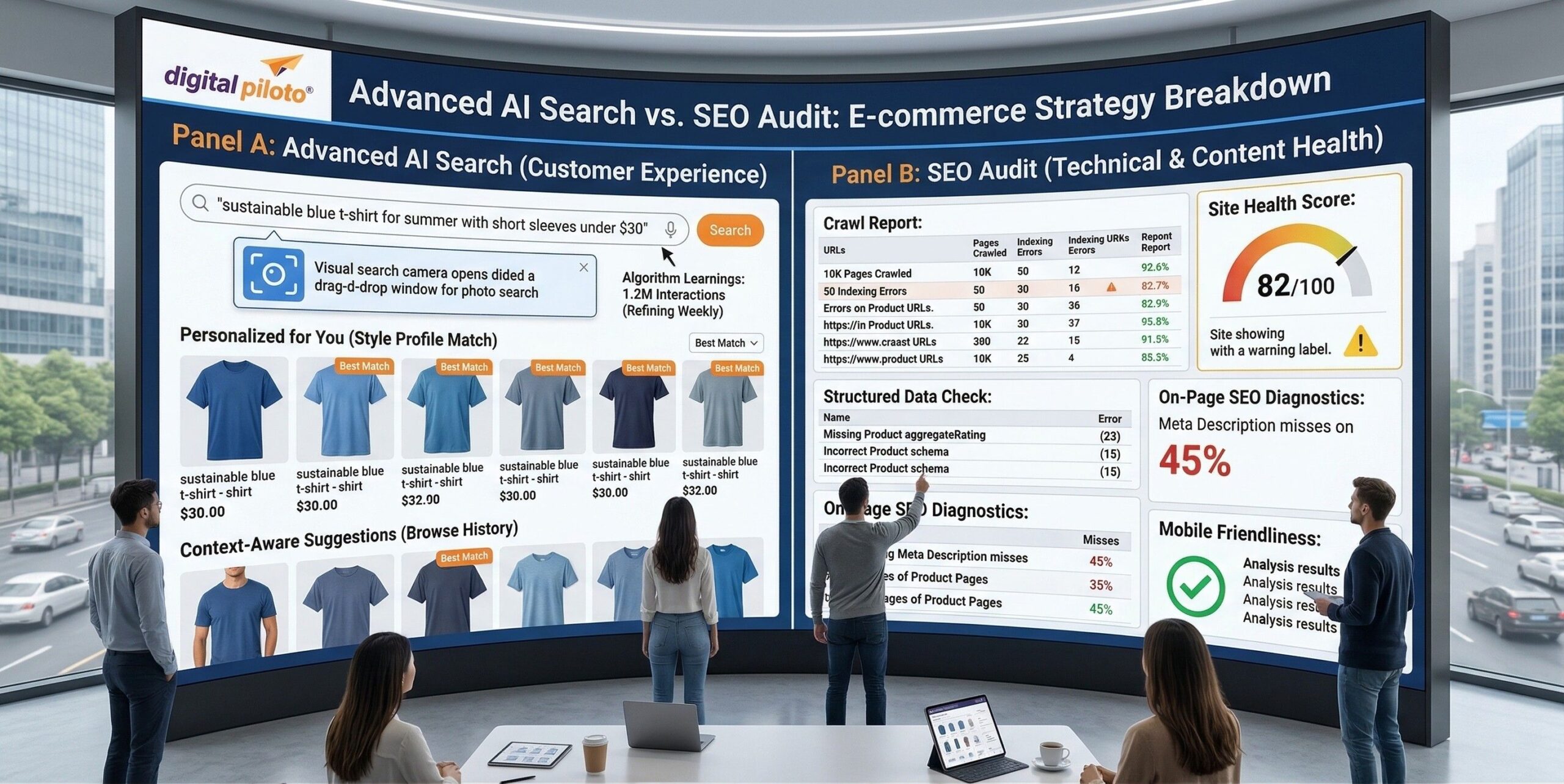
To build an AI search vs traditional SEO audit for e-commerce, you need to evaluate both ranking signals and answer visibility. Traditional SEO focuses on keywords, backlinks, and rankings, while AI search audits prioritize content clarity, structured data, and contextual relevance. A complete audit combines both—ensuring your store ranks, gets cited by AI systems, and converts traffic effectively.
Most e-commerce brands still rely on outdated checklists. But modern audits demand deeper insight. Working with a reliable SEO agency in Kolkata helps bridge this gap by aligning technical SEO with AI-driven visibility, bringing much-needed clarity into your audit process.
What Is AI Search vs Traditional SEO Audit?
Definition
An AI search vs SEO audit is a dual-layer evaluation framework that measures how well an e-commerce site performs in both traditional search engine rankings and AI-generated answer ecosystems like Google SGE or ChatGPT.
- Traditional SEO Audit: Focuses on rankings, backlinks, and crawlability
- AI Search Audit: Focuses on content understanding, context, and answer extraction
The key difference? SEO helps you get found. AI search helps you get chosen.
Why E-commerce Needs a Dual Audit Approach
Search behavior has changed. Users no longer just click links—they expect instant answers, product comparisons, and summarized recommendations.
If your audit ignores AI systems, you’re missing visibility even if rankings remain stable.
- AI-generated snippets reduce clicks but increase brand exposure
- Structured data influences AI summaries
- Content clarity determines whether your products get mentioned
This shift is where “ai search vs SEO” becomes a real business decision—not just a technical debate.
Step-by-Step: How to Build the Audit
Step 1: Audit Traditional SEO Foundations
Start with the basics. Without this layer, AI visibility won’t matter.
- Keyword rankings for product and category pages
- Backlink profile and domain authority
- Technical SEO (indexing, crawl errors, Core Web Vitals)
Step 2: Evaluate Search Intent Alignment
Many ranking losses happen because pages don’t match user intent anymore.
- Is your category page transactional or informational?
- Are competitors offering richer buying guides?
- Do your pages solve real user queries?
Step 3: Conduct AI Content Readability Audit
AI systems prefer content that is structured and easy to extract.
- Clear headings answering specific questions
- Short, factual paragraphs
- Use of definitions and bullet points
Step 4: Optimize for Structured Data
Schema markup is no longer optional. It feeds both search engines and AI systems.
- Product schema (price, availability, reviews)
- FAQ schema for informational queries
- Breadcrumb schema for navigation clarity
Step 5: Analyze SERP & AI Visibility
Don’t just track rankings—track presence.
- Are you featured in snippets?
- Do AI tools reference your brand?
- Are competitors dominating AI summaries?
Key Differences: AI Search vs SEO
Bullet Comparison
- Ranking vs Extraction: SEO ranks pages; AI extracts answers
- Keywords vs Context: SEO relies on keywords; AI understands meaning
- Clicks vs Visibility: SEO drives clicks; AI builds brand recall
- Backlinks vs Authority Signals: AI values credibility beyond links
This is why predictive SEO is gaining traction—it anticipates how search engines and AI models will interpret your content, not just rank it.
Where a Generative Engine Optimization Layer Fits
To truly bridge the gap, you need a strategy beyond traditional SEO. A specialized generative engine optimization agency focuses on making your content AI-readable and citation-worthy.
This includes:
- Creating answer-first content structures
- Optimizing product descriptions for AI summarization
- Enhancing entity-based relevance
Real-World E-commerce Example
A consumer electronics store ranked well for “best wireless headphones” but saw declining traffic.
Audit findings:
- Ranking remained in top 5
- AI summaries displayed competitor content
- Product pages lacked structured comparisons
Fix:
- Added comparison tables and FAQs
- Improved content clarity and formatting
- Implemented structured data
Result: Increased AI visibility and improved assisted conversions—even without ranking improvement.
Common Audit Mistakes to Avoid
- Focusing only on rankings, ignoring AI visibility
- Overloading pages with keywords instead of clarity
- Ignoring structured data implementation
- Failing to track SERP feature changes
Many digital marketing agencies Kolkata are now shifting toward hybrid audits to address these gaps.
FAQs: AI Search vs SEO Audit
1. What is the main difference between AI search and SEO?
SEO focuses on ranking pages in search engines, while AI search focuses on extracting and presenting answers directly to users.
2. Do I need both AI search and SEO audits?
Yes. SEO ensures visibility in search results, while AI audits ensure your content is selected and displayed in AI-generated answers.
3. How often should I run an e-commerce audit?
Ideally, every 3–6 months. However, AI visibility should be monitored continuously due to rapid SERP changes.
4. Can AI optimization replace traditional SEO?
No. AI optimization complements SEO but cannot replace the foundational elements like indexing, backlinks, and technical health.
5. What is predictive SEO?
Predictive SEO focuses on anticipating search trends and algorithm behavior to create content that remains relevant in future search environments.
Conclusion
The future of e-commerce search isn’t about choosing between AI and SEO—it’s about integrating both. When your audit evolves from rankings to relevance and clarity, you don’t just compete—you stay visible, adaptable, and ahead of the curve.
Blog Development Credits:
This article was ideated by Amlan Maiti, developed using advanced AI platforms, and refined with strategic SEO enhancements by Digital Piloto Private Limited.