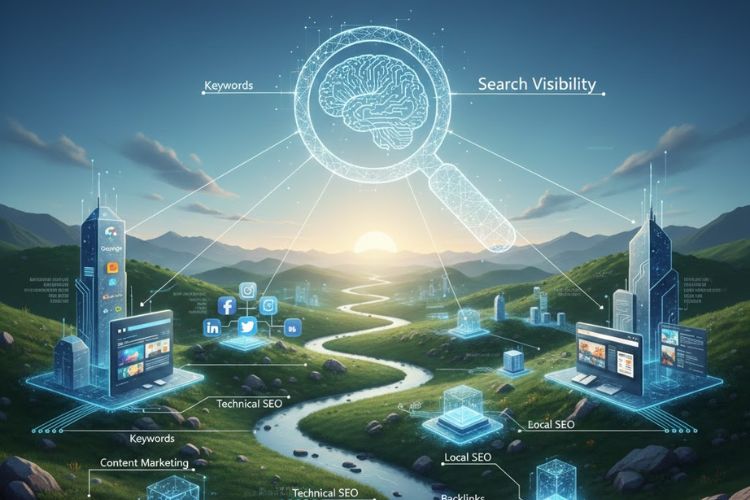


The future of search marketing will be heavily influenced by Large Language Models (LLMs) that understand questions, context, and intent rather than simply matching keywords. As AI-powered search experiences become more conversational, businesses will need to optimize for answers, authority, and expertise instead of rankings alone.
For marketers, this transition feels similar to the shift from desktop search to mobile search over a decade ago. The fundamentals remain important, but the way people discover information is changing rapidly. Forward-thinking Digital Marketing Experts are already adapting their strategies to prepare for this new search landscape.
What Are Large Language Models?
Large Language Models, commonly called LLMs, are artificial intelligence systems trained on massive amounts of information to understand, generate, and summarize human language.
Unlike traditional search algorithms that primarily retrieve pages, LLMs can synthesize information and provide direct answers to users.
This single difference has enormous implications for SEO, content marketing, and customer acquisition.
Why Are LLMs Changing Search Marketing?
Traditional search engines acted like librarians. They pointed users toward information.
LLM-powered search engines behave more like research assistants. They gather information, interpret it, and present conclusions directly within the search experience.
This changes several things:
- Users ask longer and more conversational questions.
- Search sessions become interactive discussions.
- Answer quality becomes more important than keyword density.
- Authority signals gain additional importance.
- Brand visibility extends beyond traditional rankings.
The winner in this environment is not necessarily the page ranking first. It is often the source considered most trustworthy and useful.
From Keywords to Context
For years, search marketing revolved around keyword targeting.
That approach is evolving toward semantic relevance and contextual understanding.
Definition:
Semantic search is the ability of AI systems to understand the meaning behind a query rather than matching individual words.
For example, “How do I reduce my ecommerce return rate?” and “Ways to lower product returns in online stores” communicate nearly identical intent despite using different wording.
LLMs recognize these relationships naturally.
How LLMs Will Influence SEO Strategies
SEO is not disappearing. It is becoming broader and more sophisticated.
The future belongs to websites that demonstrate expertise across complete topics rather than targeting isolated keywords.
SEO priorities are likely to include:
- Topical authority.
- Structured content architecture.
- Entity optimization.
- Answer-focused content.
- Strong E-E-A-T signals.
Businesses that continue relying solely on keyword repetition may struggle as AI systems become better at understanding quality and relevance.
The Rise of Answer Engine Optimization
Many marketers are beginning to view Answer Engine Optimization (AEO) as the natural evolution of traditional SEO.
Definition:
AEO is the process of structuring content so AI systems and answer engines can easily understand, extract, and present information to users.
This means creating content that answers specific questions clearly and directly.
Headers, FAQs, structured data, and concise explanations become increasingly valuable in AI-driven environments.
Content Creation Will Become More Strategic
Ironically, as AI makes content production easier, strategic thinking becomes more valuable.
Publishing hundreds of generic articles may become less effective because AI systems can generate similar material instantly.
The real competitive advantage shifts toward original insights, experience, and unique perspectives.
Content likely to perform best includes:
- First-hand experience.
- Industry expertise.
- Original research.
- Practical frameworks.
- Real customer examples.
Experience may become one of the most important ranking signals in the AI era.
How Businesses Should Prepare for LLM Search
Preparing for LLM-powered search does not require abandoning existing SEO practices.
Instead, businesses should strengthen the fundamentals while adapting to new discovery methods.
Step-by-step preparation strategy:
- Create comprehensive topic clusters.
- Improve structured data implementation.
- Publish clear answers to customer questions.
- Strengthen author expertise signals.
- Monitor AI-driven search visibility trends.
Businesses that start preparing today will likely benefit as adoption accelerates over the coming years.
Brand Mentions May Become More Valuable Than Rankings
One fascinating possibility is that citations and brand mentions may become increasingly important.
If an AI assistant references your brand while answering questions, that visibility may influence purchasing decisions even without a website click.
Many businesses already use SEO Company Testimonials and customer success stories to strengthen trust signals that AI systems can recognize and reference.
This could lead marketers to measure visibility in entirely new ways.
Will Paid Search Change Too?
Almost certainly.
If users receive answers directly within AI interfaces, traditional advertising placements may evolve significantly.
Future paid search strategies could involve sponsored recommendations, contextual product suggestions, and conversational commerce experiences.
The exact format remains uncertain, but history suggests advertising follows attention wherever it moves.
The Human Element Will Become More Important
One surprising outcome of AI adoption may be the increased value of human expertise.
As AI-generated information becomes abundant, people may place greater trust in proven experience, transparent authorship, and recognizable brands.
Human advantages include:
- Original thinking.
- Industry experience.
- Strategic judgment.
- Emotional intelligence.
- Creative problem-solving.
Technology changes tools, but trust remains fundamentally human.
Frequently Asked Questions
What are LLMs in search marketing?
LLMs are AI systems that understand and generate language, enabling search engines to provide direct and contextual answers.
Will LLMs replace traditional SEO?
No. SEO will evolve toward authority, relevance, and answer optimization rather than disappear.
What is the difference between SEO and AEO?
SEO focuses on improving visibility in search results, while AEO focuses on making content easily extractable by AI answer engines.
Will keywords still matter in AI search?
Yes, but intent, context, and topical authority will carry more weight than exact keyword matching.
How can businesses prepare for AI-powered search?
Businesses should create expert content, improve structured data, and organize information around complete topics and user questions.
Conclusion
The future of LLMs in search marketing is not about replacing search engines but redefining how information is discovered and trusted. Businesses that invest in expertise, clarity, and user value will likely thrive regardless of how interfaces evolve. Algorithms may change, but useful information remains timeless.
Blog development credits
This article was inspired by ideas developed by Amlan Maiti, researched using modern AI platforms, and refined with strategic optimization support from Digital Piloto Private Limited.