
Search is no longer just about finding pages that contain the right keywords. Generative search tools try to understand questions, connect related ideas, and present answers that feel useful in context. For businesses, this changes the challenge: how do you make your expertise clear enough for search engines and AI systems to recognise, interpret, and potentially reference it?
What Is Semantic SEO, and Why Does It Matter?
Semantic SEO is an approach to search optimisation that focuses on meaning, context, and relationships between topics rather than treating every keyword as an isolated target. It helps search engines understand what a page actually explains, who it serves, and how it relates to a broader subject.
Imagine a business owner searching for ways to reduce abandoned shopping carts. They might use phrases such as “improve checkout conversion,” “reduce ecommerce drop-offs,” or “why customers leave before payment.” Although the wording differs, the underlying problem is similar. A semantically strong page addresses that shared intent instead of creating a separate, repetitive article for every variation.
This is where a capable SEO agency can make a meaningful difference. By connecting keywords with search intent, supporting concepts, and useful answers, businesses can build content that serves readers while making its subject matter clearer to search systems.
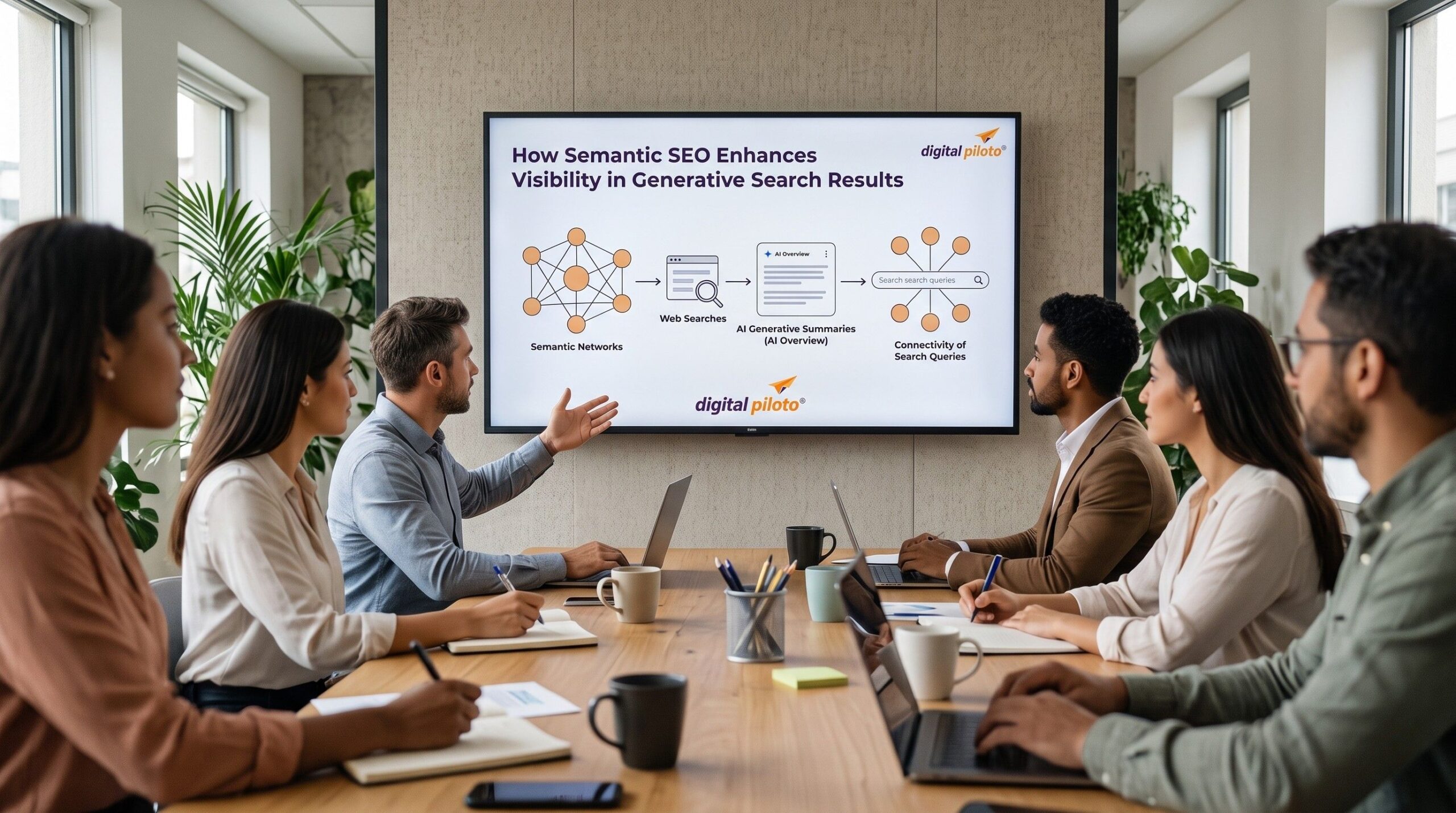
Generative search adds another dimension. AI-powered experiences may combine information from multiple sources to answer a question directly. Semantic SEO can help establish the clarity and topical depth that make a website useful in these environments, although no optimisation method guarantees inclusion in an AI-generated answer.
How Generative Search Changes Online Visibility
Traditional search commonly presents a list of links, leaving users to visit individual pages and assemble the information they need. Generative search can summarise information, explain differences, and respond to follow-up questions within the same experience.
That shift affects what visibility means. A business may want more than a high ranking for a commercial keyword. It may also want its expertise to be recognised when someone asks an AI assistant to compare providers, understand an industry problem, or explore possible solutions.
Google’s official documentation on AI features and your website explains that established SEO fundamentals remain relevant to Google’s AI experiences. Pages should be accessible to Google, provide helpful content, and meet the usual technical and quality requirements. There is no separate technical trick that guarantees a place in an AI-generated response.
The practical takeaway is simple: businesses should create content that explains subjects thoroughly, answers genuine questions, and provides information worth relying on. Semantic SEO supports this by giving content a clear conceptual structure rather than merely repeating popular search terms.
How Semantic SEO Helps AI Systems Understand Content
1. It connects related concepts
Search engines and AI systems benefit when a page makes relationships between ideas explicit. An article about local SEO, for instance, may naturally discuss business profiles, location pages, customer reviews, local intent, and accurate contact details.
These concepts reinforce the main subject. Together, they offer a fuller explanation of how local visibility works than a page repeating “local SEO services” in every other paragraph.
2. It answers the intent behind a question
Not every searcher wants the same thing, even when their queries look similar. Someone searching for “semantic SEO meaning” probably wants an explanation. Someone searching for “semantic SEO strategy for ecommerce” needs practical implementation advice.
Understanding that distinction helps businesses create content that fits the reader’s stage of decision-making. It also makes answers more specific, which is useful when generative systems attempt to respond to detailed questions.
3. It builds topical depth
A single article rarely establishes complete expertise on a complex subject. A collection of connected pages can explain the central topic, explore supporting questions, compare methods, and demonstrate how the ideas work in practice.
For example, a company discussing AI search optimisation might publish related resources on entity SEO, structured data, content credibility, generative search visibility, and technical accessibility. Each page should offer a distinct purpose, with internal links helping readers move naturally between them.
The goal is not to publish as many pages as possible. It is to cover the subject in a useful, organised way without creating unnecessary duplication.
Building a Semantic SEO Strategy for Generative Search
A strong strategy begins with understanding the audience, not collecting a giant spreadsheet of keywords. Ask what customers need to know, what problems they are trying to solve, and which details would help them make a confident decision.
From there, organise the content around meaningful themes.
- Map the topic and its entities. Identify the main subject, related concepts, relevant organisations, products, processes, and terminology. Include only relationships that genuinely help explain the topic.
- Group queries by intent. Separate informational questions from comparisons, commercial investigations, and action-oriented searches. Develop pages that satisfy these needs rather than forcing every keyword onto one URL.
- Create clear, answer-focused sections. Use descriptive headings, direct explanations, meaningful examples, and supporting evidence. Make important points understandable without requiring readers to interpret vague language.
- Strengthen internal links. Connect related pages with descriptive anchor text so readers can explore the subject and discover supporting information.
- Review gaps and overlaps. Update incomplete resources, consolidate competing pages when appropriate, and remove repetition that adds little value.
Consider a software provider targeting the phrase “CRM for small businesses.” A useful content cluster might include a main CRM overview, a guide to CRM implementation, a comparison of essential features, and a practical article about lead management. Each resource serves a different purpose while contributing to a coherent subject area.
For companies investing in digital transformation services India, this approach can also connect content strategy with broader digital operations. Customer questions gathered through sales, support, and product teams can inform more useful pages, provided that the information is handled responsibly and reflects genuine customer needs.
Content Quality, Entities, and Trust Signals
Semantic SEO is not simply a writing technique. It also depends on whether the information is accurate, consistent, and supported by credible evidence. A page can mention dozens of related terms and still be unhelpful if it never answers the reader’s actual question.
Make expertise visible in the content
Use practical examples, explain technical terms, acknowledge limitations, and distinguish established facts from predictions. If you publish a guide about AI search, for instance, explain what is currently supported, what remains experimental, and where businesses should be cautious.
Google’s helpful, reliable, people-first content guidance encourages publishers to prioritise content created for people, demonstrate first-hand knowledge where relevant, and provide a satisfying experience. These principles are useful for semantic SEO because meaningful expertise is stronger than superficial keyword coverage.
Entities matter, too. An entity is a clearly identifiable person, organisation, place, product, or concept. Consistent names, accurate business details, well-defined services, and appropriate references can help search systems distinguish one organisation from another.
Use structured data appropriately
Structured data can describe information on a webpage in a format that supported search systems can interpret. Depending on the page, relevant schema types may include Organization, Article, Product, or BreadcrumbList.
However, structured data does not automatically improve rankings or secure AI citations. It should accurately represent visible page content and follow the relevant search engine guidelines. Clear writing, sound technical implementation, and reliable information remain essential.
Measuring Semantic SEO Performance in AI Search
One challenge with generative search is that visibility may not translate neatly into traditional ranking reports. A brand could appear in an AI-generated answer without receiving a click, while a well-ranked page might never be referenced in a particular response.
For a more complete view, businesses can monitor several complementary indicators:
- Organic search performance: Track impressions, clicks, relevant queries, and landing-page performance through tools such as Google Search Console.
- Content engagement and conversions: Review qualified leads, enquiries, sales, and other outcomes associated with relevant landing pages.
- AI visibility observations: Monitor whether the brand appears in relevant AI-generated answers, record the questions tested, and note which pages or sources are referenced.
AI-generated responses can vary with the question, location, user context, and platform. Consequently, a small set of manual checks should not be treated as a definitive visibility score. Where possible, use repeatable testing methods and distinguish observed mentions from verified referral traffic or conversions.
Google Search Console reports performance data for eligible Google search experiences, but it does not provide a universal dashboard covering every AI assistant. Businesses may need additional analytics, referral analysis, and carefully documented testing to understand their wider visibility.
Common Semantic SEO Mistakes to Avoid
Even a well-intentioned strategy can go off course. The most common mistake is confusing topical breadth with content volume. Publishing ten shallow articles on closely related keywords will not necessarily outperform one strong guide supported by a few genuinely useful resources.
Other mistakes include:
- Keyword stuffing: Repeating exact phrases unnaturally instead of explaining the subject in clear language.
- Forced entity associations: Mentioning brands, people, or concepts that have no meaningful connection to the page’s purpose.
- Unsupported claims: Presenting predictions about AI rankings or citation behaviour as proven facts.
- Neglecting technical SEO: Publishing excellent content on pages that are inaccessible, poorly linked, or difficult for search engines to process.
A thoughtful digital marketing company can help align content planning, technical SEO, audience research, and conversion goals. The important thing is to evaluate the strategy against meaningful business outcomes rather than the number of keywords included in each article.
Frequently Asked Questions
1. What is semantic SEO in simple terms?
Semantic SEO helps search engines understand the meaning and context of website content. It focuses on user intent, related concepts, clear explanations, and connections between relevant pages rather than relying solely on exact-match keywords.
2. How does semantic SEO improve generative search visibility?
It can make content easier to interpret by organising related concepts, answering specific questions, and providing clear, credible information. These qualities may help a page become a useful source, but they do not guarantee that an AI system will cite it.
3. Is semantic SEO different from Generative Engine Optimization?
Yes, although they overlap. Semantic SEO focuses on meaning, context, and topical relationships. Generative Engine Optimization (GEO) focuses more broadly on improving a brand’s representation and visibility in generative AI responses. Semantic SEO can support a GEO strategy.
4. How long does semantic SEO take to show results?
There is no universal timeline. Results depend on a website’s existing authority, competition, technical condition, content quality, and how quickly search engines discover and evaluate updates. Track performance over time instead of expecting immediate changes.
Final Thoughts
Generative search is changing how people discover information, but the underlying need remains familiar: users want answers they can understand and trust. Semantic SEO helps businesses meet that need by connecting relevant ideas, explaining topics thoroughly, and making expertise easier to recognise.
Rather than chasing every new AI-search trend, start by understanding your audience and improving the quality of your website’s information. Build meaningful topic clusters, strengthen internal links, maintain technical accessibility, and measure what contributes to genuine business growth. Better visibility begins with being genuinely useful.
Blog Development Credits
This article was conceived by Amlan Maiti, developed through research and AI-assisted drafting, then refined for search performance and editorial quality by Digital Piloto Private Limited.