

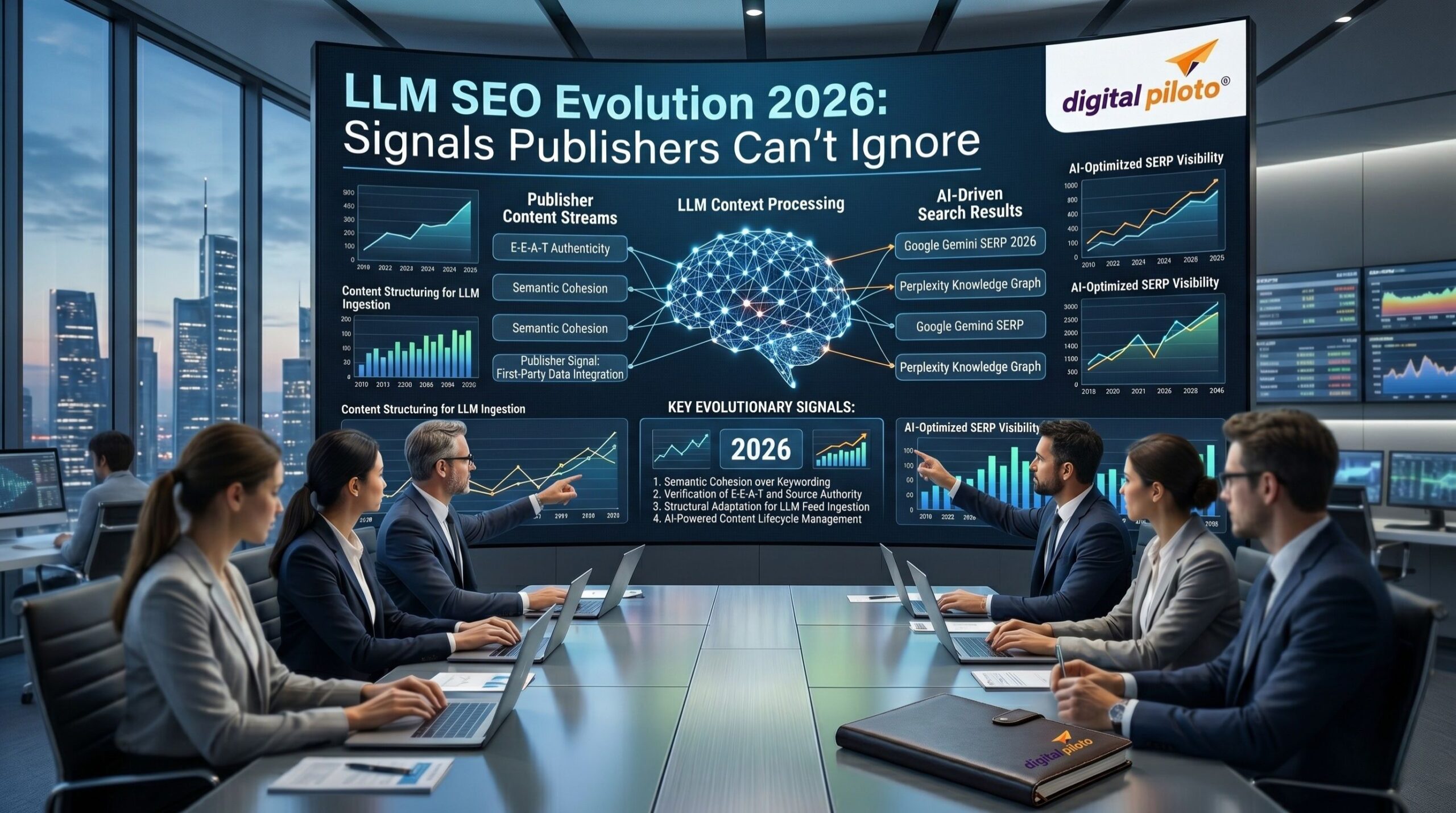
LLM SEO in 2026 is driven by how effectively publishers send clear, structured, and trustworthy signals to large language models (LLMs) so their content is selected, synthesized, and cited in AI-generated answers. It’s no longer about ranking pages—it’s about becoming a reliable source. If you’re exploring digital marketing services near me, understanding these signals is critical to staying visible in AI-first ecosystems.
What Are LLM SEO Signals?
Definition
LLM SEO signals are measurable indicators that help AI systems evaluate whether your content is accurate, relevant, and trustworthy enough to include in generated responses.
Unlike traditional ranking factors, these signals focus on meaning, credibility, and consistency across multiple sources.
- They determine if your content is cited or ignored
- They influence how AI interprets your expertise
- They shape your presence in zero-click search environments
Why Publishers Must Adapt to LLM SEO
Publishers are facing a structural shift. Traffic is no longer guaranteed—even for high-ranking pages. AI summaries often answer queries directly, reducing clicks but increasing the importance of being “the source.”
In this environment, your llm seo strategy must focus on influence rather than just visibility.
- AI engines prioritize trusted sources over optimized pages
- Content must be reusable in multiple contexts
- Authority is built through consistency, not volume
Core LLM SEO Signals in 2026
1. Source Reliability Signal
Measures how often your content is referenced across platforms and datasets.
Example: If multiple authoritative pages mention your research, LLMs treat your content as more reliable.
2. Semantic Clarity Signal
Indicates how easily AI can interpret your content’s meaning without ambiguity.
3. Contextual Alignment Signal
Evaluates how well your content matches different user intents and query variations.
4. Digital Consistency Signal
Tracks how consistent your brand messaging and data are across the web.
Inconsistent information reduces trust—even if your content is technically correct.
5. Citation Probability Score
Estimates the likelihood of your content being included in AI-generated answers.
How to Build Strong LLM SEO Signals (Step-by-Step)
Step 1: Structure Content for Extraction
Use clear headings, concise answers, and scannable formats so LLMs can easily pull information.
Step 2: Strengthen Entity Associations
Clearly define your brand, authors, and topics across all content.
Step 3: Improve Digital Consistency
Ensure your brand information is identical across your website, profiles, and citations.
Step 4: Focus on Answer Precision
Write content that directly answers specific questions without fluff.
Step 5: Monitor AI Mentions
Track how often your content appears in AI tools and refine accordingly.
Practical Signals Publishers Often Overlook
- Author credibility: Named experts increase trust signals
- Content freshness: Updated content is more likely to be used
- Topical depth: Covering a subject fully improves citation chances
- Internal linking: Helps AI understand relationships between topics
Even a PPC agency in Kolkata can benefit by aligning ad content with these signals—ensuring consistency between paid and organic messaging.
LLM SEO vs Traditional SEO: What’s Changed?
- Traditional SEO: Focus on rankings and keywords
- LLM SEO: Focus on meaning, trust, and reusability
Publishers relying only on old metrics risk losing relevance. Collaborating with an experienced SEO company Kolkata that understands AI-driven search can help bridge this gap.
How Digital Consistency Impacts LLM SEO
Digital consistency is one of the most underrated signals in 2026. It ensures that every mention of your brand aligns across platforms.
- Consistent NAP (Name, Address, Phone)
- Uniform brand messaging
- Aligned content across channels
When inconsistencies appear, LLMs lose confidence—reducing your chances of being cited.
Real-World Example: Publisher Growth via LLM Signals
A SaaS publisher we observed shifted from keyword-heavy blogs to structured, answer-first content. Within four months, their visibility in AI-generated summaries increased significantly.
The change wasn’t more content—it was better signals: clearer structure, stronger entity mapping, and improved digital consistency.
FAQs: LLM SEO for Publishers
What is LLM SEO in simple terms?
It’s the process of optimizing content so AI models can understand, trust, and include it in generated answers.
Why are LLM SEO signals important?
They determine whether your content is used by AI systems, which directly impacts visibility in modern search.
How is LLM SEO different from traditional SEO?
LLM SEO focuses on meaning and trust, while traditional SEO focuses on rankings and keywords.
What is digital consistency in LLM SEO?
It’s the alignment of your brand information across all platforms, ensuring trust and reliability for AI systems.
How can publishers improve LLM SEO quickly?
By restructuring content for clarity, improving entity signals, and maintaining consistent brand data.
Conclusion
LLM SEO isn’t a passing shift—it’s a fundamental change in how content is discovered and used. For publishers, success now depends on sending the right signals, not just creating more content. The sooner you align with this model, the stronger your long-term visibility becomes.
Blog Development Credits:
This article was originally conceptualized by Amlan Maiti, developed using AI-assisted research tools, and strategically refined by Digital Piloto Private Limited for performance and SEO excellence.