
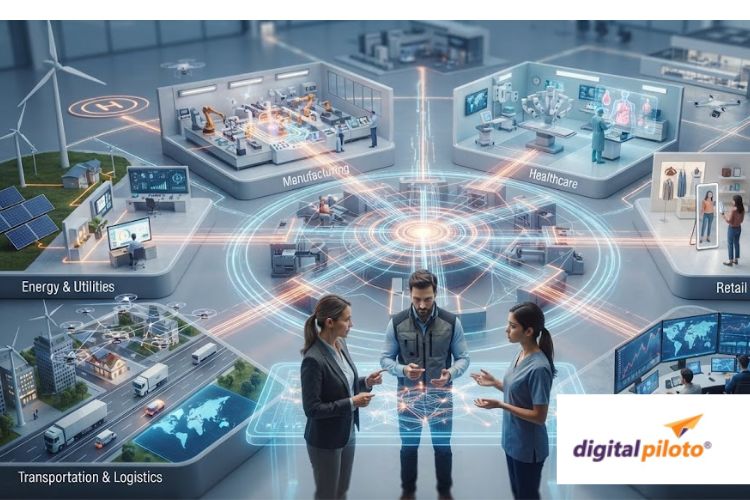
The digital transformation of global industries refers to the integration of digital technologies into business processes, operations, customer experiences, and decision-making systems. It is not simply about adopting new software; it is about fundamentally changing how organizations create value, compete in the market, and respond to rapidly evolving customer expectations.
Across sectors, businesses are moving from manual workflows to intelligent, connected ecosystems powered by cloud computing, artificial intelligence, automation, and data analytics. Even customer acquisition strategies such as Retail Lead Generation are increasingly driven by predictive analytics and digital engagement rather than traditional outreach methods.
What Is Digital Transformation?
Definition: Digital transformation is the process of using digital technologies to redesign business models, improve operational efficiency, and enhance customer experiences.
Many organizations mistakenly view digital transformation as a technology project.
In reality, it is a business strategy supported by technology.
The companies achieving the strongest results are those that rethink processes first and implement tools second.
Why Is Digital Transformation Accelerating Globally?
Several factors have accelerated digital adoption across industries:
- Changing customer expectations.
- Increased access to cloud technologies.
- Growing competitive pressure.
- Remote and hybrid work environments.
- Improved affordability of advanced technologies.
Customers now expect convenience, speed, personalization, and transparency regardless of industry.
Businesses unable to meet these expectations often struggle to remain competitive.
How Retail Is Being Transformed Digitally
Retail has evolved from product distribution to experience management.
Digital technologies now influence almost every stage of the customer journey.
Retail organizations increasingly rely on:
- AI-powered recommendation systems.
- Predictive inventory management.
- Personalized promotions.
- Omnichannel customer experiences.
- Automated customer support.
The result is a shopping experience that feels more personalized and responsive than ever before.
How Manufacturing Is Evolving
Manufacturing industries are undergoing one of the most significant digital transitions in modern business history.
Connected sensors, predictive maintenance systems, and industrial analytics are reducing downtime while improving productivity.
This transformation extends beyond production lines and increasingly supports areas such as Manufacturing Lead Generation, where digital channels help manufacturers identify high-value prospects more efficiently.
Some of the most impactful technologies include:
- Industrial IoT systems.
- Predictive maintenance platforms.
- Digital twins.
- Automated quality control systems.
- AI-assisted supply chain planning.
How Healthcare Is Changing
Healthcare organizations are becoming increasingly data-driven.
Digital transformation is improving both clinical outcomes and operational efficiency.
Examples include:
- Electronic health records.
- Remote patient monitoring.
- Telemedicine platforms.
- AI-assisted diagnostics.
- Predictive healthcare analytics.
The most successful healthcare innovations often improve access to care rather than replacing medical professionals.
How Financial Services Are Adapting
Financial institutions have embraced digital transformation faster than many other sectors.
Customers now expect banking experiences to be as seamless as online shopping experiences.
Modern financial organizations increasingly depend on:
- Fraud detection systems.
- Digital payment infrastructure.
- Automated compliance monitoring.
- AI-powered customer service.
Speed and trust have become equally important competitive advantages.
A Practical Framework for Digital Transformation
Step-by-Step Approach:
Step 1: Identify Business Friction Points
Focus on processes that create delays, inefficiencies, or customer frustration.
Step 2: Prioritize Customer Experience
Technology investments should improve customer outcomes rather than simply modernize internal systems.
Step 3: Build a Scalable Data Strategy
Data becomes significantly more valuable when collected consistently and used strategically.
Step 4: Introduce Automation Carefully
Automation should support employees, not create additional complexity.
Step 5: Measure Outcomes Continuously
Digital transformation is an ongoing process rather than a one-time project.
Common Challenges Organizations Face
Despite the opportunities, transformation initiatives often encounter obstacles.
- Legacy technology limitations.
- Employee resistance to change.
- Data integration issues.
- Cybersecurity concerns.
- Skills shortages.
Organizations that approach transformation as a cultural initiative rather than a software upgrade often experience stronger adoption rates.
The Future of Digital Transformation
The next phase of transformation may become increasingly invisible.
Artificial intelligence, automation, and connected devices will likely operate quietly in the background while employees focus on creativity, relationships, and strategic thinking.
Businesses that succeed will not necessarily adopt the most technology, but the technology that best supports their customers and teams.
Frequently Asked Questions
What is digital transformation in simple terms?
Digital transformation is the use of digital technologies to improve business processes, customer experiences, and operational efficiency.
Why is digital transformation important?
It helps businesses remain competitive, improve productivity, and meet changing customer expectations.
Which industries are most affected by digital transformation?
Retail, manufacturing, healthcare, finance, logistics, and education are among the industries experiencing significant transformation.
Is digital transformation only about technology?
No. It also involves strategy, culture, leadership, and process redesign.
What is the biggest challenge in digital transformation?
Resistance to organizational change is often a greater challenge than technology implementation itself.
Conclusion
The digital transformation of global industries is no longer a future trend or competitive advantage reserved for large enterprises. It has become a fundamental requirement for organizations seeking resilience, efficiency, and long-term growth in an increasingly connected world.
This article was developed through a combination of strategic research, AI-assisted analysis, and human editorial expertise. The original concept was inspired by insights from Amlan Maiti, while final optimization and SEO enhancements were contributed by Digital Piloto.