
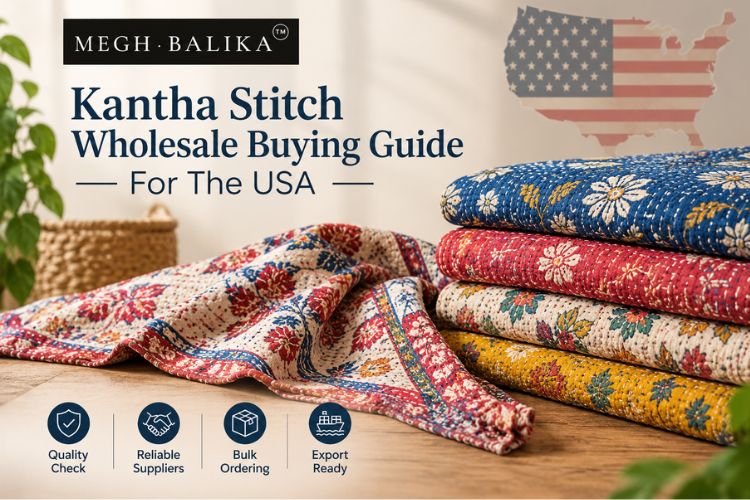
Buying Kantha sarees wholesale for the U.S. market means finding a supplier that can document fabric and embroidery details, provide reliable samples, and support a clear import plan—not simply offer an attractive bulk price. Buyers exploring Kantha Stitch Wholesale USA should assess craftsmanship, product consistency, and total landed cost before confirming a large order.
Also Read: How to Effectively Stock Sarees for a Stylish Wedding Season
What Is Kantha Stitch, and Why Does It Matter to Retailers?
Kantha is a traditional Bengal embroidery style associated with repeated running stitches and decorative motifs inspired by everyday life, nature, and cultural storytelling. The technique is used on sarees and other apparel, as well as quilts and home textiles. The Indian government’s Nakshi Kantha resource provides further background on this craft tradition.
For retailers, Kantha offers a distinctive product story built around visible stitching and regional craftsmanship. However, Kantha describes a textile technique, not a single fabric composition. Cotton, silk, and other fabric options can differ in texture, price, care requirements, and suitability for a particular customer.
Do not assume that every Kantha saree uses reclaimed fabric or automatically qualifies for a geographical indication (GI) claim. Verify specific material and certification statements against the product being purchased.
How to Evaluate Kantha Sarees Before Buying Wholesale
Request clear product photographs, a representative sample, and written specifications for each proposed design. Use the same criteria across suppliers so that quotations can be compared fairly.
| What to check | What buyers should verify |
|---|---|
| Base fabric | Confirm the exact fiber composition, fabric description, texture, and any available supporting documentation. |
| Embroidery | Examine stitch placement, coverage, loose threads, finishing, and consistency with the approved sample. Minor handmade variations may be expected. |
| Dimensions | Confirm saree length, width, blouse-piece inclusion, and permitted measurement tolerances. |
| Color and finish | Ask about colorfastness, handling, finishing, and any known differences between sample photography and delivered goods. |
| Care | Obtain fabric-appropriate care instructions before preparing retail product descriptions and labels. |
| Quality control | Agree on acceptable defects, pre-shipment inspection, replacement or credit terms, and procedures for reporting discrepancies. |
A single close-up photograph is not enough to prove handwork. Ask for detailed images of the front and reverse, and compare a physical sample against the supplier’s written specifications. Stitch regularity alone should not be treated as conclusive proof of how a piece was made.
How to Choose the Right Wholesale Supplier
A dependable supplier should be able to explain the product, document the agreed specifications, and communicate clearly about production and shipping. Before making a commitment, ask these questions:
- What is the minimum order quantity (MOQ) for standard designs and customized collections?
- Can you provide a sample, a current product catalogue, and a price breakdown?
- Which fabrics, embroidery techniques, and finishing methods are used?
- What production timeline applies to this exact order, and what could delay dispatch?
- Which export documents, labeling services, and shipping arrangements are included in the quotation?
- What happens if the delivered goods materially differ from the approved sample?
Direct sourcing from India may provide access to regional collections and customization, while a U.S.-based wholesaler may offer a simpler domestic replenishment process. The better option depends on order size, inventory needs, delivery expectations, and your capacity to manage imports.
Calculate the Full Cost of Wholesale Buying
The supplier’s unit price is only one part of a saree’s cost. Before comparing quotations, calculate the estimated landed cost: the cost of getting the goods to the intended destination, including applicable additional charges.
Estimated landed cost = product purchase + export preparation + freight and insurance + applicable duties and entry fees + brokerage + domestic delivery + quality-control allowance.
Ask whether the quotation is EXW, FOB, CIF, DDP, or another clearly defined shipping arrangement. These terms allocate costs and responsibilities differently. Confirm the named destination, who arranges clearance, which charges are included, and which remain payable by the buyer.
Also compare likely retail margins, packaging expenses, payment terms, and the cost of replacing defective items. A slightly higher supplier price may be commercially preferable when specifications, documentation, and delivery responsibilities are clearer.
What Should U.S. Buyers Know About Importing Sarees?
Before importing, check the requirements that apply to the specific textile product. The Federal Trade Commission’s textile-labeling guidance covers relevant requirements concerning fiber content, country of origin, and company identification. The FTC Care Labeling Rule addresses care instructions for covered apparel and certain piece goods.
Ask your supplier who will prepare the product information and labeling, but do not assume that a supplier’s assurances remove the U.S. importer’s responsibilities. Verify the requirements for your products and retail arrangement before shipping.
Import duties also depend on the applicable product classification and current rules. Consult the USITC Harmonized Tariff Schedule and, when appropriate, a qualified customs broker or CBP import specialist. Avoid budgeting from an old tariff estimate or from the rate applied to a product that merely looks similar.
Planning a Collection for Your Boutique
Start with a focused collection that reflects your customers’ preferences for fabric, color, motifs, price, and occasion. Confirm the MOQ and production schedule for each design before allocating the purchasing budget. Keep approved samples, specifications, quotations, and inspection records together so that reorders are easier to assess.
Retailers looking to broaden an Indian textile assortment can also explore Megh Balika’s Jamdani Textile Supplier collection. Comparing different textile traditions may help buyers build a more considered assortment without treating every hand-crafted product as interchangeable.
Megh Balika offers a curated range of Indian sarees and traditional textiles for boutiques, retailers, and wholesale buyers. To discuss Kantha designs, request current wholesale pricing and confirm the relevant specifications, MOQ, sample availability, labeling arrangements, and shipping terms before placing an order.
Frequently Asked Questions
How can U.S. boutiques buy Kantha stitch sarees wholesale?
Shortlist suppliers, request specifications and samples, compare full quotations, confirm the order terms, and review applicable import and labeling requirements before dispatch.
What is the minimum order quantity for wholesale Kantha sarees?
There is no single industry-wide MOQ. It can vary by supplier, fabric, design, customization, and order type. Confirm the MOQ for the actual collection and obtain the terms in writing.
How can buyers check whether Kantha embroidery is handmade?
Request close-up photographs, inspect the front and reverse, and compare a physical sample with the supplier’s description. Ask for clear information about the production method; visual stitch variation alone does not conclusively establish authenticity.
Do wholesale sarees imported into the USA need labels?
Covered textile products may be subject to U.S. fiber-content, country-of-origin, company-identification, and care-labeling requirements. Check the FTC and CBP guidance for your actual product and import arrangement before shipping.
Make Your Next Wholesale Order with Confidence
The best Kantha wholesale purchase balances craftsmanship, documented specifications, reliable communication, and a realistic landed-cost estimate. A sample-first process and written quality expectations can help retailers make more informed buying decisions.
Explore Megh Balika’s Kantha Stitch Sarees and enquire about the current catalogue, samples, wholesale pricing, and export terms for your U.S. business.
Also Read: Top Jamdani Handloom Suppliers for Retailers
Blog Development Credits
This article was thoughtfully developed by Megh Balika, enriched through advanced AI-assisted research, carefully refined by industry expertise, and professionally optimized by Megh Balika for readability and SEO excellence.