
Search is no longer a single doorway to a business. Customers may discover a brand through Google, ask an AI assistant for recommendations, compare providers on review platforms, and visit a website only when they are ready to act. Indian businesses need a search strategy that connects these touchpoints instead of treating each one as an isolated marketing task.
That is where a structured CRSEO roadmap can help. In this article, CRSEO refers to a coordinated approach to conventional search engine optimization, conversational discovery, and AI-assisted search visibility. Working with the best SEO company in India can help businesses turn these priorities into a practical plan built around their audience, resources, and growth goals.
What Does CRSEO Mean for Modern Businesses?
CRSEO does not have one universally standardized definition across the SEO industry. Here, it describes a roadmap that combines traditional SEO fundamentals with conversational search behavior, AI-driven discovery, and measurable business outcomes.
Think of it as building a bridge between how people search and how a business earns their trust. Ranking for a relevant keyword remains useful, but a customer might also ask an AI tool to compare suppliers, explain a technical problem, or recommend a service provider in a particular city.
A resilient strategy helps a business communicate clearly across these experiences. It focuses on making important information discoverable, accurate, well-organized, and genuinely helpful. It does not assume that a specific optimization technique can guarantee an AI citation or a first-page ranking.
Why Indian Businesses Need a Connected Search Strategy
India is not one uniform search market. A manufacturing company targeting procurement teams in Pune may need technical product pages and detailed capability information. A restaurant in Kolkata may depend heavily on local discovery, opening hours, customer reviews, and directions. A SaaS company selling nationwide may prioritize comparison content, product education, and qualified demo requests.
These businesses need different tactics, but they share a common challenge: customers can move between search engines, social platforms, review sites, websites, and AI-powered experiences before making a decision.
The Internet and Mobile Association of India (IAMAI) publishes research on India’s digital ecosystem. Such industry research can provide useful market context, but businesses should also examine their own analytics, customer feedback, and sales conversations to understand how their audiences actually behave.
The practical lesson is to build a roadmap around evidence rather than assumptions. Not every company needs to invest equally in every channel, and chasing every new search trend can quickly consume resources without producing meaningful results.
Step 1: Audit Your Existing Search Performance
Before planning new campaigns, establish what is already working. A baseline audit helps identify technical barriers, content gaps, missed conversion opportunities, and areas where the brand is difficult to discover.
Review the foundations first
Start with the website’s crawlability, indexability, mobile experience, page speed, internal links, and URL structure. Check whether important service, category, and product pages can be discovered and understood by search engines. Look for broken links, duplicate pages, outdated information, and redirects that create unnecessary friction.
Next, examine existing content. Does each important page satisfy a distinct user need? Are service pages specific enough to explain the business’s expertise? Do informational articles lead readers toward useful next steps, or do they leave them without a clear path?
Your audit should cover three practical areas:
- Visibility: Relevant organic impressions, clicks, rankings, brand searches, local presence, and available AI search mentions.
- Experience: Page usability, content clarity, navigation, mobile performance, and accessibility.
- Business impact: Qualified leads, enquiries, purchases, conversion rates, and revenue where reliable tracking is available.
Do not confuse a large traffic number with success. A smaller volume of highly relevant visitors may be much more valuable than thousands of visits from people who will never need the product or service.
Step 2: Map Customer Intent Before Choosing Keywords
Keyword research is more useful when it reflects the questions customers are trying to answer. Someone searching for “what is industrial automation” may be gathering information. Someone searching for “industrial automation supplier in India” may be evaluating providers. A person requesting a consultation is further along the buying journey.
Group important queries by intent, then map each group to an appropriate page. Educational articles should explain concepts clearly, comparison pages should help readers evaluate alternatives, and service pages should communicate capabilities, process, and next steps.
Account for conversational and regional searches
Customers do not always phrase questions as short keywords. They may ask which software suits a small business, how a machine performs in particular conditions, or which service provider covers their location. Use customer interviews, support tickets, sales calls, search suggestions, and website search data to identify these natural questions.
Regional context also matters. If research shows that customers prefer Hindi, Bengali, Tamil, or another language for certain queries, consider content that serves that preference accurately. Avoid publishing thin city pages or mechanically translated articles simply to increase keyword coverage.
The objective is not to create a separate page for every possible phrase. It is to build a coherent set of resources that answers related questions without unnecessary repetition or keyword cannibalization.
Step 3: Build Content That Deserves Attention
Good search content should leave readers better informed than they were before clicking. That sounds obvious, yet many business websites rely on broad claims, repeated keywords, and paragraphs that could describe almost any competitor.
Develop content around the knowledge your business can genuinely contribute. A logistics company might explain how it handles regional distribution challenges. A financial software provider could clarify integration requirements and reporting workflows. A manufacturer might publish detailed specifications, maintenance guidance, or product comparison information.
Google’s guidance on helpful, reliable, people-first content offers a useful editorial benchmark: content should serve its intended audience rather than exist solely to manipulate rankings.
To put that principle into practice:
- Answer the main question early, then add supporting explanation and relevant detail.
- Use original examples, credible sources, expert input, and specific evidence where available.
- Keep pricing, product specifications, author information, and service claims accurate.
- Connect related pages through meaningful internal links and descriptive headings.
- Update older content when products, regulations, processes, or customer needs change.
AI tools may assist with research or drafting, but human review remains important for factual accuracy, originality, context, and brand voice. Content should not make unsupported promises merely because they sound persuasive.
Step 4: Prepare for AI Search and Conversational Discovery
AI search optimization builds on many familiar SEO fundamentals. Search systems still need to discover relevant information, interpret page content, and assess whether it is useful for a particular query. The precise methods used by different AI experiences vary, so no single checklist guarantees inclusion.
Begin by ensuring that important pages are accessible, clearly written, and internally connected. Use structured data where it accurately represents visible content, and keep business names, product details, and service descriptions consistent across the website and relevant public profiles.
Next, create a simple AI visibility monitoring process. Select realistic customer questions, such as “Which CRM works for a small Indian distributor?” or “What should I check before choosing an SEO service provider?” Test these queries across relevant AI search experiences and record the date, response, mentioned brands, cited URLs, and factual accuracy.
Repeat the checks periodically. Responses may differ by platform, phrasing, location, and time, so a single result should not be treated as definitive evidence of visibility.
A digital technology solutions provider can support the integration of analytics, content workflows, customer data, and technical systems when these capabilities need to work together. However, the right technology is the one that solves a defined business problem—not necessarily the newest platform on the market.
Step 5: Strengthen Local SEO and Brand Credibility
For Indian businesses serving specific cities or regions, local SEO can play a central role in the wider CRSEO plan. Keep business profiles accurate, maintain consistent contact details, and provide useful information about locations, opening hours, services, and coverage areas.
Location pages should explain what the business actually offers in each market. A page for Chennai should provide relevant service information, not simply duplicate a page for Delhi with the city name changed.
Brand credibility also depends on the details customers can verify. Publish clear company information, explain service processes, identify relevant expertise, and respond professionally to legitimate customer feedback. Where appropriate, support important claims with certifications, documented processes, case studies, or authoritative references.
Reviews and brand mentions can influence customer confidence, but businesses should never manufacture testimonials or misrepresent customer experiences. Trust develops through consistency between what the company says and what customers experience.
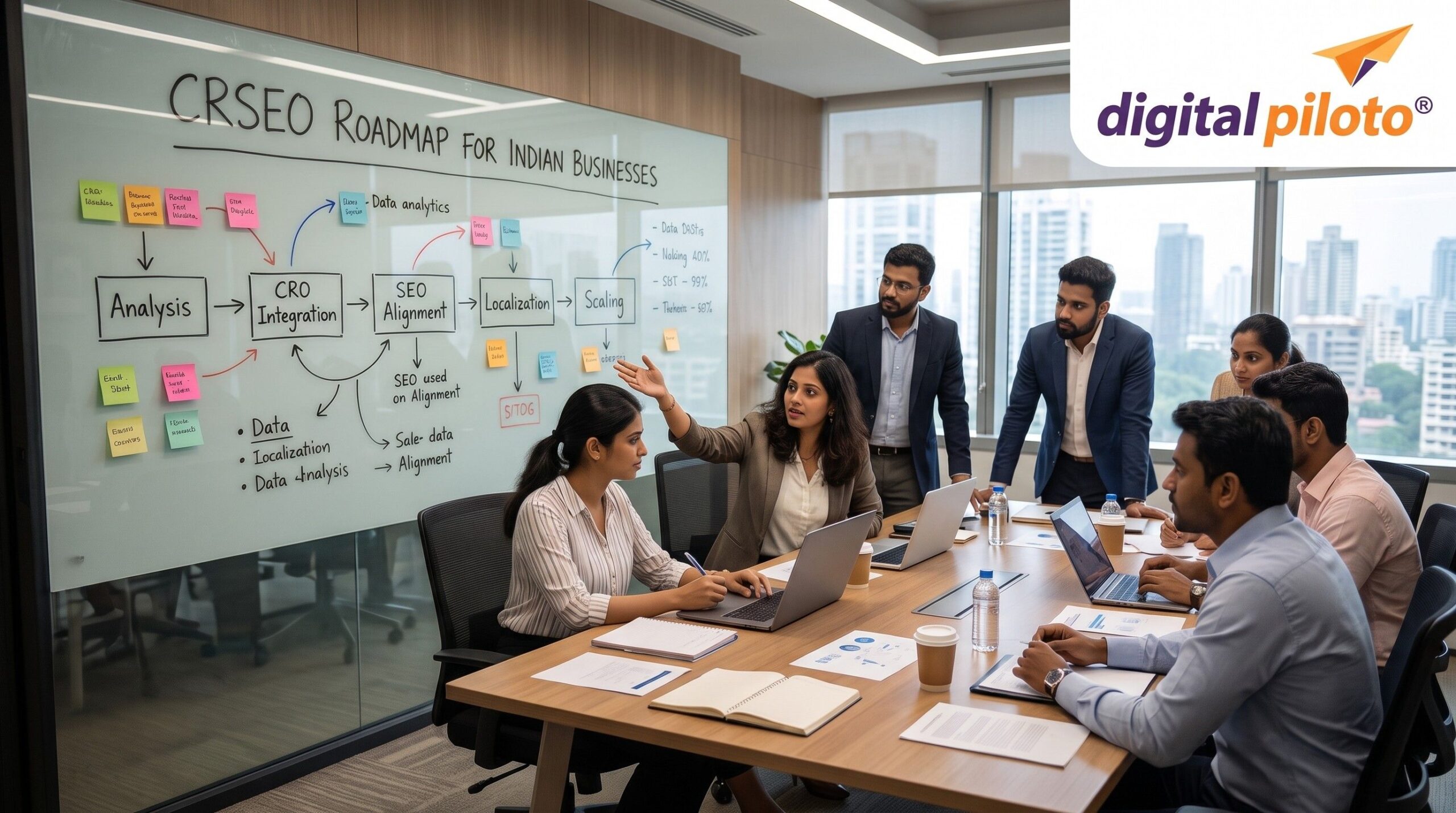
Step 6: Turn the Strategy Into a 90-Day Roadmap
A useful roadmap breaks a large objective into manageable stages. The following timeline is a starting point; complex websites or highly competitive industries may need more time.
- Days 1–30 — Diagnose: Audit technical health, assess existing content, identify customer intent, set performance baselines, and prioritize urgent fixes.
- Days 31–60 — Improve: Update important landing pages, publish high-value content, strengthen internal linking, improve local profiles, and correct structured data where needed.
- Days 61–90 — Evaluate: Review search performance, lead quality, conversion behavior, and available AI visibility observations. Refine the plan based on evidence.
Give every task an owner, deadline, and success measure. A digital marketing agency in India can help coordinate these activities when responsibilities, deliverables, and reporting expectations are agreed upon in advance.
Most importantly, resist the urge to change everything at once. Prioritize improvements with a plausible connection to customer needs and business goals, then measure their effects over a reasonable period.
Step 7: Measure Outcomes and Keep Improving
Search rankings and impressions are useful diagnostic signals, but they should not be the only measures of progress. A business needs to know whether better visibility is attracting the right audience and helping customers move toward a meaningful action.
Monitor qualified organic leads, relevant non-branded traffic, conversion rates, engagement with priority pages, and revenue contribution where attribution is dependable. For AI discovery, track accessible referrals, citations, and brand mentions, while recognizing that these observations may not capture every interaction.
Review the data monthly and investigate significant changes before assigning causes. Seasonality, competition, pricing, technical releases, and shifts in demand can all influence performance. A consistent review process helps teams learn what works and avoid reacting to every short-term fluctuation.
Frequently Asked Questions
1. What is a CRSEO roadmap?
In this article, CRSEO describes a coordinated search strategy connecting traditional SEO, conversational discovery, AI search visibility, and business outcomes. The term does not have one universally standardized definition across the industry.
2. How long does a CRSEO strategy take to show results?
Some technical improvements may show effects relatively quickly, while competitive rankings, content authority, and lead quality improvements often take longer. Timelines depend on the website, competition, implementation, and market demand.
3. Do Indian businesses need separate SEO and AI search strategies?
Not necessarily. Many foundational practices—useful content, technical accessibility, clear business information, and strong user experience—support both traditional search and AI discovery. Monitoring should account for differences between platforms.
4. How should businesses measure CRSEO success?
Combine visibility indicators with qualified leads, conversions, relevant traffic, and revenue where measurable. Track AI citations or referrals when data is available, but avoid relying on one metric to represent the entire search ecosystem.
Final Thoughts
A strong CRSEO roadmap does not require Indian businesses to predict every future change in search. It requires them to understand customers, maintain a technically sound website, publish genuinely useful information, build trust, and measure what contributes to growth. Start with the fundamentals, improve in deliberate stages, and let evidence—not hype—guide the next move.
Blog Development Credits
Amlan Maiti shaped the article’s concept, supported by AI-assisted research and drafting, with final editorial refinement and search optimization from Digital Piloto Private Limited.