
Industrial pipelines rarely operate under perfectly stable conditions. One moment, hot steam rushes through a system; the next, temperatures begin dropping during shutdown. These constant fluctuations can create significant stress on connected equipment. This is where bellows expansion joints become valuable, helping piping systems accommodate thermal movement while maintaining operational stability.
Understanding the Challenge of Extreme Temperature Changes
Temperature variations cause metal pipes to expand when heated and contract when cooled. Although this movement may appear minor, it can create substantial mechanical stress across long industrial pipelines. When the movement has nowhere to go, connected equipment, welds, supports, and joints may experience unwanted loads.
Consider a steam pipeline operating inside a manufacturing facility. During operation, the pipe becomes significantly hotter than its installation temperature. As the metal expands, it pushes against fixed points and connected components. When the system cools, it contracts again. Repeating this process can gradually affect the reliability of the entire installation.
The U.S. Department of Energy explains the relationship between temperature variation and material expansion through the coefficient of thermal expansion. This engineering principle helps designers calculate how much a material changes dimension as its temperature rises or falls. Read the DOE material science handbook for further technical information.
How Bellows Expansion Joints Accommodate Thermal Movement?
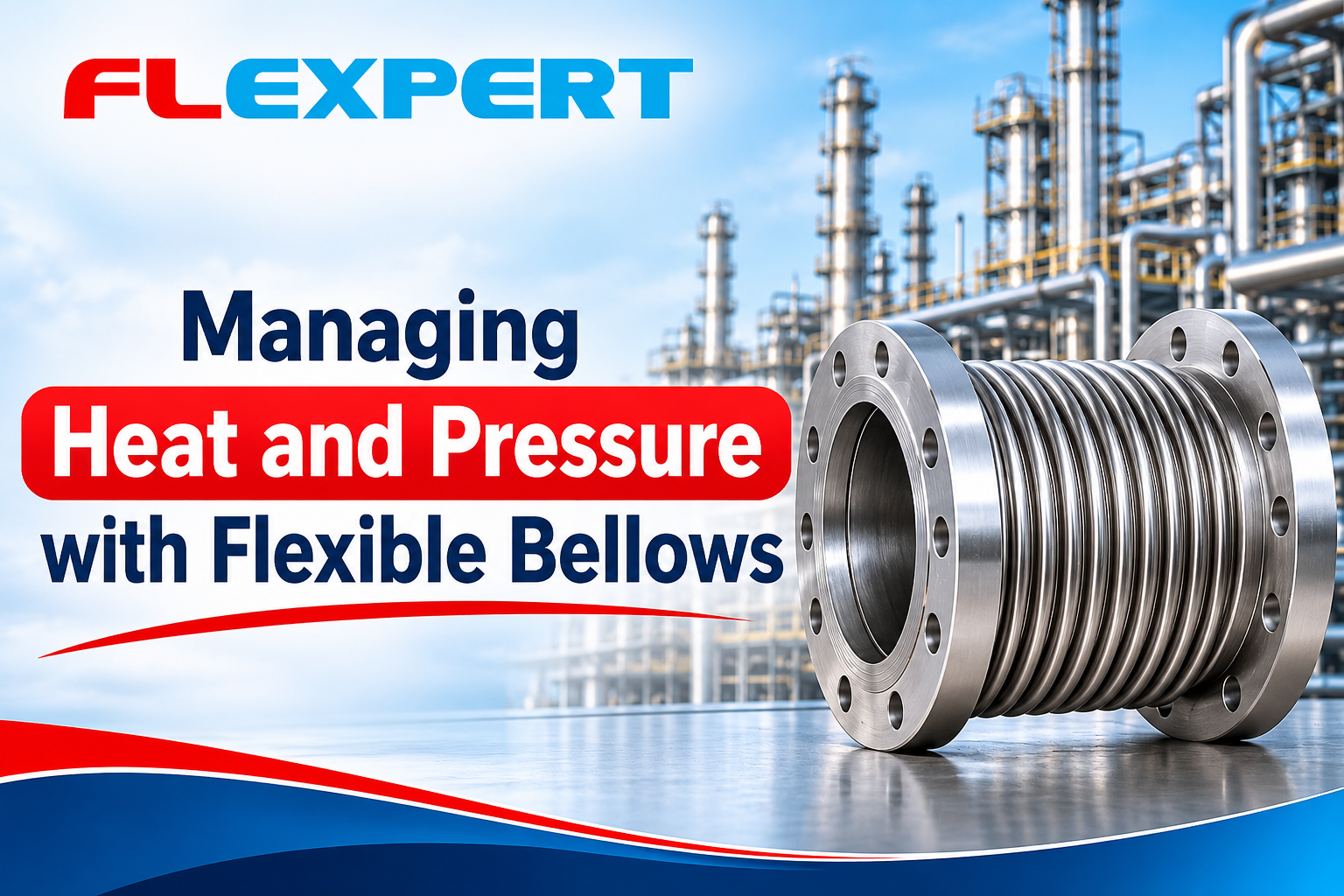
The secret lies in their flexible corrugated construction. Unlike rigid pipe connections, a metallic bellows contains carefully formed folds, commonly called convolutions. These folds allow the component to flex as the connected pipeline changes length.
When a pipeline heats up, the bellows can compress to accommodate the resulting axial movement. When temperatures decrease, it can extend as the pipeline contracts. Depending on the design, it can also accommodate lateral displacement and angular movement.
This flexibility helps reduce unwanted forces transferred to surrounding equipment. Rather than allowing thermal movement to create excessive stress throughout the piping network, the expansion joint provides a controlled location for that movement to occur.
Key movements accommodated by bellows
- Axial compression: Allows the joint to shorten as heated pipes expand.
- Axial extension: Accommodates length reduction when the pipeline cools.
- Lateral movement: Handles sideways displacement between connected pipe sections.
- Angular movement: Supports specified rotational displacement caused by system movement.
According to the Expansion Joint Manufacturers Association (EJMA), the number and geometry of convolutions influence flexibility and movement capacity. Its technical guidance also highlights the importance of selecting a design that matches the actual operating conditions.
Why Material Selection Matters in High-Temperature Applications?
Flexibility alone is not enough. The material used to manufacture a bellows must withstand the temperature, pressure, and chemical conditions inside the pipeline. A material that performs well in a moderate-temperature environment may not be suitable for a demanding industrial application.
Stainless steel is commonly considered for metallic bellows because of its useful combination of strength, corrosion resistance, and flexibility. However, the appropriate grade depends on the specific operating environment. Certain applications may require specialised nickel alloys or other materials to handle demanding temperature and corrosion conditions.
Important material selection considerations
- Operating temperature: Check both maximum and minimum design temperatures rather than considering normal operating conditions alone.
- Corrosion resistance: Evaluate exposure to chemicals, moisture, and the transported medium.
- Pressure requirements: Ensure the material and bellows geometry can safely withstand the specified pressure.
- Thermal cycling: Consider how frequently the system moves between hot and cold operating conditions.
Working with an experienced expansion bellows manufacturer can help engineers identify a suitable material and configuration. Proper selection is particularly important in power generation, petrochemical processing, refineries, and other facilities where temperature fluctuations are part of everyday operations.
Design Features That Improve Performance and Reliability
A reliable expansion joint is the result of more than simply choosing a flexible metal component. Its geometry, pressure rating, movement capacity, and installation arrangement must work together.
Several design features contribute to dependable performance:
- Multiple convolutions: Provide the required flexibility for specified movement conditions.
- Flow liners: Help protect the bellows from erosion and flow-related vibration in suitable applications.
- Protective covers: Reduce the risk of external mechanical damage and accidental contact.
- Tie rods and restraints: Help manage pressure thrust and control movement in appropriately designed assemblies.
Anchors, guides, and supports are equally important. Even a well-designed bellows can experience premature problems if the piping arrangement places unintended loads on it. Torsional movement, for example, should generally be avoided unless the joint has been specifically designed to accommodate it.
Pressure integrity also deserves attention. For a closer look at industrial component safety, read Why Pressure Testing is Essential for the Safety of Industrial Components.
Where Temperature-Resistant Bellows Make a Difference?
Thermal movement management is essential across several industries. In power plants, steam pipelines experience repeated heating and cooling. Chemical processing facilities handle fluids at varying temperatures, while refineries depend on reliable piping connections under demanding operating conditions.
Metal bellows expansion joints are also useful in industrial exhaust systems, heating installations, and manufacturing equipment. In each application, the objective remains similar: accommodate expected movement without placing unnecessary stress on connected components.
Frequently Asked Questions
1. Can bellows expansion joints handle extreme temperatures?
Yes. Properly engineered metallic bellows can operate in demanding high- and low-temperature environments. Their performance depends on material selection, design temperature, pressure, and the expected movement range.
2. Why do pipelines need expansion joints during temperature changes?
Temperature fluctuations cause pipelines to expand and contract. Expansion joints accommodate this movement and help reduce excessive mechanical stress on connected equipment, supports, and piping components.
3. Which materials are suitable for high-temperature bellows?
Stainless steel grades are commonly used, while specialised nickel alloys may be considered for more demanding environments. The final choice depends on temperature, pressure, corrosion exposure, and operating conditions.
4. How can the service life of bellows expansion joints be improved?
Correct engineering calculations, suitable materials, proper installation, adequate pipe supports, and regular inspections all contribute to longer service life. Operating conditions and the number of thermal cycles should also be considered during design.
Final Thoughts
Extreme temperature changes are an unavoidable part of many industrial processes, but the mechanical stress they create can be managed with the right engineering approach. Bellows expansion joints offer the flexibility needed to accommodate thermal movement while supporting safer and more reliable piping operations. With careful material selection, appropriate design, and professional installation, industries can build systems that perform consistently even when operating conditions become challenging.
Listen Here: Click Now