

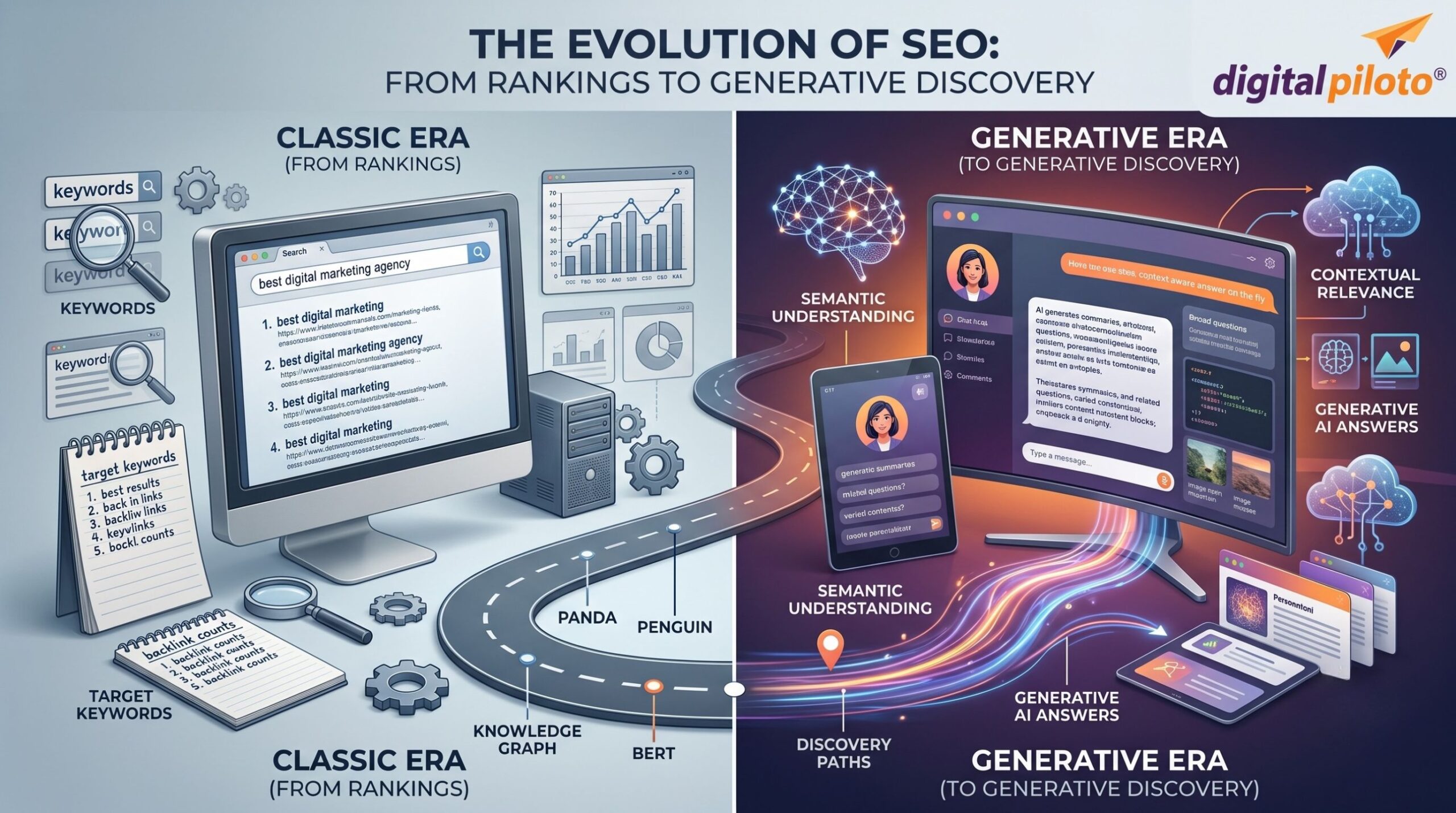
For years, SEO had a simple scoreboard: rankings, clicks, traffic. But search is becoming less like a directory and more like a conversation. AI-generated answers, multimodal queries, and conversational discovery are changing how people find information. The question for businesses is no longer only, “How do we rank?” It is increasingly, “How do we become part of the answer?”
That shift is changing the work of every digital marketing company that wants to remain relevant. Traditional search visibility still matters, but it now sits inside a much larger discovery journey involving search engines, AI assistants, summaries, recommendations, images, and increasingly conversational interfaces.
SEO Was Once a Race for the Blue Links
Think back to the classic Google search experience. You typed a query, scanned a page of results, clicked a promising blue link, and continued browsing until you found what you needed.
SEO evolved around that behavior.
Businesses researched keywords, optimized title tags, improved technical performance, earned backlinks, published content, and competed for increasingly valuable positions in search results. Ranking near the top could dramatically increase the chance of receiving a visit.
That model has not disappeared. Search rankings remain useful signals, and technical SEO still matters. But the interface around those rankings is changing.
AI Overviews and AI Mode can synthesize information from multiple sources. Microsoft is also expanding AI-powered experiences across Bing and Copilot. Instead of simply choosing one result, users can increasingly receive a synthesized response and then decide whether they need to explore further.
Google’s current guidance makes an important point: existing SEO fundamentals remain relevant for AI features. There is no separate technical trick that guarantees inclusion in generative results. Strong crawling, indexing, useful content, clear information, and sound technical foundations continue to matter. Google’s documentation on AI features in Search outlines this relationship.
From Keywords to Conversations
The next major change is not simply technological. It is behavioral.
People are becoming comfortable asking search systems complete questions instead of constructing short keyword combinations.
Compare:
- Traditional: “best CRM software India”
- Conversational: “Which CRM would suit a growing Indian B2B company with a small sales team?”
- Follow-up: “What should I compare before choosing one?”
- Decision query: “Which features would actually matter if the team has only ten salespeople?”
The underlying topic is similar, but the information requirement is much richer.
This is where modern search optimization becomes less about matching exact phrases and more about understanding intent, entities, relationships, context, and the complete decision journey.
A business that creates a page solely because it contains a high-volume keyword may miss the larger opportunity. A business that explains the problem thoroughly, answers related questions, demonstrates expertise, and supports important claims creates something much more useful for both people and information systems.
The Search Result Is Becoming an Answer Layer
One of the biggest changes in SEO is that the search engine itself can now perform more of the information-processing work.
Instead of sending every user directly to a website, AI-powered search can gather information, interpret it, summarize it, and provide links to supporting sources.
This creates an uncomfortable but important question for publishers: what happens when the user gets enough information without clicking?
The answer is not that websites become irrelevant. Rather, the value of visibility starts to change.
A brand may be discovered because its research supports an AI-generated response. Its product may be mentioned during a recommendation. Its guide may be cited as supporting evidence. Its business information may help answer a local question. In each case, the exposure happens before a traditional website visit.
Microsoft’s AI Performance reporting reflects this evolution. Its Bing Webmaster Tools now provides publishers with information about citations in AI-generated answers, including cited URLs and grounding queries. In June 2026, Microsoft expanded the reporting with concepts such as intents, topics, citation share, and comparison views. Microsoft describes citation share as an observational measure of citation presence rather than a conventional ranking score. Microsoft’s AI visibility announcement explains the new capabilities.
That distinction is crucial. A citation is not simply “position one” in another format. AI visibility is contextual and can depend on the question, topic, source material, and generated response.
Why Authority Is Becoming More Important
When search engines mainly returned links, users could inspect several pages themselves. In an AI-generated answer, the system may summarize those sources on the user’s behalf.
That raises the importance of source quality.
If your website makes a claim about an industry trend, explains a technical concept, publishes research, or offers professional advice, the surrounding evidence matters. Who wrote it? Is the information current? Can the claim be supported? Does the site demonstrate real knowledge of the subject?
This is one reason E-E-A-T—experience, expertise, authoritativeness, and trustworthiness—continues to be relevant to modern search strategy.
It also explains why generic content at scale is becoming a weaker long-term strategy. Publishing another lightly rewritten explanation of a topic rarely gives an AI system a compelling reason to use that source.
Stronger authority can come from:
- Original research and first-hand observations.
- Clear authorship and professional expertise.
- Useful examples that demonstrate practical understanding.
- Accurate, current information backed by credible sources.
- Detailed explanations that go beyond surface-level summaries.
- Consistent business and subject information across the website.
Google’s guidance on creating helpful content similarly emphasizes originality, substantial value, expertise, and satisfying the user’s information need rather than producing content primarily to attract search traffic. Google’s people-first content guidance provides the broader principles.
Generative Discovery Changes What “Visibility” Means
Traditional SEO tends to ask: “Where does this page rank?”
Generative discovery asks several additional questions.
Is the brand understood by AI systems? Is its content being surfaced for relevant topics? Are its pages cited? Does the content contribute useful evidence? Is the business appearing when users ask comparison or recommendation questions?
This is where generative AI search engine optimization enters the conversation.
Rather than treating GEO as a replacement for SEO, it is more useful to view it as part of the broader evolution of search visibility. The goal is to make a brand’s knowledge easier for AI-powered systems to discover, understand, connect, and potentially reference.
Microsoft’s own description of the emerging AI web uses the concept of “grounding”—connecting AI-generated answers to web evidence. Its guidance notes that AI systems increasingly rely on structured, verifiable, applicable information. Microsoft’s discussion of grounding on the AI web provides useful context.
That makes content architecture important. A single excellent article can help, but a connected body of trustworthy information can communicate expertise much more clearly.
SEO Is Expanding Beyond Text
Another important development is multimodal search.
People are no longer limited to typing words into a search box. They can use images, screenshots, cameras, visual searches, and combinations of text and imagery to express what they want.
Google introduced new Search Console reporting for web multimodal search in September 2026. The reporting covers sources such as Google Lens, Circle to Search on Android, image uploads to Search, and Chrome’s “Search this image” functionality. Google says the new reporting is designed to help site owners understand how their content appears in these visual search experiences. Google Search Central’s September 2026 announcement documents the change.
This means image optimization is no longer merely about adding an ALT attribute and moving on.
For relevant businesses, useful images can become part of the information layer. Product photography, diagrams, original charts, screenshots, location imagery, instructional visuals, and explanatory graphics may all contribute to how a page communicates meaning.
The bigger lesson is simple: search is becoming multimodal because human questions are multimodal.
What Happens to Rankings?
Rankings are not going away. But their role is becoming less complete as a measure of visibility.
Imagine a restaurant appearing in traditional local results, being mentioned in an AI recommendation, appearing in image-based discovery, and being surfaced when someone asks an assistant for options nearby. A single ranking number cannot describe that entire journey.
For businesses, this means SEO reporting needs to become broader.
Useful measurement areas include:
- Traditional search: rankings, impressions, clicks, organic traffic, and indexed pages.
- AI visibility: citations, referenced URLs, AI-generated mentions, and relevant grounding queries where data is available.
- Engagement: qualified visits, assisted conversions, return visitors, and meaningful interactions.
- Business outcomes: leads, sales, enquiries, pipeline contribution, and customer acquisition quality.
None of these metrics tells the whole story by itself. The smarter approach is to connect them rather than replacing one scoreboard with another.
The Role of SEO Teams Is Changing Too
The evolution of search is also changing what an experienced SEO agency needs to think about.
Technical optimization remains essential, but modern SEO increasingly overlaps with content strategy, digital PR, analytics, brand building, UX, structured data, conversion optimization, and AI visibility.
An SEO professional may now need to ask:
- What does this brand want to be known for?
- Which topics genuinely demonstrate its expertise?
- Are important pages connected through a logical content architecture?
- Can search systems clearly identify the people, products, services, and organizations discussed?
- Does the content offer something original rather than another generic summary?
- Can performance be measured beyond conventional rankings?
In other words, SEO is becoming less of a narrow traffic discipline and more of a digital discovery discipline.
How Businesses Can Prepare for Generative Discovery
The transition does not require throwing away everything that worked in traditional SEO. It requires extending it.
Start by strengthening the fundamentals: crawlability, indexing, internal linking, useful page structure, fast experiences, descriptive titles, accurate metadata, and clear content.
Then build outward.
Create topic clusters around genuine expertise. Develop original resources. Answer the questions customers actually ask. Keep important information current. Strengthen author and company credibility. Use structured data where it is supported and appropriate. Make important facts consistent across pages.
Most importantly, stop treating every piece of content as a separate traffic opportunity.
A useful content ecosystem is more powerful than a warehouse of disconnected articles.
AI Search Does Not Cancel Traditional SEO
There is a temptation to frame the industry as “old SEO versus AI SEO.” That makes for a catchy headline, but reality is more nuanced.
Google’s guidance continues to say that the same fundamental SEO best practices remain applicable to AI features. Meanwhile, Microsoft’s AI Performance tools build on its existing webmaster infrastructure rather than replacing traditional search measurement altogether.
The evolution is therefore additive.
Technical SEO supports discoverability. Content builds relevance. Authority strengthens trust. Internal linking creates context. Brand recognition reinforces meaning. GEO helps teams think about how content participates in AI-generated experiences.
These pieces work together.
Frequently Asked Questions
Is SEO becoming obsolete because of AI search?
No. Traditional SEO remains an important foundation for search visibility. The change is that businesses now need to consider additional discovery surfaces, including AI-generated answers, citations, conversational search, and multimodal experiences.
What is generative discovery in SEO?
Generative discovery refers to situations where users discover brands, products, services, or information through AI-generated answers, recommendations, summaries, and conversational search rather than only through conventional search-result listings.
How is AI search different from traditional search?
Traditional search primarily presents a set of results for the user to evaluate. AI search can retrieve information from multiple sources, synthesize it into an answer, and provide supporting citations or links. The exact behavior varies by platform and query.
Should businesses stop tracking keyword rankings?
No. Rankings still provide useful information about conventional search visibility. However, they should be combined with broader measures such as organic traffic, conversions, AI citations where available, branded discovery, and other business outcomes.
Final Thoughts
SEO has not really moved from rankings to something entirely different. It has expanded.
The search box is becoming a gateway to a much wider discovery ecosystem, where answers can be synthesized, recommendations can be conversational, and information can be retrieved through text, images, and AI assistants.
The businesses that adapt well will not necessarily abandon the fundamentals. They will build on them—creating useful content, strengthening authority, organizing information clearly, and measuring visibility wherever customers are actually discovering them.
The future of SEO, then, is not simply about being number one on a page. It is about becoming a credible, recognizable, and useful source wherever the next generation of search looks for an answer.
Blog Development Credit
The concept was developed by Amlan Maiti, with research and drafting supported by advanced AI tools, followed by final SEO refinement from Digital Piloto Private Limited.