
Search is no longer just a box where people type keywords and choose from ten blue links. Today, users can ask complex questions, compare options, request recommendations, and receive synthesized answers in seconds. For every digital marketing agency, this raises a bigger question: what happens to SEO when discovery itself becomes conversational?
The answer is not that SEO disappears. Instead, search is becoming broader, more contextual, and increasingly influenced by generative AI.
Digital Discovery Is Entering a New Phase
For years, digital discovery followed a fairly predictable pattern. Someone had a question, typed a keyword into Google or another search engine, scanned the results, opened a few websites, and made a decision.
That process still happens millions of times every day. But there is now another path.
A customer can ask an AI-powered search experience, “What should a mid-sized Indian ecommerce company do to reduce abandoned carts without relying heavily on discounts?” Instead of receiving a list of pages, the user may get a synthesized explanation containing recommendations, examples, comparisons, and links to supporting sources.
That is a fundamental change in the discovery experience.
The search engine is no longer merely helping someone find information. It is increasingly helping them understand information.
And that distinction has major implications for marketers.
Why Generative AI Is Changing Search Behaviour
Generative AI has made conversational interaction with information remarkably accessible. People do not have to know the perfect keyword anymore. They can describe a situation in ordinary language and refine the request as the conversation develops.
Google’s expansion of AI Overviews provides one clear indication of this transition. In its May 2025 update, Google said AI Overviews had expanded to more than 200 countries and territories and more than 40 languages. Google also reported increased usage of queries that trigger AI Overviews in the United States and India.
Google later reported that AI Mode had passed one billion monthly active users globally, highlighting how quickly conversational search interfaces can move from experimentation into mainstream behaviour.
There is an important nuance here. This does not mean traditional search has become irrelevant. Search engines continue to crawl, index, rank, and display web pages. What is changing is the layer between the user’s question and the information they ultimately consume.
That layer is increasingly intelligent, conversational, and generative.
SEO Is Moving From Rankings Toward Relevance
Traditional SEO often encourages a ranking-oriented mindset: choose a keyword, optimize a page, earn authority, improve rankings, and attract clicks.
Those fundamentals still matter. But generative search introduces another question:
Can an AI system understand why this source is relevant to the user’s question?
Consider two websites selling the same category of service. One publishes dozens of short pages repeating variations of the same keyword. The other explains customer problems in detail, publishes original observations, answers difficult questions, provides useful examples, and maintains consistent information across its digital presence.
The second website gives both humans and machines considerably more context.
This is where the future of SEO becomes less about manipulating isolated signals and more about building a credible information ecosystem.
Search Intent Is Becoming More Conversational
One of the biggest changes brought by generative AI is the way people express intent.
Search queries used to be relatively compressed. Someone might type:
“best CRM for small business”
With conversational AI, the request could become:
“I run a 20-person B2B sales team, most leads come from LinkedIn and organic search, and we need a CRM that is easy for non-technical employees. What should we consider?”
Both queries have a similar commercial theme. The second, however, contains considerably more context.
That means marketers need to understand not only what people search for, but why they search, what constraints they have, and what follow-up questions naturally emerge.
A useful content strategy should therefore address several layers of intent:
- Problem intent: What is going wrong and why?
- Educational intent: What does the customer need to understand before acting?
- Comparison intent: What alternatives exist and how do they differ?
- Solution intent: What type of product, service, or approach could solve the problem?
- Decision intent: What evidence does the buyer need before choosing?
This is essentially search intent becoming a conversation rather than a single query.
What Happens to the Traditional Search Funnel?
The classic journey might look like this:
Search → Click → Read → Compare → Contact → Buy
Generative discovery can create something more fluid:
Question → AI answer → Follow-up question → Recommendation → Brand discovery → Website visit → Validation → Conversion
The difference is subtle but important.
A brand might influence the customer before receiving a website visit. Its content could contribute to an AI-generated explanation, its research might become a supporting reference, or its expertise could be associated with a particular topic.
That makes brand visibility more distributed.
The website remains important, but it is no longer necessarily the first place where the customer encounters the brand.
The Rise of AI Search Visibility
This emerging environment has given rise to a new marketing priority: AI search visibility.
AI search visibility is not simply about appearing when someone asks an AI tool for a company name. It involves being discoverable and contextually relevant when users ask questions related to the problems a brand solves.
For example, an accounting firm should not think only about appearing for “accounting firm near me.” It may also want its expertise to be associated with questions about tax planning, cash-flow management, financial reporting, business compliance, or startup accounting.
The same principle applies across industries.
Restaurants, software companies, healthcare organizations, manufacturers, ecommerce brands, educational institutions, and professional service firms all have opportunities to become useful sources within their respective information ecosystems.
Where Generative AI Search Engine Optimization Fits
This is where generative AI search engine optimization enters the picture.
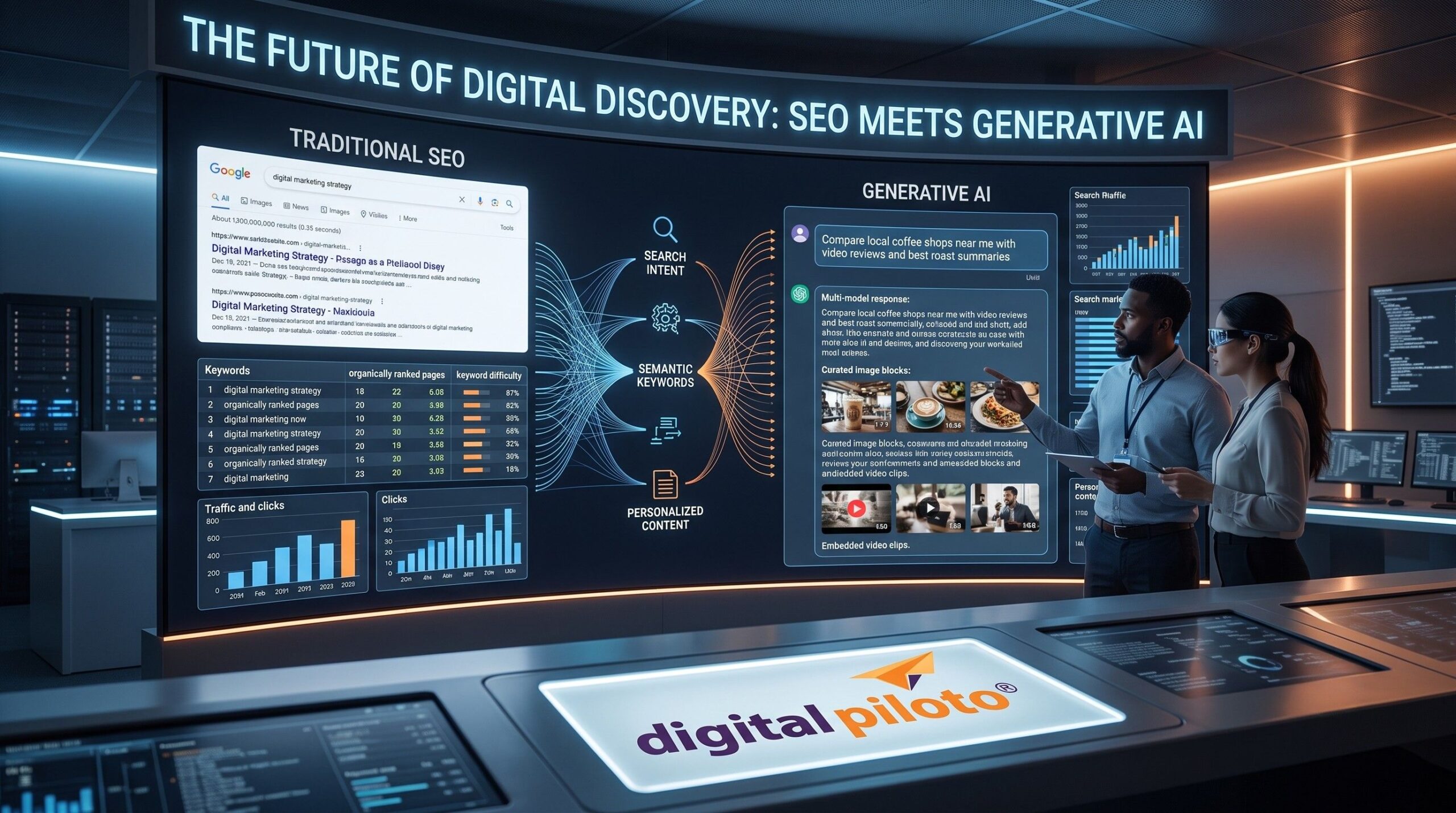
The discipline is closely connected to SEO but considers a broader discovery environment. Instead of focusing exclusively on conventional rankings, marketers examine how information can be understood, retrieved, summarized, referenced, and associated with a brand within AI-driven search experiences.
A useful strategy may involve several connected areas:
- Semantic clarity: Make it obvious what a page is about, who it serves, and what problem it addresses.
- Topical depth: Build supporting content around important subjects rather than creating isolated keyword pages.
- Original evidence: Add research, examples, proprietary insights, expert commentary, and practical observations.
- Entity consistency: Keep important business information, products, services, people, and locations accurately represented.
- External credibility: Develop legitimate references and mentions across relevant third-party sources.
None of this is a shortcut to guaranteed inclusion in an AI answer. Generative systems can vary in their sources and outputs, and their behaviour can change over time.
The more sensible goal is to make the brand’s information genuinely useful and machine-understandable.
Zero-Click Search Makes Brand Presence More Important
One of the most interesting consequences of generative search is the possibility of receiving an adequate answer without clicking through to a website.
Pew Research Center analysed nearly 69,000 Google searches conducted by users in the United States in March 2025. Its research found that AI-generated summaries appeared in roughly 18% of searches. When an AI summary appeared, users clicked a traditional search result less frequently than when no summary was shown.
This makes zero-click search an increasingly relevant concept for digital marketers.
But there is an important distinction between losing a click and losing a customer.
If someone sees a brand’s expertise in an AI-generated answer, remembers the company, searches for it later, visits its website directly, and eventually becomes a customer, the initial AI interaction may have influenced the journey even though it never generated a conventional click.
Attribution becomes messier. Brand building becomes more important.
Content Quality Matters More Than Content Volume
There is an understandable temptation to respond to AI search by publishing more content.
More pages. More keywords. More FAQs. More variations.
But volume alone does not create authority.
In fact, large quantities of repetitive content can make a website harder to understand. Customers become frustrated, internal pages compete with one another, and the brand has little genuinely distinctive information to contribute.
Generative search makes originality more valuable because AI systems have an enormous amount of generic information available to draw upon.
If your article says the same thing as hundreds of other pages, there is little reason for your source to stand out.
Original research, firsthand experience, useful frameworks, clear explanations, expert perspectives, and carefully documented examples give content a stronger reason to exist.
The new content test
Before publishing an important page, ask:
- Does this answer a real customer question?
- Does it add information that is genuinely useful?
- Could an expert identify a clear point of view or practical insight?
- Are important claims supported by reliable evidence?
- Would someone still find the page useful if search engines did not exist?
That final question is surprisingly revealing.
E-E-A-T Becomes More Practical
Google’s guidance around experience, expertise, authoritativeness, and trust has been relevant to quality-focused SEO for years. Generative discovery makes those ideas even more practical because AI systems need reliable information to construct useful answers.
A company claiming to be an expert is one thing. A company demonstrating its expertise through detailed guides, original research, customer examples, named specialists, transparent information, and credible external references is another.
For businesses, this means expertise should become visible rather than merely claimed.
If an organisation has spent fifteen years solving a particular industry problem, its content should contain some evidence of that accumulated knowledge.
Otherwise, an AI-generated answer has little reason to distinguish it from a generic article produced last week.
SEO and Generative AI Will Work Together
The idea that SEO and AI search are competing disciplines is misleading.
Technical SEO still helps search systems discover and interpret websites. Structured content still helps machines understand relationships. Internal linking still provides context. Page experience still matters to users. Authoritative external references still help establish credibility.
What changes is the scope of the job.
A modern SEO company increasingly has to think about search visibility as an ecosystem rather than a single ranking page.
That ecosystem can include:
- Traditional search: Organic rankings, snippets, local results, images, videos, and other search features.
- Generative search: AI summaries, conversational answers, recommendations, and citations.
- Brand discovery: Reviews, social platforms, publishers, communities, directories, and third-party references.
- Conversion environments: Websites, product pages, landing pages, forms, stores, and direct communication channels.
The strongest strategy connects these environments instead of treating each one as a separate marketing project.
How Businesses Can Prepare for the Next Search Era
Businesses do not need to predict exactly how AI search will look five years from now. That is probably impossible anyway.
They need to build assets that remain valuable as interfaces change.
Start with the fundamentals.
- Map customer questions: Document what customers ask before, during, and after considering your solution.
- Audit existing content: Find outdated, repetitive, thin, contradictory, or overly promotional pages.
- Create topic clusters: Build interconnected resources around commercially important subjects.
- Publish original insights: Turn company knowledge and customer experience into genuinely useful information.
- Strengthen entity information: Keep business details, services, products, authors, locations, and other important facts consistent.
- Monitor AI discovery: Regularly test realistic customer questions across major AI-powered search experiences.
- Measure business impact: Connect visibility signals with branded searches, qualified traffic, leads, sales, and customer behaviour.
The goal is not to manufacture an AI citation. It is to build a brand that has enough substance to be worth citing.
The Metrics of Search Are Changing Too
Rankings will remain useful, but they cannot tell the entire story.
A company might rank well for hundreds of keywords while being almost invisible when customers ask AI systems more complex questions. Conversely, a brand may receive fewer conventional clicks but become increasingly recognised during high-intent research.
That is why marketers should gradually expand their measurement framework.
Useful signals can include AI answer visibility, citation frequency, branded search growth, direct traffic, assisted conversions, qualified organic leads, and the consistency with which a brand is associated with its core topics.
These metrics should be interpreted carefully. There is no universal standard for measuring AI visibility yet, and different AI systems can produce different answers for similar questions.
Still, measuring nothing is not a strategy.
What Will Digital Discovery Look Like Next?
The most interesting future may not be a world where people stop searching and simply talk to AI.
It is more likely to be a blended environment.
Someone might begin with Google, continue with an AI-generated overview, watch a product demonstration on YouTube, read customer discussions on Reddit, visit a company’s website, ask an AI assistant for a comparison, and finally purchase through a completely different platform.
Discovery becomes distributed.
The customer may not even think about these interactions as separate channels. To them, it is simply research.
That creates a powerful lesson for marketers: the customer’s journey is continuous even when the platforms are not.
Frequently Asked Questions
Is generative AI replacing traditional SEO?
No. Traditional SEO remains important for helping search engines discover, understand, and rank web content. Generative AI adds another discovery layer where information can be synthesized into conversational answers and recommendations.
What is generative AI search engine optimization?
Generative AI search engine optimization focuses on making a brand’s information clear, useful, credible, and contextually relevant for AI-powered discovery experiences. It complements conventional SEO rather than replacing it.
How should businesses prepare for AI-powered search?
Businesses should strengthen technical SEO, create genuinely useful content, answer detailed customer questions, demonstrate expertise, maintain accurate business information, develop credible external references, and monitor how their brand appears across generative search experiences.
Will zero-click searches hurt website traffic?
They can reduce some direct clicks when users receive sufficient information within search results or AI-generated answers. However, the effect varies by query and industry. Brands should also consider assisted discovery, branded searches, direct visits, and eventual conversions rather than judging visibility solely by clicks.
Final Thoughts
The future of digital discovery is unlikely to belong exclusively to traditional search engines or generative AI. It will belong to the connection between them.
SEO provides the technical and strategic foundation for being discoverable. Generative AI changes how that information is interpreted and delivered. Together, they are creating a search environment where relevance, context, authority, and usefulness matter more than simply matching a keyword.
For businesses, the opportunity is refreshingly straightforward: stop thinking only about where a page ranks and start thinking about whether the brand deserves to be part of the answer.
That shift—from ranking for searches to becoming useful within discovery—is likely to define the next chapter of digital marketing.
Blog Development Credits
This article was conceptualized by Amlan Maiti, developed through AI-assisted research and writing, and given final SEO and optimization refinements by Digital Piloto Private Limited.