
Quality control is the foundation of reliable engineering casting manufacturing. It ensures that every metal component meets the required standards for strength, dimensional accuracy, surface finish and performance. From selecting raw materials to final inspection, each manufacturing stage matters. Bengal Iron Corporation understands the importance of consistent quality in producing dependable cast components for everyday industrial applications.
Choosing an experienced engineering casting manufacturer is equally important because even a small manufacturing defect can affect how a component performs after installation. Good quality control is not simply about rejecting defective products; it is about preventing problems before they reach the customer.
What Does Quality Control Mean in Engineering Casting?
Quality control in engineering casting refers to the systematic inspection and testing of materials, manufacturing processes and finished components to ensure they meet defined technical requirements.
It involves checking metal composition, mould preparation, pouring conditions, cooling behaviour, dimensional tolerances and surface quality. The objective is straightforward: manufacture components that perform consistently under their intended working conditions.
Consider an industrial cast iron component used in machinery. A casting may look perfectly acceptable from the outside, but internal porosity or an uneven structure could affect its strength. This is why appearance alone cannot determine product quality.
Why Is Quality Control So Important in Modern Casting?
Modern engineering components often operate under demanding conditions. They may experience mechanical loads, vibration, pressure, temperature variations and continuous use. Without proper quality checks, minor manufacturing inconsistencies can become expensive problems.
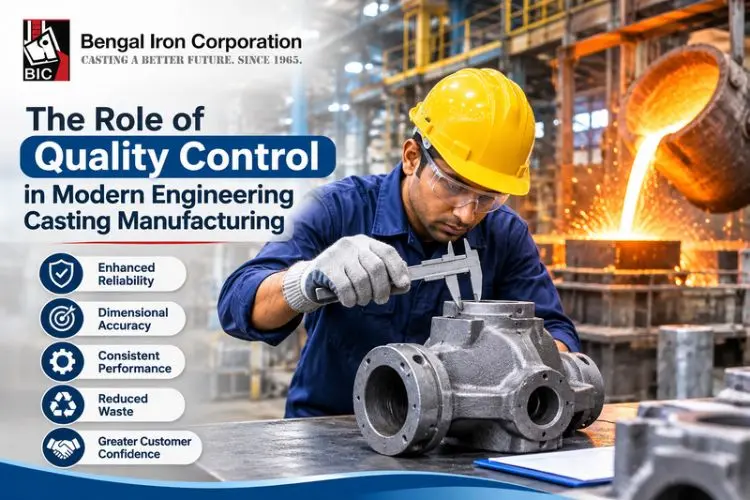
Here are five practical reasons why quality control matters:
- Improved structural reliability: Proper inspection helps identify defects that may compromise the strength and service performance of cast components.
- Better dimensional accuracy: Accurate measurements ensure components fit their intended assemblies without unnecessary adjustments.
- Consistent product performance: Monitoring manufacturing parameters helps maintain uniformity between production batches.
- Reduced material wastage: Early identification of process problems helps minimise rejected castings and avoidable rework.
- Greater customer confidence: Reliable inspection practices give buyers more confidence in the products they purchase.
In practical terms, a properly inspected component is less likely to create unexpected installation difficulties or require premature replacement.
Which Stages Require Quality Inspection?
Quality cannot be added to a casting at the final stage. It must be built into the manufacturing process from the beginning. A dependable quality management approach generally covers several important stages.
1. Raw Material Selection and Testing
The quality of a finished casting starts with its raw materials. Foundries need to select suitable metal grades and verify that their chemical composition meets the required specifications.
Depending on the material and application, spectrometric analysis and other material-testing methods can help identify unwanted variations before production begins.
2. Mould Preparation and Design Verification
A well-prepared mould plays a major role in achieving the correct shape and dimensions. Incorrect mould design, poor compaction or unsuitable gating arrangements may contribute to defects such as shrinkage, sand inclusions and incomplete filling.
Checking mould condition and dimensions before pouring helps reduce avoidable production problems.
3. Monitoring the Metal Pouring Process
Temperature control during melting and pouring is essential. Metal poured outside its suitable processing range may cause filling difficulties, surface defects or changes in the final casting structure.
Monitoring temperature, pouring time and metal handling conditions helps maintain process consistency.
4. Cooling, Cleaning and Finishing
Cooling conditions influence the final structure and properties of a casting. Uneven cooling may contribute to residual stresses, distortion or cracking.
After solidification, cleaning and fettling remove unwanted material. The component is then examined for surface irregularities, cracks and other visible imperfections.
5. Final Inspection and Testing
Finished components should be checked against their technical drawings and specified acceptance criteria. Depending on the application, inspection may include dimensional measurements, hardness testing, mechanical testing and non-destructive examination.
How Do Manufacturers Detect Casting Defects?
Different defects require different inspection methods. A visual examination may identify surface problems, but internal defects often require specialised testing.
Common inspection methods include:
- Visual inspection: Identifies visible cracks, rough surfaces, incomplete sections and other surface irregularities.
- Dimensional inspection: Uses measuring instruments and gauges to verify component dimensions and tolerances.
- Hardness testing: Evaluates resistance to indentation and helps assess material consistency.
- Ultrasonic testing: Uses high-frequency sound waves to examine certain internal discontinuities.
- Radiographic testing: Uses X-rays or gamma rays to reveal internal defects such as porosity and shrinkage, where appropriate.
- Mechanical testing: Evaluates properties such as tensile strength and elongation using suitable test specimens.
Not every casting needs every test. The appropriate inspection method depends on the material, component geometry, applicable standards and intended service conditions.
How Quality Control Affects Everyday Infrastructure Products
Quality control is not limited to complicated machinery or large industrial equipment. It also matters in products that people encounter in residential, commercial and public infrastructure.
For example, a chamber cover must have suitable dimensions, adequate load-bearing characteristics and a properly finished seating surface. Poor dimensional accuracy can create fitting difficulties, while material defects may affect its performance during service.
When comparing a cast iron chamber cover near you India, buyers should consider more than price and appearance. Material specifications, intended load class, manufacturing consistency and relevant inspection documentation deserve equal attention.
Similarly, ductile iron access covers India should be selected according to their installation environment and required performance specifications.
How to Evaluate the Quality of an Engineering Casting Manufacturer
For individual buyers, contractors and industrial customers, evaluating a manufacturer’s quality practices can make purchasing decisions easier.
Before choosing a supplier, consider these practical points:
- Ask about the material grades and specifications used for the product.
- Check whether dimensional inspection is part of the production process.
- Understand which testing methods are available for the particular component.
- Request relevant inspection reports or material test certificates where applicable.
- Compare the product’s technical specifications with your actual application requirements.
A manufacturer should be able to explain how its products are made and what inspection procedures are relevant to their intended use. Clear technical communication is often a good sign of a responsible manufacturing approach.
How Is Technology Improving Casting Quality Control?
Modern foundries are increasingly adopting digital tools to improve process monitoring and inspection accuracy. Computer-aided design, simulation software, digital measurement systems and automated inspection equipment can help identify inconsistencies earlier.
For example, casting simulation can help engineers study how molten metal fills a mould and where shrinkage risks may develop. This allows potential design or process issues to be addressed before actual production.
Digital inspection records also make it easier to compare production batches, identify recurring defects and maintain traceability. However, technology works best when supported by experienced operators, sound process knowledge and clearly defined acceptance criteria.
Frequently Asked Questions (FAQs)
Q. Why is quality control necessary in engineering casting?
A. Quality control helps ensure that cast components meet required material, dimensional and performance specifications. It reduces the risk of defects, fitting problems and premature component failure.
Q. What are the most common defects found in metal castings?
A. Common casting defects include porosity, shrinkage cavities, cracks, sand inclusions, cold shuts and dimensional inaccuracies. Their occurrence depends on material selection, mould design and manufacturing conditions.
Q. Which tests are used to check casting quality?
A. Common methods include visual inspection, dimensional measurement, hardness testing, tensile testing, ultrasonic testing and radiographic examination. The selection depends on the component’s requirements.
Q. How can buyers identify a reliable engineering casting manufacturer?
A. Buyers should evaluate material specifications, manufacturing capabilities, inspection procedures, relevant certifications and quality documentation before selecting a manufacturer.
Q. Does quality control increase the cost of engineering castings?
A. Quality control may add to initial manufacturing costs, but it can reduce rejection, rework, material wastage and replacement expenses. Over time, effective inspection can improve overall value.
Conclusion:
Quality engineering castings are the result of careful decisions at every manufacturing stage. From raw material selection to final inspection, consistent monitoring makes a meaningful difference to product reliability and customer satisfaction.
For buyers, the lesson is simple: do not judge an engineering casting by its appearance or price alone. Understand how it is manufactured, what standards it meets and how its quality is verified. Bengal Iron Corporation recognises the importance of dependable casting solutions and the role that manufacturing quality plays in supporting modern industrial and infrastructure requirements.
Blog Development Credit:
This article was developed through collaborative research, content planning and editorial assistance using ChatGPT, Google Gemini and Bengal Iron Corporation, with a focus on engineering casting quality, manufacturing practices and industry insights.