
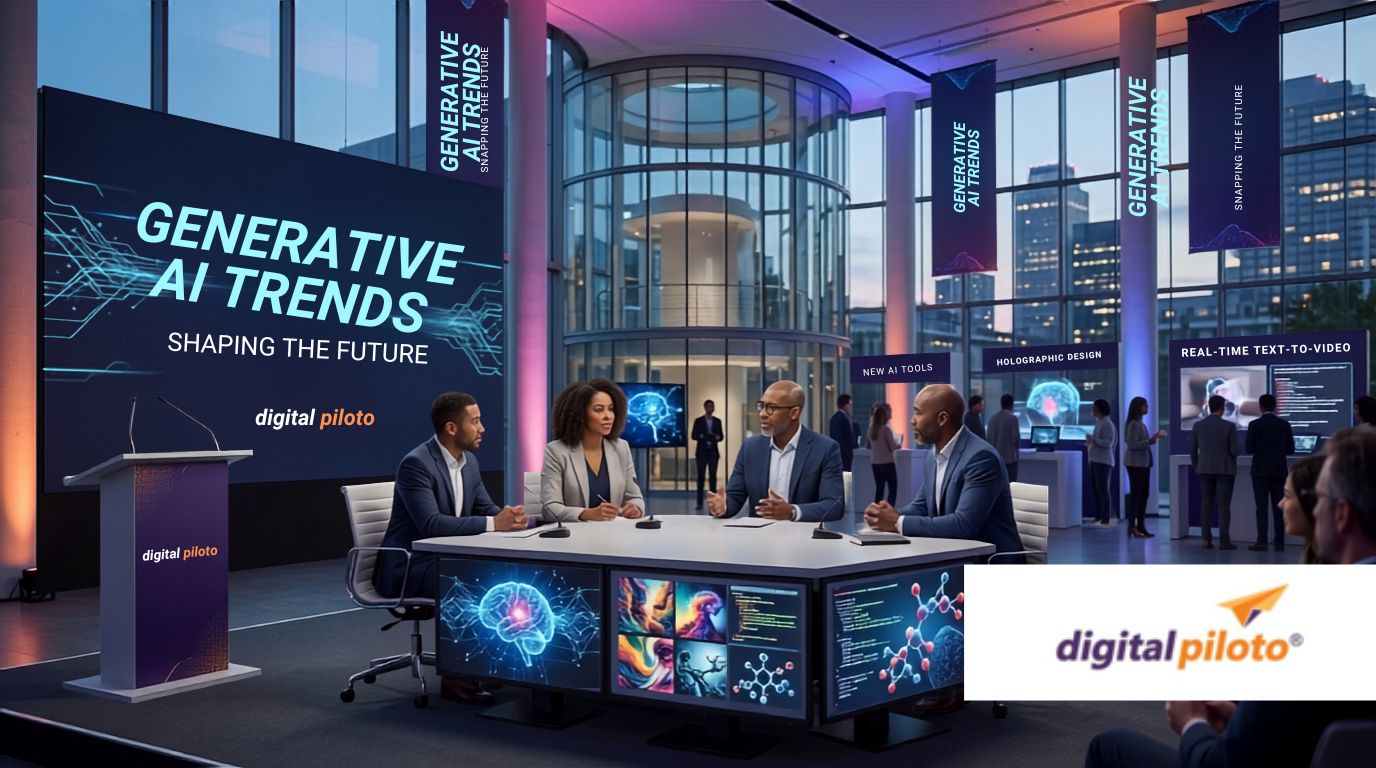
Generative AI is shaping the future by making technology more creative, personalized, and capable of handling complex tasks that once required human expertise. From content creation and software development to healthcare and customer experiences, the latest innovations are changing how businesses operate and compete. Organizations that understand these trends today will be better prepared for tomorrow.
Companies are already integrating AI into everyday workflows, including Performance Marketing Services, product development, customer support, and analytics. Rather than replacing people, the most successful implementations focus on helping teams work faster, make smarter decisions, and deliver more personalized experiences.
What Is Generative AI?
Generative AI is a branch of artificial intelligence that creates new content based on patterns learned from existing data. Unlike traditional AI systems that mainly analyze or classify information, generative AI produces original outputs such as text, images, videos, audio, software code, and business insights.
Large language models, multimodal AI, and diffusion models are among the technologies driving this transformation across industries.
Why Are Generative AI Trends Important?
Every major technology wave changes how businesses compete. Generative AI is different because it impacts nearly every department simultaneously. Marketing teams create campaigns faster, developers write code more efficiently, designers generate concepts instantly, and customer service teams deliver personalized support at scale.
The competitive advantage no longer comes from simply adopting AI. It comes from applying AI responsibly, strategically, and in ways that improve customer value.
Top Generative AI Trends Shaping the Future
1. Multimodal AI Will Become the New Standard
Modern AI systems are moving beyond text generation. They now understand and generate text, images, videos, speech, and structured data within a single workflow.
This allows businesses to create marketing campaigns, presentations, training materials, and customer experiences much faster without switching between multiple tools.
2. AI Agents Will Handle Complex Workflows
Instead of answering a single prompt, AI agents will complete multi-step business processes independently.
- Research information
- Create reports
- Schedule meetings
- Analyze customer feedback
- Generate recommendations
This shift moves AI from being an assistant to becoming an intelligent collaborator.
3. Personalized Customer Experiences Will Scale
Consumers increasingly expect personalized interactions. Generative AI makes this possible by producing customized emails, advertisements, recommendations, landing pages, and customer responses in real time.
Brands that balance personalization with transparency will build stronger customer trust.
4. Industry-Specific AI Models Will Grow
General AI models are powerful, but specialized models trained for healthcare, finance, manufacturing, education, and legal services deliver more accurate and compliant results.
This trend is helping businesses reduce errors while improving decision-making.
5. Responsible AI Will Become a Competitive Advantage
As AI adoption increases, organizations are placing greater emphasis on governance, security, and ethical implementation.
Future AI success will depend as much on trust as technological capability.
How Businesses Can Prepare for Generative AI
Preparing for AI adoption requires more than purchasing software. It involves improving processes, developing skills, and identifying practical business opportunities.
Step 1: Identify Repetitive Work
Start with tasks that consume significant time but follow predictable processes.
Step 2: Choose High-Impact Use Cases
Focus on areas where AI improves productivity without compromising quality.
Step 3: Train Teams
Employees who understand prompt engineering, AI verification, and workflow integration gain the greatest value from these tools.
Step 4: Measure Results
Track productivity improvements, customer satisfaction, content quality, and operational efficiency rather than simply counting AI-generated outputs.
Generative AI in Marketing and Retail
Marketing teams are among the earliest adopters of generative AI because content production, campaign optimization, and customer analysis benefit immediately.
For retailers, AI supports personalized shopping experiences, dynamic pricing, inventory forecasting, and Retail Lead Generation strategies that improve customer acquisition while reducing advertising waste.
Combined with predictive analytics, AI enables marketers to deliver relevant messages at precisely the right moment.
Benefits Businesses Can Expect
- Higher employee productivity
- Faster content creation
- Improved customer engagement
- Better business forecasting
- Smarter decision-making
- Lower operational costs
- Greater innovation across departments
Challenges That Should Not Be Ignored
Although AI creates enormous opportunities, organizations should address potential risks before scaling implementation.
- Data privacy concerns
- Bias in AI-generated outputs
- Copyright and intellectual property issues
- Hallucinated or inaccurate information
- Regulatory compliance requirements
The most successful businesses combine human expertise with AI verification rather than relying entirely on automation.
Frequently Asked Questions
What is the biggest trend in generative AI?
The rise of multimodal AI and autonomous AI agents is currently the most significant trend because these systems can perform increasingly complex business tasks across multiple formats.
Will generative AI replace human jobs?
Generative AI is more likely to automate repetitive work while creating new opportunities for people who can manage, verify, and strategically use AI tools.
Which industries benefit the most from generative AI?
Marketing, healthcare, finance, retail, education, software development, manufacturing, and customer service are among the industries seeing the greatest impact.
How can small businesses use generative AI?
Small businesses can use AI for content creation, customer support, social media management, email marketing, market research, and business automation without requiring large technical teams.
What skills are important for the future of AI?
Prompt engineering, critical thinking, AI governance, data literacy, and workflow automation are becoming increasingly valuable skills across industries.
Conclusion
Generative AI is no longer an emerging technology—it is becoming a core part of how businesses innovate, communicate, and grow. The organizations that combine human creativity with responsible AI adoption will be better positioned to adapt to changing markets, deliver exceptional customer experiences, and maintain a lasting competitive advantage.
Blog development Credits
This article was developed from an original concept by Amlan Maiti, researched with advanced AI platforms including ChatGPT, Google Gemini, and Copilot, then refined with editorial improvements and SEO optimization by Digital Piloto.