
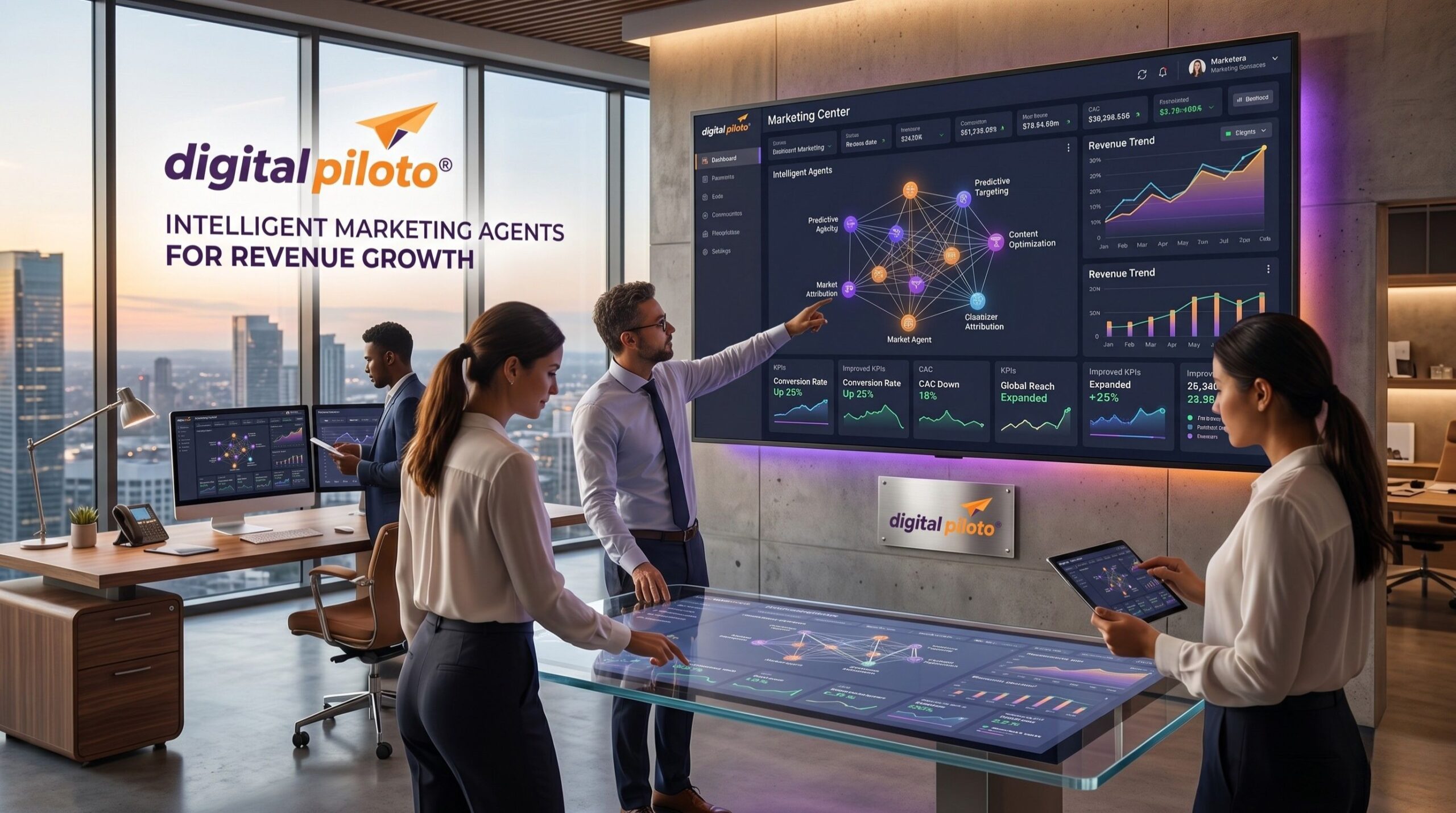
Intelligent marketing agents help businesses generate revenue by automating customer targeting, campaign optimization, lead nurturing, and personalized engagement in real time. These AI-driven systems analyze user behavior faster than manual teams, allowing brands to increase conversions while reducing wasted marketing spend. Businesses searching for a reliable digital marketing agency near me are increasingly prioritizing AI-enabled marketing solutions because they create measurable business outcomes rather than vanity metrics.
The shift is not just about automation anymore. Modern companies are using intelligent marketing agents to predict buying behavior, identify revenue opportunities, and deliver highly relevant experiences across email, search, social media, and paid campaigns. In competitive markets, speed and personalization often determine who wins the customer.
What Are Intelligent Marketing Agents?
Intelligent marketing agents are AI-powered systems designed to perform marketing tasks with minimal human intervention. They use machine learning, customer data, predictive analytics, and automation to improve marketing decisions continuously.
Definition in Simple Terms
An intelligent marketing agent acts like a digital strategist that studies customer behavior, learns from interactions, and adjusts campaigns automatically to improve results.
Core Functions of Intelligent Marketing Agents
- Analyze customer intent and online behavior
- Automate campaign execution across channels
- Optimize ad spending in real time
- Personalize messaging for different audience segments
- Predict future buying actions using behavioral data
Unlike traditional automation tools, these systems improve themselves through continuous learning. That makes them significantly more valuable for long-term revenue generation.
How Intelligent Marketing Agents Increase Revenue
The biggest advantage of intelligent marketing agents is their ability to connect marketing activities directly to revenue outcomes. Instead of relying on assumptions, businesses can make decisions using real-time data patterns.
1. Smarter Customer Targeting
AI agents can identify high-intent customers by analyzing browsing patterns, search behavior, engagement history, and demographic signals. This reduces wasted ad spend and improves conversion rates.
For example, an eCommerce business selling fitness equipment may discover that customers who watch product videos for more than 45 seconds are far more likely to purchase within 72 hours. An intelligent marketing agent can instantly retarget those users with customized offers.
2. Personalized Customer Journeys
Generic campaigns rarely perform well today. Customers expect brands to understand their preferences.
Intelligent marketing systems personalize:
- Email recommendations
- Website experiences
- Product suggestions
- Remarketing advertisements
- Content delivery timing
Personalization improves engagement because customers feel the communication is relevant rather than promotional.
3. Real-Time Campaign Optimization
Traditional campaign optimization often happens days or weeks later. AI marketing agents optimize campaigns instantly.
They automatically adjust:
- Ad bids
- Audience segments
- Keyword targeting
- Creative variations
- Budget allocation
This is particularly valuable for businesses working with a PPC company in Kolkata, where real-time optimization can significantly improve return on ad spend.
Step-by-Step: How Businesses Use Intelligent Marketing Agents
Step 1: Collect Customer Data
The AI system gathers information from websites, CRM tools, social media platforms, paid ads, and customer interactions.
Step 2: Analyze Behavioral Patterns
The system identifies trends such as purchase intent, customer preferences, and engagement timing.
Step 3: Create Automated Strategies
AI agents build audience segments and personalize campaigns automatically.
Step 4: Launch and Monitor Campaigns
Campaigns are executed across channels while the system continuously monitors performance metrics.
Step 5: Optimize for Revenue
The intelligent agent reallocates resources toward strategies generating the highest revenue impact.
This continuous optimization cycle creates a major competitive advantage for businesses adopting AI-driven marketing earlier than competitors.
Why Intelligent Marketing Agents Matter in 2026
Consumer attention spans are shrinking, advertising costs are rising, and competition is becoming more aggressive. Businesses can no longer depend solely on manual marketing processes.
Intelligent marketing agents help companies respond faster to changing customer behavior. They reduce delays between data collection and action, which is often where revenue opportunities are lost.
Another important factor is scalability. A small business can now compete more effectively against larger brands because AI systems automate complex marketing tasks that once required large teams.
Common Business Areas Where AI Marketing Agents Deliver Results
Lead Generation
AI systems identify and prioritize high-quality leads based on behavioral intent rather than basic demographic assumptions.
Content Marketing
AI tools analyze content performance and recommend topics likely to generate engagement and conversions.
Search Engine Optimization
Brands investing in SEO services In Kolkata are increasingly using AI-driven search insights to improve visibility, keyword targeting, and content performance.
Email Automation
Intelligent systems determine the best time, format, and messaging approach for higher email open and click-through rates.
Customer Retention
AI agents can predict churn risks and trigger personalized retention campaigns before customers leave.
The Difference Between Automation and Intelligent Marketing
Many businesses confuse automation with intelligence. They are not the same.
| Traditional Automation | Intelligent Marketing Agents |
|---|---|
| Follows fixed rules | Learns from data continuously |
| Requires manual updates | Optimizes automatically |
| Limited personalization | Dynamic personalization |
| Reactive decisions | Predictive decision-making |
This distinction matters because businesses focused only on automation often miss the predictive power that drives actual revenue growth.
Challenges Businesses Should Prepare For
While intelligent marketing agents offer major advantages, implementation requires careful planning.
Data Quality Issues
AI systems are only as effective as the data they receive. Poor data quality leads to inaccurate decisions.
Human Oversight Still Matters
AI can optimize performance, but human creativity and brand understanding remain essential.
Privacy and Compliance
Businesses must ensure ethical data usage and compliance with evolving privacy regulations.
The most successful companies combine AI efficiency with human strategy rather than replacing marketers completely.
FAQs About Intelligent Marketing Agents
What is an intelligent marketing agent?
An intelligent marketing agent is an AI-powered system that automates and optimizes marketing activities using customer data and machine learning.
How do intelligent marketing agents generate revenue?
They improve targeting, personalization, campaign optimization, and customer engagement, leading to higher conversions and reduced marketing waste.
Are intelligent marketing agents only for large businesses?
No. Small and medium-sized businesses can also use AI marketing systems to scale operations and compete more effectively.
Can AI marketing agents replace human marketers?
No. AI enhances efficiency and decision-making, but human creativity, strategy, and emotional understanding are still essential.
Which industries benefit most from intelligent marketing agents?
e-Commerce, SaaS, healthcare, finance, education, and service-based businesses commonly achieve strong results with AI-driven marketing systems.
Conclusion
Intelligent marketing agents are no longer experimental tools reserved for enterprise brands. They have become practical revenue-generation systems that help businesses make smarter decisions, personalize customer experiences, and improve marketing efficiency at scale. Companies that adopt AI strategically today are positioning themselves for stronger customer relationships and more predictable growth tomorrow.
Blog Development Credits:
This article was strategically developed through expert research and AI-assisted content refinement inspired by the insights of Amlan Maiti. Final editorial improvements, optimization, and SEO structuring were completed by Digital Piloto Private Limited.