

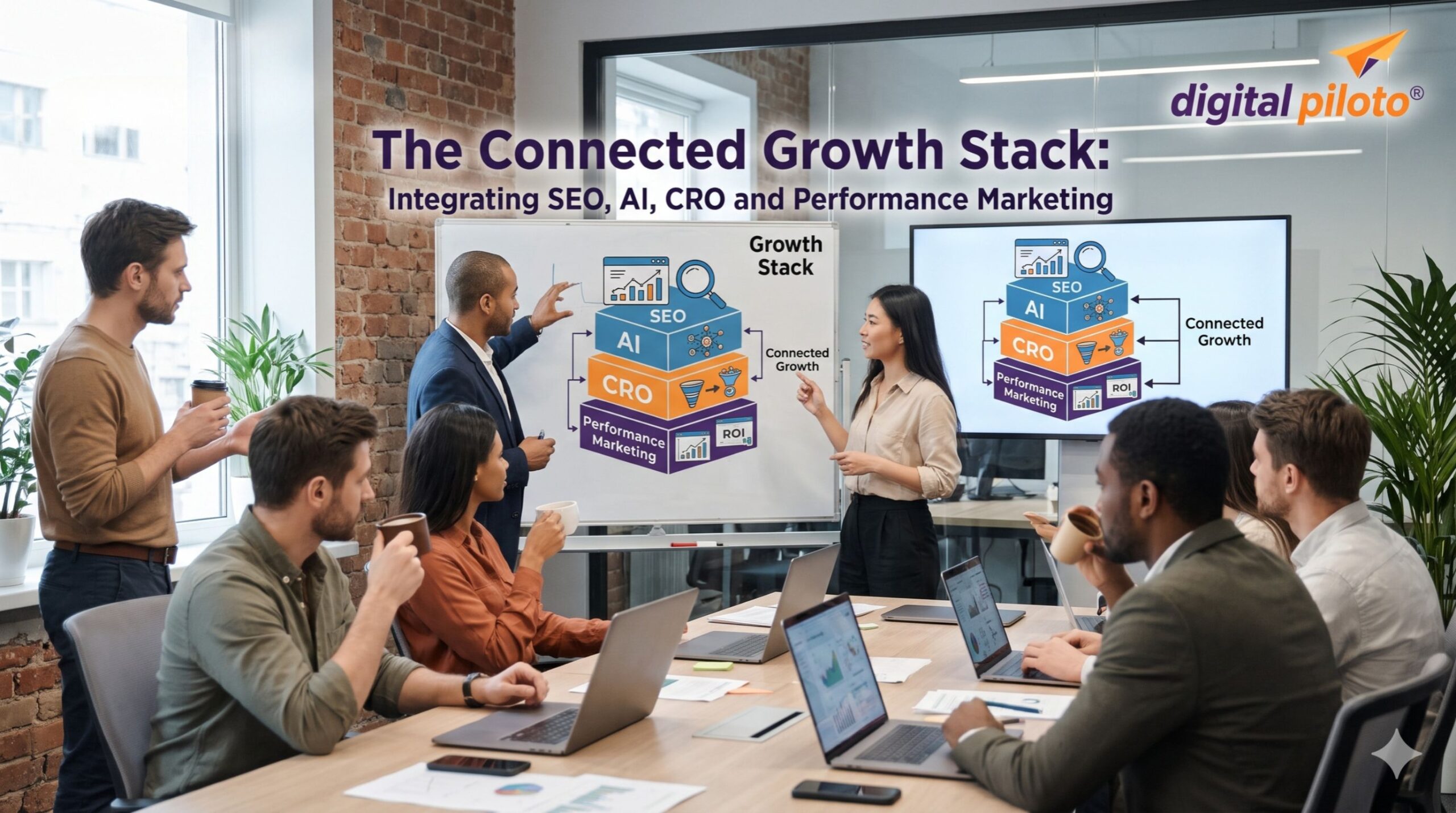
Businesses rarely struggle because they have no marketing channels. More often, they struggle because those channels work independently. SEO attracts visitors, paid campaigns generate clicks, AI produces insights, and conversion optimisation improves websites—but disconnected efforts rarely deliver their full potential. Sustainable growth begins when these activities share information, coordinate decisions, and work towards the same commercial outcome.
A modern digital marketing company in India must therefore think beyond individual campaigns. The objective is to build a connected growth stack where search visibility, intelligent automation, customer experience, and performance marketing reinforce one another instead of competing for attention and budget.
Why Marketing Channels Need to Work Together
Consider a business spending money on Google Ads while publishing SEO articles every week. Its website receives traffic, but enquiries remain disappointing. The SEO team blames the landing pages, the paid media team asks for a higher budget, and the website team requests more time for redesign. Everyone may be doing their job, yet the business is still losing potential customers.
The problem might be much simpler: visitors are arriving with one expectation and finding something different on the website. Perhaps the advertisement promises a quick consultation, while the landing page hides the contact form. Or the organic article answers an informational question but immediately pushes a sales message before establishing trust.
A connected growth strategy looks at the entire journey. It asks how people discover a brand, what information they need, what makes them hesitate, and which experience finally encourages them to act.
That is why SEO, artificial intelligence, conversion rate optimisation (CRO), and performance marketing should be treated as connected capabilities. Each contributes a different strength, but the real value appears when insights move between them.
Understanding the Four Drivers of Connected Growth
1. SEO creates sustainable discovery
Search engine optimisation helps a business become visible when people are actively looking for information, products, or services. It includes technical website health, useful content, keyword research, internal linking, local visibility, and authority building.
However, SEO should not be judged only by rankings or traffic. A page attracting thousands of irrelevant visitors may contribute less to revenue than a focused service page bringing in a smaller number of qualified prospects.
In a connected stack, SEO identifies customer questions and search intent. Those insights can inform paid advertising messages, content development, landing-page structure, and even the language used by sales teams.
2. AI turns information into actionable intelligence
AI can help marketing teams analyse large datasets, identify patterns, group customer queries, generate content variations, and automate repetitive tasks. Predictive models may also help estimate which leads are more likely to convert or which customers may need additional engagement.
But AI is only as useful as the information and instructions behind it. If advertising data, CRM records, website analytics, and customer interactions are disconnected, automated recommendations may be incomplete or misleading.
Think of AI as an intelligent assistant that can process information quickly. It still needs accurate business context and human oversight to make its output useful.
3. CRO converts attention into action
Conversion rate optimisation focuses on what happens after a visitor reaches the website. It examines whether people can understand the offer, find relevant information, trust the business, and complete the next step without unnecessary friction.
Small improvements can matter. A clearer headline, a shorter enquiry form, stronger proof points, faster page loading, or a more visible call to action may improve the visitor experience.
CRO also helps other channels. When a landing page performs better, paid campaigns can generate more value from the same advertising spend, while organic traffic has a better chance of producing enquiries.
4. Performance marketing accelerates measurable demand
Performance marketing uses paid channels such as search advertising, social media campaigns, display placements, and retargeting to reach defined audiences and drive measurable actions.
Its strength is speed and control. Businesses can test audiences, messages, offers, and budgets without waiting months for organic visibility to develop. Yet paid traffic becomes expensive when the campaign promise, landing-page experience, and actual customer need do not match.
Connected performance marketing uses insights from SEO and CRO to improve targeting and creative decisions. It also shares campaign results with the wider growth team, helping everyone understand which audiences and messages generate meaningful business outcomes.
Build the Data Foundation Before Adding More Tools
It is tempting to assume that integration means buying another dashboard or marketing platform. In reality, the first step is deciding which information the business needs to share.
Salesforce’s State of Marketing research highlights the challenge of connecting customer information across systems. Its report notes that marketing organisations use an average of at least seven data sources, while only around one-quarter of marketers are completely satisfied with how they unify customer data. The finding illustrates an important point: collecting information is not the same as making it useful across teams.
A practical growth stack should connect essential information such as:
- Discovery data: Search queries, organic landing pages, keyword performance, and referral sources.
- Campaign data: Advertising spend, impressions, clicks, audience segments, and campaign conversions.
- Behavioural data: Page interactions, form abandonment, navigation patterns, and engagement signals.
- Customer data: Enquiries, lead quality, sales outcomes, repeat purchases, and customer lifetime value.
Not every business needs an expensive enterprise platform to achieve this. A carefully connected analytics setup, CRM, advertising accounts, and reporting system may be enough to begin. What matters is consistency: teams should use shared definitions for leads, conversions, qualified enquiries, and revenue.
Connect the Customer Journey, Not Just the Software
Technology integration is useful, but customer journey integration is the bigger goal. A person may first discover a company through an organic article, return after seeing a social advertisement, compare service options, and finally submit an enquiry after reading a case study.
If every channel measures success independently, the business may give all the credit to the final advertisement and overlook the earlier interactions that built trust.
A connected approach maps the journey from discovery to conversion and retention. It considers what information a customer needs at each stage and which channel is best placed to provide it.
For example, a technology solutions company may use educational SEO content to explain a business problem, AI-assisted analysis to identify relevant audience segments, paid campaigns to promote a solution, and CRO experiments to make the enquiry process easier.
A technology solutions company in India can benefit from this joined-up approach by aligning its website, digital campaigns, customer information, and automation processes around a consistent business experience.
A Practical Framework for Integrating the Growth Stack
Integration does not need to happen everywhere at once. In fact, trying to connect every platform, report, and workflow simultaneously can create unnecessary complexity. A phased approach is usually easier to manage.
- Choose a shared growth objective. Start with a commercial goal such as qualified enquiries, online sales, recurring revenue, or lower customer acquisition cost. Avoid giving every team a separate definition of success.
- Map the customer journey. Identify how people discover the business, what influences their decisions, where they hesitate, and which actions lead to conversion.
- Connect essential data. Bring together analytics, CRM, advertising, and website information where practical. Check tracking accuracy before using the data for major decisions.
- Use AI for focused tasks. Begin with specific applications such as lead categorisation, search-query analysis, content research, or campaign reporting. Review outputs before acting on them.
- Run CRO experiments. Test meaningful changes to headlines, page layouts, forms, offers, and calls to action. Change one important variable at a time where possible.
- Redistribute budgets using evidence. Compare channels using lead quality and revenue contribution, not just clicks or impressions. Keep testing rather than assuming past performance will continue.
This framework gives teams a repeatable process. It also reduces the familiar situation where marketing decisions are made using incomplete reports or isolated channel metrics.
Measure Growth With Metrics That Reflect Business Value
A connected growth stack needs a balanced measurement system. Traffic and impressions remain useful diagnostic indicators, but they should not become the final definition of success.
Consider tracking these measures together:
- Customer acquisition cost (CAC): How much does the business spend to acquire a customer?
- Conversion rate: What proportion of relevant visitors complete the desired action?
- Lead quality: How many enquiries match the business’s target customer profile?
- Return on advertising spend (ROAS): How much attributed revenue is generated relative to advertising expenditure?
- Customer lifetime value (CLV): What is the longer-term value of customers acquired through different channels?
These metrics should be interpreted together. For instance, a campaign may produce a low cost per lead but attract people who rarely become paying customers. Another campaign may cost more initially but generate higher-value clients.
Attribution also deserves careful attention. Customers often interact with several channels before converting, and no measurement model captures every influence perfectly. Use attribution reports as decision-making aids, not unquestionable proof that one channel deserves all the credit.
Common Mistakes That Weaken an Integrated Strategy
Even businesses with good tools can struggle when the operating approach is fragmented. A few mistakes appear repeatedly:
- Adding tools without a clear purpose: More platforms can increase costs and reporting complexity without improving decisions.
- Automating unreliable processes: AI and marketing automation can amplify inaccurate data or poorly designed workflows.
- Optimising for vanity metrics: High traffic and impressive click-through rates do not automatically translate into profitable growth.
- Ignoring the landing-page experience: Advertising cannot compensate indefinitely for unclear messaging or a difficult conversion process.
- Keeping teams in separate reporting systems: When SEO, paid media, sales, and CRO teams use different definitions, useful insights get lost.
Businesses seeking the best SEO services in India should look for a strategy that connects organic visibility with conversion goals and wider marketing performance. Search optimisation is most valuable when it contributes to a measurable customer journey rather than operating as an isolated activity.
FAQs
1. What is a connected growth stack?
A connected growth stack is an integrated marketing approach that brings SEO, AI, CRO, performance advertising, analytics, and customer data together to improve discovery, conversions, and business growth.
2. Why should SEO and performance marketing work together?
SEO reveals customer search intent and the topics that attract relevant visitors. Performance marketing can use these insights to improve audience targeting, ad messaging, and campaign landing pages. Both channels also contribute useful performance data.
3. How does AI improve marketing integration?
AI can analyse data, identify patterns, support audience segmentation, automate repetitive tasks, and assist with campaign optimisation. Its effectiveness depends on reliable data, suitable processes, and human oversight.
4. What should a business measure in an integrated growth strategy?
Businesses should monitor qualified leads, conversion rates, customer acquisition cost, revenue contribution, return on advertising spend, and customer lifetime value alongside traffic and engagement metrics.
Final Thoughts
Growth rarely comes from one channel doing everything perfectly. It comes from several capabilities working intelligently together. SEO attracts the right attention, AI helps teams understand and act on information, CRO improves the experience, and performance marketing expands reach. Connect these strengths around shared customer and revenue goals, and marketing becomes less like a collection of campaigns—and more like a dependable growth engine.
Blog Development Credits
Concept development was led by Amlan Maiti, with research and drafting assistance from ChatGPT, Google Gemini, and Copilot, followed by SEO refinement from Digital Piloto Private Limited.