
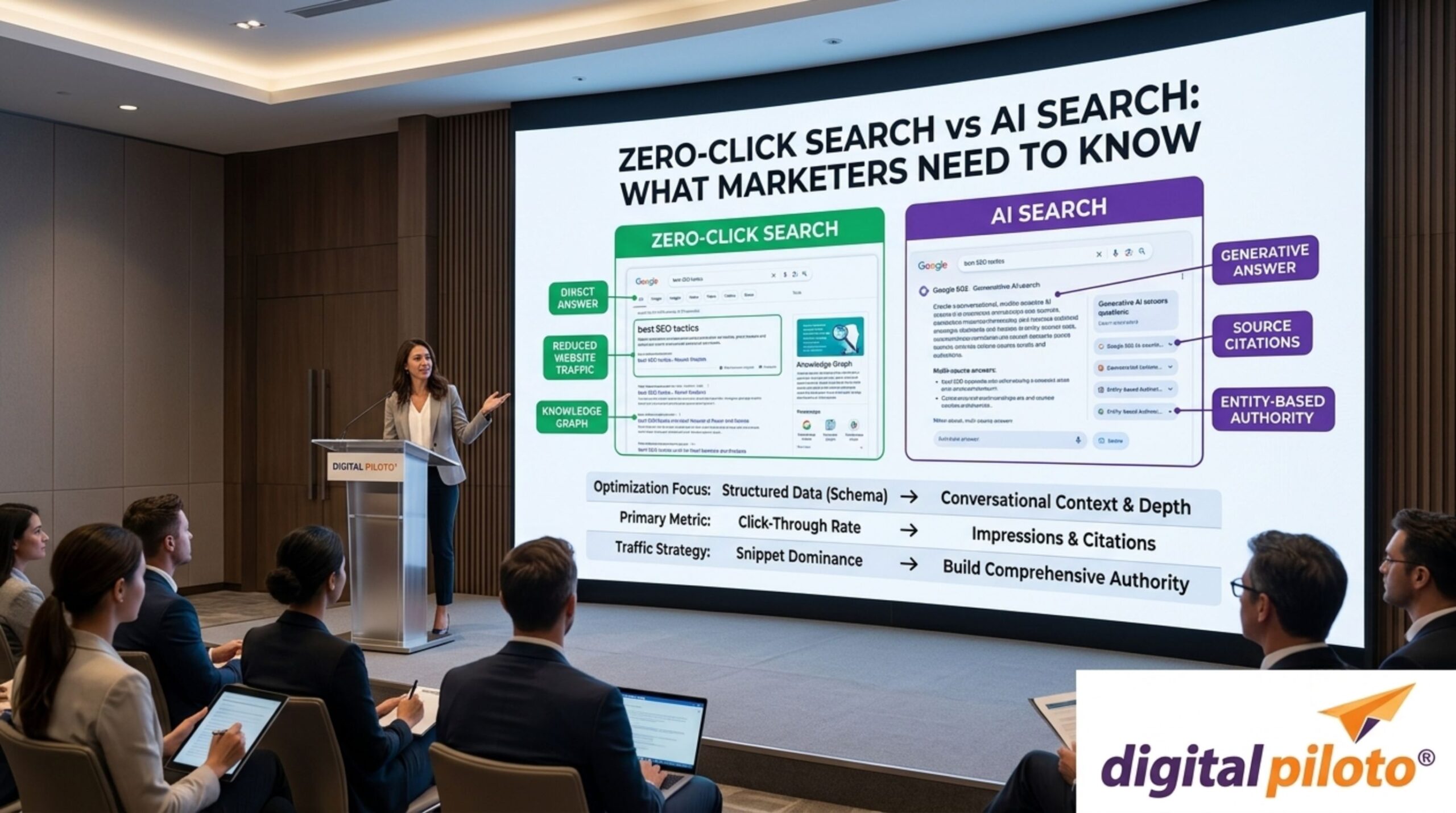
Zero-click search and AI search both reduce the need for users to visit traditional search results, but they do it differently. Zero-click search answers a query directly on the search results page, while AI search can synthesize information, compare sources, and guide users through a decision. For marketers, the difference changes what visibility and success actually mean.
This is why a modern SEO company cannot focus only on rankings and website clicks. The real challenge is earning visibility wherever the answer is formed, whether that means a featured snippet, a knowledge panel, an AI-generated response, or a traditional organic listing.
What Is Zero-Click Search?
Zero-click search is a search experience where users get the information they need directly from the results page without clicking through to another website.
Google has supported this behavior through features such as featured snippets, knowledge panels, local packs, calculators, weather information, and other search-result enhancements.
For example, someone searching “What is the capital of Japan?” does not need to visit a website if the answer is already displayed prominently in the results.
For marketers, this creates a familiar tension: visibility can increase while website traffic does not.
What Is AI Search?
AI search uses generative AI to interpret a user’s intent and produce a synthesized answer, often drawing on information from multiple sources.
Instead of simply presenting a ranked list of pages, an AI search experience can explain a topic, compare alternatives, summarize evidence, ask follow-up questions, and help users move toward a decision.
That makes AI search fundamentally more conversational and exploratory than many traditional zero-click experiences.
Zero-Click Search vs AI Search: The Key Difference
The simplest distinction is this: zero-click search removes the need for a click, while AI search can remove the need to browse through multiple sources.
- Zero-click search: Usually provides a direct answer or information element within the search results.
- AI search: Generates a contextual response based on information retrieved or synthesized from multiple sources.
- User behavior: Zero-click often satisfies a narrow question; AI search can support a longer research journey.
- Marketing challenge: Both require brands to become visible without relying entirely on website visits.
This distinction matters because the same SEO strategy will not necessarily perform equally well in both environments.
Why AI Search Changes the Zero-Click Problem
Traditional zero-click optimization often focuses on owning a specific answer. AI search expands the battlefield.
A user might ask, “What are the best CRM platforms for a growing B2B company?” The AI response may consider pricing, integrations, use cases, reputation, features, and customer feedback before presenting a recommendation.
A brand therefore needs more than one perfectly optimized page. It needs a credible digital footprint that gives AI systems enough context to understand the company and its offering.
How Marketers Should Think About Visibility
The old model was relatively straightforward: rank → attract click → convert.
The emerging model is closer to: be discovered → be understood → be mentioned → earn consideration → capture demand.
This does not make clicks irrelevant. It means clicks are becoming one part of a larger visibility system.
Three visibility layers to monitor
- Direct visibility: Organic rankings, paid listings, featured snippets, and local results.
- Answer visibility: Whether your brand, content, or expertise appears in AI-generated answers.
- Decision visibility: Whether your company is mentioned when users compare providers, products, or solutions.
The third layer is especially important for commercial searches. Being visible when someone asks “What is SEO?” is useful. Being considered when someone asks “Which SEO provider should my company hire?” can be far more valuable.
How to Optimize for Both Search Experiences
Step 1: Identify questions at every stage
Map the questions customers ask before, during, and after a purchase decision. Do not limit the research to high-volume keywords.
Step 2: Build answer-focused content
Give direct answers before adding deeper explanation. Use clear headings, concise definitions, examples, comparisons, and supporting evidence.
Step 3: Strengthen your brand entity
Make your company’s identity, services, expertise, locations, people, and relationships clear across your website and relevant external platforms.
Step 4: Create evidence, not filler
Original research, case studies, expert commentary, product documentation, customer experiences, and credible mentions can provide stronger signals than another generic 1,000-word article.
Step 5: Measure assisted visibility
Track branded searches, referral traffic, conversions, third-party mentions, AI references, and qualified leads alongside traditional rankings and clicks.
Where PPC Fits Into the New Search Landscape
Paid search remains valuable because not every user journey will be resolved through organic or AI-generated answers. Commercial intent still creates opportunities for immediate visibility.
A PPC agency in Kolkata, for example, can help a business capture high-intent searches while its organic strategy builds longer-term authority and answer visibility.
The smarter approach is not SEO versus PPC. It is understanding which channel should capture which stage of the customer’s decision process.
What Should Marketers Measure?
Click-through rate remains useful, but it should no longer be treated as the only proof of search performance.
A broader search visibility dashboard can include:
- Organic rankings and impressions
- Featured snippet and SERP feature presence
- Branded search volume
- AI search mentions and citations
- Qualified organic leads
- Conversion-assisted searches
- Share of visibility for important commercial questions
One practical test is simple: search the questions your sales team hears most often. Then check whether your company appears anywhere in the resulting answer ecosystem.
If competitors repeatedly appear while your brand is absent, the issue may not be rankings alone. It may be a lack of relevant, credible, and retrievable information about your business.
What This Means for Content Strategy
Content should increasingly be designed around decision usefulness, not just keyword coverage.
A strong digital marketing agency should help brands answer questions such as “Which solution is right for this situation?”, “What are the trade-offs?”, “How much does it typically cost?”, and “What should buyers evaluate before choosing a provider?”
That type of content has a better chance of remaining useful when search moves from keyword retrieval toward conversational decision support.
The Biggest Mistake to Avoid
The biggest mistake is treating zero-click and AI search as reasons to abandon traditional SEO.
Technical SEO, crawlability, quality content, internal linking, authority, structured data, and strong user experience still matter. AI systems need reliable information to retrieve and interpret, and much of that information still originates from the open web.
The strategy is therefore not to replace SEO. It is to expand the definition of search visibility.
FAQs
What is the difference between zero-click search and AI search?
Zero-click search provides an answer directly in the search results, while AI search generates a contextual response that may synthesize information from multiple sources.
Is zero-click search bad for SEO?
Not necessarily. A zero-click result can increase brand visibility and establish authority, although some informational searches may generate fewer website visits.
Does AI search replace traditional SEO?
No. Technical SEO, useful content, authority, structured information, and crawlability remain important foundations for both traditional and AI-powered search visibility.
How can businesses optimize for AI search?
Businesses should create clear, authoritative content, strengthen entity signals, answer customer questions directly, demonstrate expertise, and maintain consistent information across relevant sources.
Should marketers still track organic traffic?
Yes. Organic traffic remains an important performance metric, but it should be evaluated alongside rankings, qualified leads, branded demand, AI visibility, and assisted conversions.
Conclusion
Zero-click search taught marketers that visibility does not always end in a website visit. AI search takes that lesson further by making the answer itself a competitive space.
The brands that adapt will not simply chase clicks. They will build useful information, credible expertise, and strong digital signals that make them easy to discover, understand, and trust—wherever the customer chooses to search.
Blog Development Credit
This article was conceptualized by Amlan Maiti, researched with AI-assisted tools, and professionally refined through SEO expertise from Digital Piloto Private Limited.