

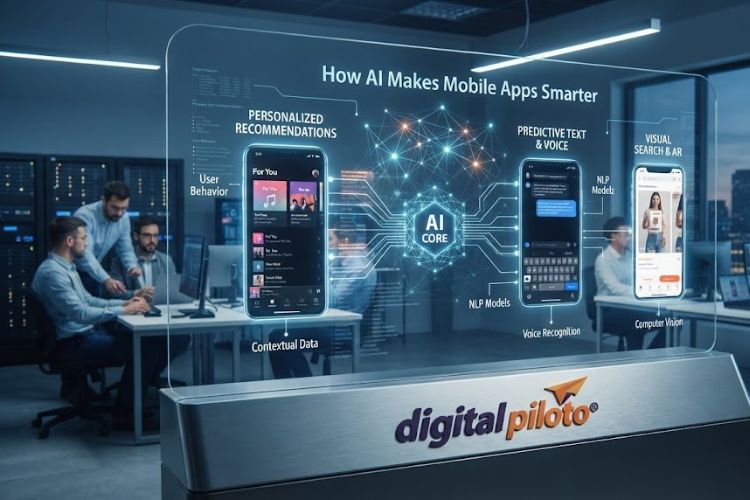
Artificial intelligence makes mobile apps more intelligent by enabling them to learn from user behavior, predict needs, automate decisions, and deliver personalized experiences in real time. Instead of functioning as static tools, AI-powered apps adapt continuously, becoming more useful and efficient with every interaction.
This shift is redefining what users expect from mobile experiences. Whether it is a shopping app recommending products or a fitness platform adjusting workout plans automatically, intelligence has become a competitive advantage. Businesses investing in Custom Software Development are increasingly prioritizing AI capabilities from the earliest stages of product planning.
What Makes an App Intelligent?
An intelligent mobile app uses artificial intelligence to analyze data, recognize patterns, make predictions, and improve experiences without requiring constant manual instructions.
Traditional apps follow predefined rules. Intelligent apps learn from interactions and adjust their behavior accordingly.
The difference is similar to comparing a calculator with a personal assistant. One responds to commands, while the other anticipates needs.
How Does AI Learn From User Behavior?
Every tap, search, purchase, and interaction generates valuable signals.
AI systems analyze these signals to understand preferences, habits, and intent.
For example:
- Streaming apps learn viewing preferences.
- Ecommerce apps understand buying behavior.
- Finance apps recognize spending patterns.
- Travel apps identify preferred destinations and booking habits.
The result is an experience that feels increasingly personal over time.
Personalization Is the Biggest Advantage
Personalization is often where users notice AI first.
Recommendation engines suggest products, playlists, articles, and services based on previous activity.
Instead of asking users to search endlessly, AI brings relevant content directly to them.
This not only improves engagement but also increases retention and conversions.
Predictive Features Are Changing User Expectations
Modern mobile users increasingly expect apps to think ahead.
AI makes this possible through predictive analytics.
Examples include:
- Calendar apps suggesting meeting times.
- Navigation apps predicting traffic delays.
- Retail apps forecasting inventory demand.
- Health apps identifying potential risks based on trends.
Prediction reduces friction and creates smoother user journeys.
How AI Improves Mobile Security
Security is another area where AI is quietly transforming mobile experiences.
AI systems can identify unusual behavior patterns that may indicate fraud or unauthorized access.
Common applications include:
- Biometric authentication.
- Fraud detection algorithms.
- Behavior-based login verification.
- Suspicious transaction monitoring.
These protections often operate invisibly while improving user trust.
The Rise of Conversational Interfaces
Chatbots and voice assistants have evolved dramatically in recent years.
Instead of simply answering questions, modern assistants can complete tasks, understand context, and manage workflows.
This is one reason businesses building next-generation applications are increasingly investing in Custom AI Solutions that combine conversational intelligence with business automation.
Computer Vision Is Expanding Mobile Possibilities
AI-powered image recognition is creating entirely new app experiences.
Today, mobile apps can:
- Identify products from photos.
- Translate text using cameras.
- Detect objects in real time.
- Support augmented reality experiences.
These capabilities were once considered experimental. They are quickly becoming standard features.
How Businesses Build Intelligent Apps: Step by Step
Step 1: Define the Problem
Successful AI features solve specific user problems rather than adding complexity.
Step 2: Collect Relevant Data
AI models require high-quality data to learn effectively.
Step 3: Choose the Right Model
Recommendation systems, language models, and predictive algorithms serve different purposes.
Step 4: Train and Improve Continuously
AI systems become more accurate through ongoing learning and refinement.
Step 5: Monitor User Feedback
The most intelligent apps evolve alongside user expectations.
Why AI Is Becoming Essential for App Development
Consumers now compare every digital experience with the best applications they use daily.
If a music app understands preferences instantly, users begin expecting similar intelligence elsewhere.
This growing expectation is pushing businesses involved in Custom App Development to integrate machine learning, predictive analytics, and automation capabilities directly into product roadmaps.
Challenges Businesses Must Consider
AI creates opportunities, but implementation requires careful planning.
- Data privacy regulations.
- Model accuracy requirements.
- Infrastructure costs.
- Bias prevention and fairness.
- Transparent decision-making processes.
The goal should always be useful intelligence rather than technology for its own sake.
Frequently Asked Questions
How does AI improve mobile apps?
AI improves apps through personalization, automation, predictions, and smarter recommendations.
What industries benefit most from AI-powered apps?
Healthcare, finance, ecommerce, education, and logistics are among the largest beneficiaries.
Do AI mobile apps require internet connectivity?
Not always. Many AI models can now run directly on mobile devices using edge computing.
Is AI development expensive for mobile applications?
Costs vary depending on complexity, data requirements, and infrastructure needs.
Will AI replace traditional mobile app features?
No. AI enhances traditional functionality rather than replacing it completely.
Conclusion
The future of mobile applications is unlikely to be defined by more features alone. It will be defined by better decisions, deeper personalization, and experiences that adapt naturally to users. AI is turning mobile apps from tools people use into systems that actively help people succeed.
Blog development credits
This article was inspired by the strategic insights of Amlan Maiti, developed with research support from advanced AI technologies including ChatGPT, Gemini, and Copilot, and refined with optimization expertise from Digital Piloto Private Limited.