
Practical experiences make school education more meaningful by helping children connect classroom knowledge with real-life situations. Through experiments, projects, creative activities and collaborative tasks, students learn to ask questions, solve problems and apply what they know. Ruby Park Public School recognises the importance of a learning environment where children can develop understanding, confidence and essential skills alongside academic knowledge.
What Is Learning by Doing in School Education?
Learning by doing is an educational approach in which students actively participate in the learning process instead of relying entirely on listening, reading or memorising information. Children explore ideas, test possibilities, observe results and reflect on what they discover.
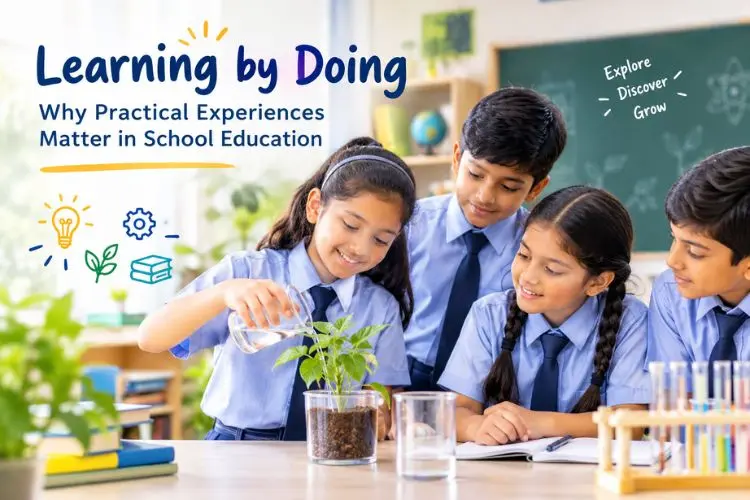
For example, a student studying plant growth may understand the concept more clearly by growing a seed, recording its progress and comparing the effects of sunlight and water. The textbook provides the explanation, while the activity makes the concept tangible.
This approach does not replace traditional classroom teaching. Instead, it complements lessons by giving students opportunities to experience and apply the knowledge they acquire.
Why Do Practical Experiences Matter for Children?
Children often understand a concept differently when they experience it themselves. Practical learning helps bridge the gap between knowing a fact and understanding how it works in everyday life.
1. It Develops Deeper Understanding
Memorised information can be difficult to apply in unfamiliar situations. Practical activities encourage children to explore why something happens, not simply remember the answer.
When students measure classroom objects during a mathematics activity, for instance, they begin to see measurement as a useful everyday skill rather than an abstract calculation.
2. It Encourages Independent Thinking
Activities involving observation, experimentation and problem-solving give children room to make decisions. They learn to consider different possibilities, recognise mistakes and adjust their approach.
These experiences gradually build confidence. Students become more willing to ask questions, share ideas and attempt unfamiliar tasks without expecting an immediate answer from someone else.
3. It Strengthens Communication and Teamwork
Group projects teach children how to listen, explain their reasoning, divide responsibilities and work towards a shared outcome. These skills matter both inside and outside school.
Building a simple model together, for example, requires students to discuss their ideas, resolve disagreements and coordinate their efforts. The finished project is valuable, but the learning that happens during collaboration is equally important.
4. It Makes Learning More Engaging
Practical tasks introduce variety into classroom routines. Students who struggle to connect with a topic through written explanations may discover a new interest when they can explore it through experiments, demonstrations or creative work.
Engagement does not mean every activity must be entertaining. It means students have a meaningful reason to participate, think and discover.
How Can Schools Make Learning More Practical?
Effective practical education does not always require expensive equipment or elaborate facilities. Well-planned activities using accessible materials can make lessons more interactive, relevant and memorable.
- Science: Conduct simple experiments, observe changes in materials and maintain records of findings.
- Mathematics: Use shopping simulations, measuring activities and classroom surveys to apply numbers and calculations.
- Language: Encourage storytelling, role-play, presentations and classroom discussions to develop expression and listening skills.
- Environmental studies: Explore plants, waste segregation, water conservation and responsible everyday habits.
- Creative projects: Use drawing, model-making and design challenges to develop imagination and practical problem-solving.
The most effective activities have a clear learning objective. A project should help students understand a concept or develop a skill, rather than simply produce an attractive display.
How Does Practical Learning Work Step by Step?
A structured approach helps teachers turn activities into genuine learning experiences. These five steps provide a useful framework.
- Introduce a question: Begin with a concept or everyday problem that encourages curiosity. For example, ask why some objects float while others sink.
- Invite predictions: Let students explain what they think will happen and why. This reveals their existing understanding.
- Explore through activity: Give students an opportunity to test their ideas through a suitable experiment, demonstration or project.
- Discuss the results: Compare observations with predictions and help students understand the reasons behind the outcome.
- Apply the learning: Ask students to use the concept in a new example, explain it in their own words or suggest a real-life application.
This cycle makes the activity purposeful. It also helps teachers identify misunderstandings before students move to more advanced concepts.
What Should Parents Look for in a School’s Learning Approach?
When exploring schools, parents should look beyond activity photographs or impressive project displays. The important question is whether practical experiences genuinely support children’s understanding and development.
Families considering a CBSE School in Taratala Kolkata can look for an educational approach that balances academic learning with opportunities to explore, question and apply knowledge.
Here are four useful indicators to consider:
- Purposeful classroom activities: Teachers explain what students are expected to learn from an experiment or project.
- Active student participation: Children get opportunities to investigate and contribute ideas instead of only watching demonstrations.
- Constructive feedback: Teachers discuss mistakes and guide students towards better understanding.
- Balanced development: The school supports academic progress alongside communication, creativity, responsibility and collaboration.
Parents researching CBSE school admission in Kolkata can also ask how classroom activities are incorporated into everyday teaching, how student progress is assessed and what opportunities children have to participate in projects.
How Can Practical Learning Support Early Childhood Development?
In the early years, children learn a great deal through play, movement, conversation and exploration. Sorting objects by colour, counting blocks, listening to stories and participating in pretend-play activities can strengthen foundational skills.
For young learners, these experiences help develop language, coordination, early mathematical thinking and social awareness. They also allow children to learn at a manageable pace through repetition and discovery.
Parents exploring nursery admission should therefore consider whether a school’s early-learning environment encourages age-appropriate exploration alongside routines, emotional security and foundational learning.
Does Practical Learning Replace Academic Study?
No. Practical learning works best when it complements structured teaching, reading, discussion and written practice. Students still need subject knowledge, clear explanations and opportunities to practise essential skills.
The difference lies in how that knowledge is reinforced. Reading about a scientific principle builds understanding, while conducting an experiment can help students examine it in action. Combining the two gives children more than one way to approach a concept.
Assessment should also reflect this balance. Written tests can measure certain kinds of understanding, while presentations, observations and projects can reveal how students apply knowledge, explain their reasoning and work through challenges.
Frequently Asked Questions
Q. What is learning by doing in education?
A. Learning by doing is an approach in which students understand concepts through practical activities, experiments, projects and real-world applications rather than relying only on memorisation.
Q. What are examples of practical learning activities?
A. Examples include science experiments, gardening, measuring objects, role-play, model-making, classroom surveys and group problem-solving projects.
Q. How does practical learning benefit school students?
A. It can improve conceptual understanding, encourage curiosity, develop problem-solving skills and strengthen communication, teamwork and independent thinking.
Q. Is practical learning suitable for nursery students?
A. Yes. Age-appropriate activities such as sorting, counting, storytelling, drawing and guided play can help nursery students develop foundational language, mathematical, motor and social skills.
Q. How can parents identify a school that encourages practical learning?
A. Parents can ask about classroom projects, hands-on activities, student participation, teacher feedback and how practical experiences connect with the curriculum.
Conclusion
Meaningful school education should help children understand ideas, use their knowledge and develop the confidence to face unfamiliar challenges. Practical experiences make this possible by turning lessons into opportunities for exploration and reflection.
For parents choosing a school, the goal is not simply to find a place where children stay busy, but one where every activity has a learning purpose. When classroom teaching and hands-on experiences work together, children are better equipped to become curious learners, thoughtful problem-solvers and confident individuals.
Blog Development Credit:
This article was developed using insights from current education research and content trends, including perspectives from CBSE, the Ministry of Education, UNESCO, ChatGPT and Google Gemini. The content strategy, SEO optimisation and final publishing were managed by Ruby Park Public School.