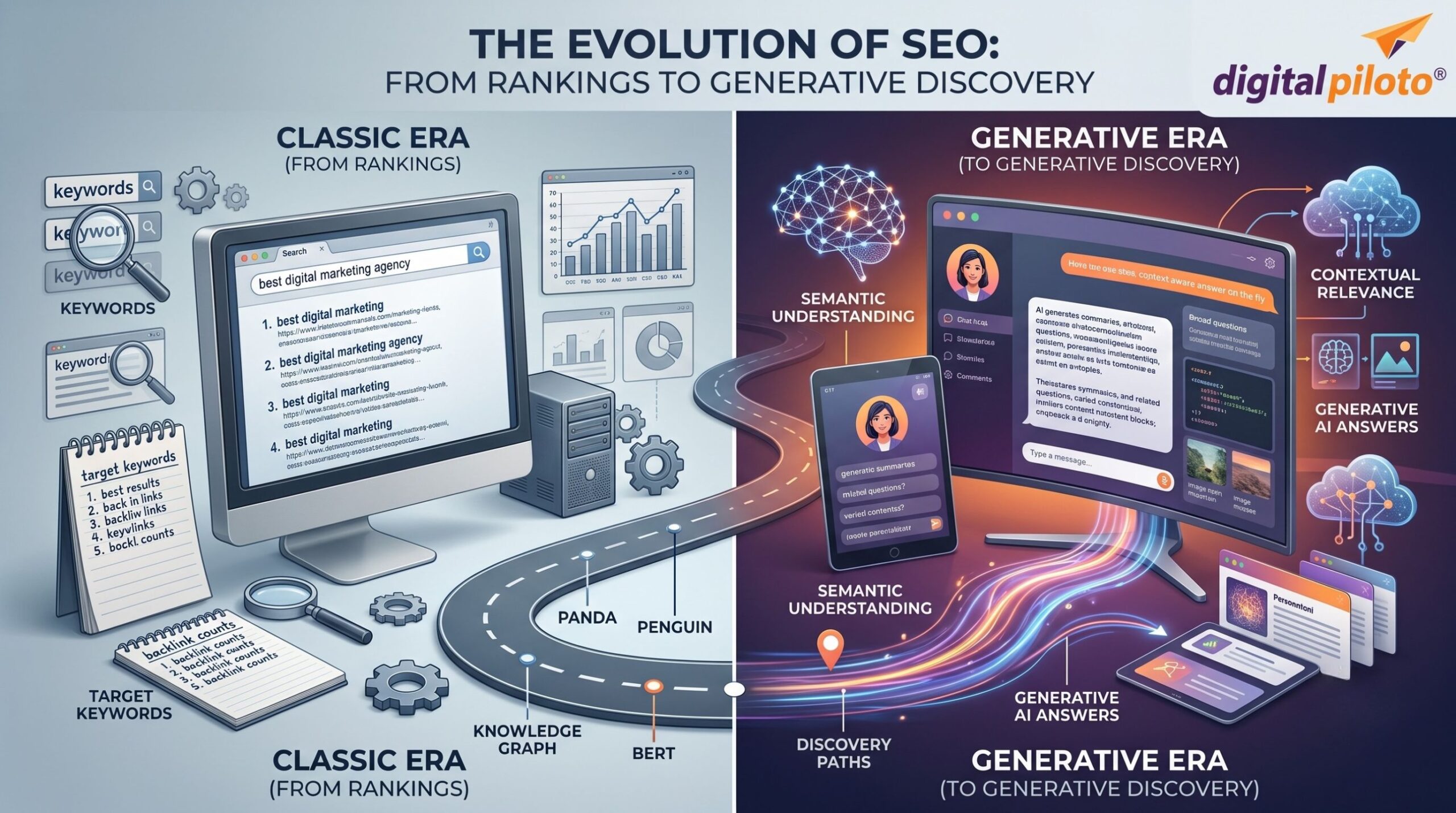


Search behaviour rarely stays still. A person researching a laptop today may search for comparisons tomorrow, pricing next week, and nearby sellers after that. Predictive SEO tries to understand that movement before it happens. Instead of asking only what people search now, marketers use data, AI and behavioural signals to anticipate what users may want next.
What Is Predictive SEO?
Predictive SEO is an approach to search optimization that uses historical search data, audience behaviour, market trends and artificial intelligence to identify likely future search demand.
Traditional SEO often works backwards. A keyword gains traction, marketers notice it, create content around it and compete for rankings. Predictive SEO flips the sequence. It asks: What will people probably search for next?
Think of it like stocking a neighbourhood grocery store. A shopkeeper does not wait until every customer asks for umbrellas before ordering them during monsoon season. Experience, weather, timing and past sales provide clues. Search marketers can use a similar principle, although the signals are much more complex.
A capable SEO company can use these insights to move beyond reactive keyword targeting and build content around emerging customer needs.
Why Search Prediction Matters More Now
Search has become increasingly dynamic. People do not necessarily begin and end their buying journey with one Google query. They may discover a topic through social media, ask an AI assistant for clarification, compare products through search, read reviews and then return with a highly specific commercial query.
Google’s own documentation explains that its systems use multiple signals and systems to understand queries, content and relevance. Its AI search experiences can also fan out a question into related searches to explore different aspects of a topic before generating a response. Google Search Central provides guidance on how AI features interact with search.
This creates an interesting opportunity. The valuable keyword may not be the one generating the most searches today. It could be the question that is beginning to emerge around a product, problem, technology or customer concern.
How AI Predicts Future Search Behaviour
AI does not possess a crystal ball. Predictive SEO is better understood as pattern recognition at scale.
Machine-learning systems can process large amounts of historical and current information to identify relationships that may be difficult to spot manually. Search marketers can then combine those insights with business knowledge and editorial judgement.
1. Historical search patterns
Past search behaviour can reveal recurring cycles. Travel searches increase before holiday periods. Tax-related queries tend to rise around relevant deadlines. Searches for certain consumer products may follow predictable seasonal patterns.
Historical data does not guarantee what happens next, but it can establish a useful baseline.
2. Emerging topics and trend signals
New technologies, policy changes, product launches and cultural shifts can create entirely new search categories.
Consider the early stages of a new technology. At first, people may search for “what is it?” Later, searches shift toward “how does it work?”, “is it safe?”, “best tools”, “pricing” and eventually brand-specific or transactional queries.
The sequence itself becomes a strategic clue.
3. Customer journey signals
A user’s next search is often connected to their previous question.
Someone searching for “how to choose solar panels” may soon search for installation costs, maintenance requirements, local providers or financing. Understanding these transitions can help businesses create a connected content journey rather than a collection of unrelated articles.
4. Real-time behaviour
AI can also process rapidly changing signals. Trending subjects, news events, product interest and shifts in online conversations can indicate that a previously insignificant topic is becoming important.
Google Trends, for example, allows users to explore search interest over time and compare topics, terms and geographic areas. Google Trends can therefore be a useful starting point for identifying changes in search demand.
From Keywords to Search Sequences
This is perhaps the most important conceptual shift.
Instead of building an SEO plan around isolated keywords, predictive SEO looks at search sequences.
Imagine a customer considering an electric vehicle. Their journey might look something like this:
- Discovery: “Are electric cars practical for city driving?”
- Education: “How long do EV batteries last?”
- Comparison: “Best EV under ₹20 lakh.”
- Evaluation: “EV charging cost in Kolkata.”
- Local intent: “EV dealers near me.”
- Action: “Book EV test drive.”
Each query reflects a different level of intent. A business that understands the sequence can prepare useful content before the customer reaches the next stage.
That is considerably more powerful than publishing another generic article simply because a keyword has high monthly search volume.
Predictive SEO and Search Intent
Search intent has always mattered in SEO. Predictive SEO simply takes the idea one step further.
Instead of asking, “What does this person want from this query?” marketers can also ask, “What are they likely to want after they get this answer?”
For example, someone searching for “best CRM features for small businesses” is probably not finished researching after reading one article. Their next questions might involve implementation, pricing, integrations, migration or comparisons.
A strong content strategy anticipates those questions without forcing the reader through artificial pages.
This creates what could be called a predictive content map—a network of resources designed around the natural progression of customer curiosity.
Where Generative Search Changes the Game
AI-powered search makes predictive thinking even more relevant because users can now ask longer, more contextual questions and continue the conversation.
Instead of searching five separate keywords, someone might ask an AI system a detailed question and then follow up with, “What about the cheaper option?” or “Which of these is available near me?”
This means the journey can become conversational rather than a series of disconnected searches.
Businesses should therefore think about generative AI search engine optimization as part of a broader strategy for being discoverable throughout these evolving information journeys.
Google says its AI features can use a “query fan-out” approach, issuing multiple related searches to gather supporting information for a response. That makes topical depth and the ability to answer related questions increasingly valuable. Google’s AI features documentation explains this process in more detail.
What Data Should Marketers Watch?
Predictive SEO becomes useful when marketers combine several signals rather than trusting a single metric.
- Search trends: Look for topics whose interest is steadily increasing rather than chasing every short-lived spike.
- Search-console behaviour: Examine queries that are already generating impressions but have not yet become major traffic drivers.
- Content gaps: Identify questions customers ask that existing pages barely address.
- Internal site searches: Your own visitors can reveal future content opportunities through the questions they type into your website.
- Sales and support conversations: Customer questions often appear in search later, especially when the underlying problem is becoming widespread.
The last point is frequently underestimated. A sales team might hear the same objection twenty times before it ever becomes a meaningful keyword. That conversation can be an early warning signal.
Building a Predictive SEO Workflow
Predictive SEO does not require an enormous data science department. A practical workflow can start with information marketers already have.
Step 1: Find today’s demand
Begin with existing search queries, customer questions and high-performing content. Establish what people are asking right now.
Step 2: Identify the next logical questions
Map the questions that naturally follow. What would someone need to know before making a decision? What uncertainty remains after reading your current content?
Step 3: Add external signals
Use trend data, industry developments, seasonal patterns and competitor movement to determine whether those questions are likely to become more important.
Step 4: Prioritize opportunities
Not every predicted topic deserves a 2,000-word article. Rank opportunities according to business value, relevance, expected demand and the organization’s ability to provide genuinely useful information.
Step 5: Publish before the spike
The objective is not to predict perfectly. It is to establish useful content early enough that search engines and audiences have time to discover it.
A digital marketing agency can help connect this process with wider content, paid media, conversion and customer acquisition strategies.
The Biggest Mistake: Confusing Prediction With Guesswork
There is a temptation to throw AI at a spreadsheet and ask it to produce “the next 100 keywords.” That is not really predictive SEO.
Prediction without context can produce a mountain of plausible-looking topics that nobody actually needs.
Human judgement still matters. A marketer understands the product, the customer, the market and the commercial priorities. AI is excellent at processing patterns, clustering information and surfacing relationships, but strategy determines which signals deserve action.
In practice, the strongest approach combines machine intelligence with human curiosity.
Why Search Forecasting Can Improve Content ROI
Publishing content after a topic becomes saturated can be expensive. Competition is already high, established websites may dominate the results and customers have dozens of similar resources to choose from.
Predictive SEO encourages businesses to identify demand earlier.
That can create several advantages:
- Earlier topical authority: Useful content can establish relevance before a subject becomes crowded.
- Better content planning: Editorial calendars become connected to customer journeys rather than arbitrary publishing schedules.
- Stronger commercial alignment: Emerging questions can be matched with products, services and genuine business expertise.
- Less keyword chasing: Teams can focus on meaningful themes instead of producing dozens of thin variations.
Of course, there is no guarantee that every prediction will be correct. Search behaviour is influenced by unexpected events, economic conditions, cultural shifts and changes in technology. The point is not perfect forecasting. It is making better-informed bets.
Frequently Asked Questions
What is predictive SEO?
Predictive SEO uses historical search data, behavioural patterns, trends, customer insights and AI-assisted analysis to anticipate topics and queries that users may search in the future.
How is predictive SEO different from traditional SEO?
Traditional SEO often responds to existing search demand by optimizing for known queries. Predictive SEO adds a forward-looking layer by identifying emerging needs and likely future search behaviour before those opportunities become obvious.
Can AI accurately predict future keywords?
AI can identify patterns and estimate likely opportunities, but it cannot guarantee future search behaviour. Predictions become more useful when combined with trend data, customer research, industry knowledge and human judgement.
Does predictive SEO work with AI search?
Yes. As search becomes more conversational and AI systems connect related queries, understanding the sequence of customer questions can help businesses create deeper, more useful content ecosystems.
Final Thoughts
The future of SEO may belong less to marketers who react fastest and more to those who notice what is changing before everyone else does. Predictive SEO turns search data into an early-warning system. It encourages businesses to follow curiosity, anticipate the next question and create useful answers before demand reaches its peak. The goal is not to guess the future perfectly. It is to be ready for it.
Blog Development Credits
Conceptualized by Amlan Maiti, this article was developed through AI-assisted research and writing, then refined with final SEO optimization by Digital Piloto Private Limited.