
Marketing used to reward the team that could read yesterday’s numbers fastest. AI is changing that rhythm. Businesses can now combine customer signals, search behaviour, campaign data, and predictive models to decide what to do next—not merely explain what already happened. The rise of AI decision intelligence is quietly turning marketing from reporting into a continuous decision-making system.
For a modern digital marketing company, this shift is significant. Clients increasingly want more than dashboards full of impressions and clicks. They want to know which audience to target, which message to change, where budgets should move, which customer is likely to convert, and what the business should test next.
What Is AI Decision Intelligence?
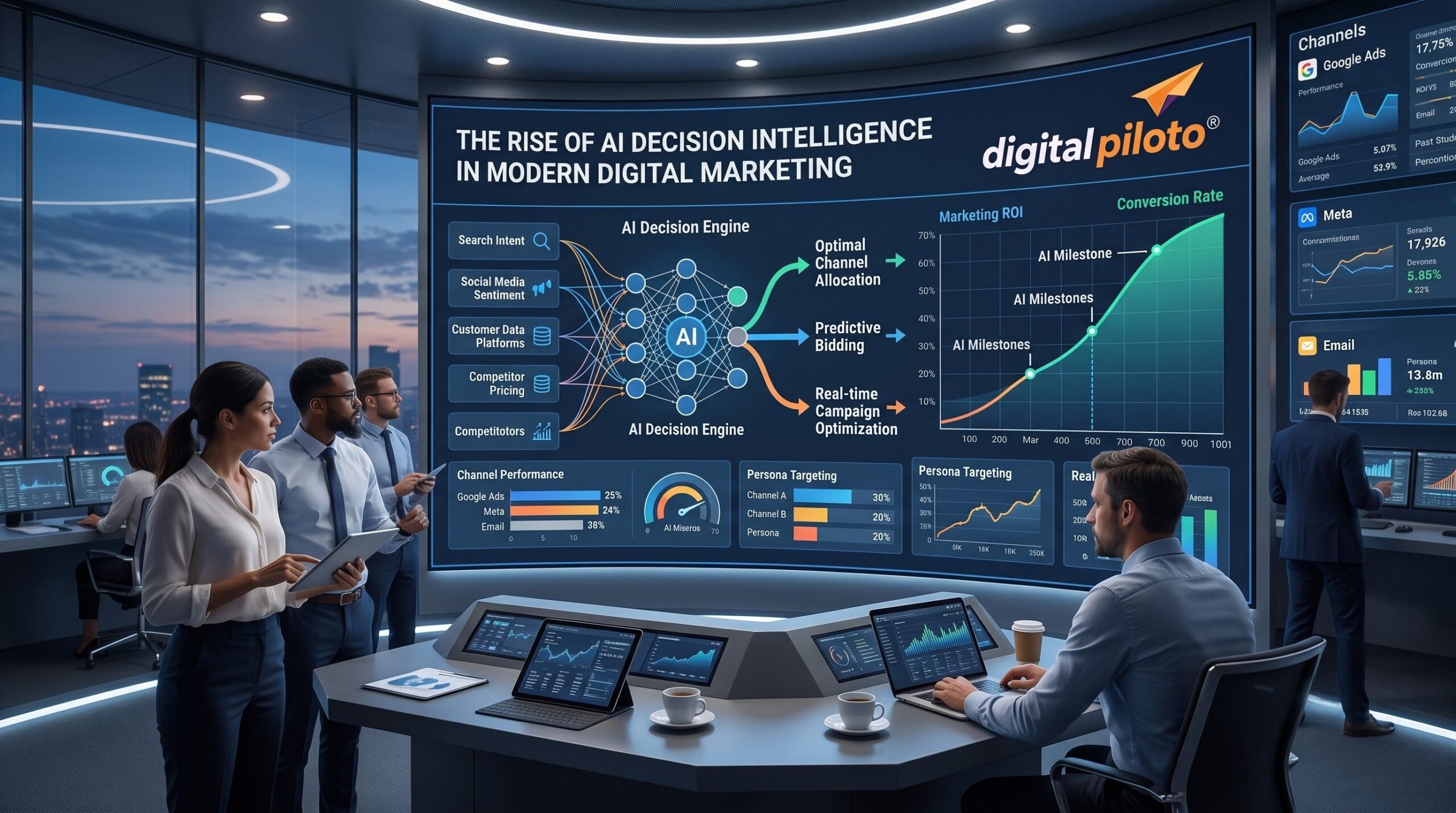
AI decision intelligence sits somewhere between analytics, artificial intelligence, automation, and business strategy. Its purpose is not simply to produce another report. It helps transform large amounts of information into recommendations or decisions that marketers can actually act upon.
Think of traditional analytics as the dashboard in a car. It tells you your speed, fuel level, and engine temperature. Decision intelligence is closer to having an intelligent navigation system that considers traffic, road conditions, your destination, and your preferences before suggesting what to do next.
In marketing, that could mean identifying a customer segment with rising purchase intent, recommending a different offer, predicting campaign fatigue, reallocating advertising spend, or suggesting which content deserves further investment.
IBM describes decision intelligence as combining rules, machine learning, and generative AI to create decisions that can be transparent and governed. That distinction is important: business decisions should not become mysterious simply because AI is involved.
Why Marketing Needs Better Decisions, Not Just More Data
Modern marketing teams are surrounded by information. CRM records, website analytics, advertising platforms, social engagement, search queries, email behaviour, ecommerce transactions, customer reviews—the list keeps growing.
The problem is rarely a complete absence of data. It is knowing what deserves attention.
Salesforce’s 2026 State of Marketing research found that 75% of marketers globally had adopted AI. Yet the same research found that 84% said they sometimes run generic campaigns, while 78% said they need more personalised content than they can produce.
That tells an interesting story. AI adoption is rising, but adoption alone does not automatically create intelligent marketing.
If customer information remains scattered across systems, an AI model may simply help a business make old decisions faster.
The Data Foundation Comes First
AI decision intelligence is only as useful as the context behind it.
Consider an ecommerce company trying to identify customers likely to purchase again. If its marketing platform knows purchase history but cannot see customer-service interactions, returns, loyalty activity, or recent website behaviour, its prediction may be incomplete.
The answer is not necessarily another AI tool. It may be better data integration.
Salesforce’s India findings from its 2026 State of Marketing report illustrate this challenge. While 81% of Indian marketers surveyed had adopted AI, only 60% reported complete access to service data, 61% to sales data, and 58% to commerce data. Salesforce also found that 98% faced barriers to personalisation, with data issues among the leading problems.
In plain English: you cannot expect intelligent decisions from disconnected information.
Where AI Decision Intelligence Fits Into Marketing
The most useful applications are not always the flashy ones. Often, AI creates value by helping teams make dozens of small decisions better and faster.
- Audience decisions: Identify segments showing changing behaviour or stronger purchase intent.
- Budget decisions: Detect where advertising spend is producing diminishing returns or emerging opportunities.
- Content decisions: Determine which topics, formats, and messages deserve further investment.
- Customer decisions: Predict churn risk, next-best actions, or opportunities for personalised engagement.
- Search decisions: Identify changing queries, emerging topics, and gaps in conventional and AI-driven discovery.
None of these should be treated as automatic truth. They are decision support. A strong marketing team still asks, “Does this recommendation make sense in the real world?”
From Predictive Analytics to Prescriptive Marketing
There is a subtle but important difference between predicting something and recommending what to do about it.
Predictive analytics might tell a retailer that a customer has a high probability of purchasing within the next 30 days.
Prescriptive decision intelligence takes the next step: What should the brand do now?
Perhaps the customer should receive a product reminder rather than a discount. Perhaps they have already received too many messages and should be excluded from the next campaign. Perhaps their browsing behaviour indicates interest in a higher-value category.
That is where AI becomes more than an analytical assistant. It starts participating in the decision loop.
AI Can Change the Marketing Operating Rhythm
Traditional campaign planning often follows a familiar pattern: research, strategy, creative development, launch, reporting, and post-campaign analysis.
AI makes it possible to shorten that loop.
Instead of waiting until the end of the month to discover that a segment is underperforming, an intelligent system can flag the change earlier. Instead of reviewing hundreds of campaign combinations manually, marketers can ask AI to identify patterns worth investigating.
McKinsey’s 2026 research describes a future marketing model built around insights, creativity, personalisation, agentic commerce, and orchestration, with AI increasingly coordinating activities across the marketing ecosystem.
The important word here is continuous.
Marketing becomes less like launching isolated campaigns and more like operating a system that constantly learns from customer behaviour.
AI Search Adds Another Decision Layer
Search behaviour is also becoming part of this decision environment.
Customers can now ask AI systems to compare products, research vendors, explain services, summarise reviews, or suggest alternatives. McKinsey’s 2026 advertising research found that more than half of surveyed advertisers believed AI had already reshaped discovery and consideration, while its consumer research indicates growing use of AI during purchase decision-making.
For marketers, this creates a new question: What information is influencing the decision before the customer ever reaches our website?
That is where generative AI search engine optimization becomes relevant. The focus expands from ranking pages for keywords to improving the way a brand’s information can be understood, retrieved, referenced, and surfaced within AI-mediated discovery.
This is not a replacement for SEO. It is another layer of the search ecosystem.
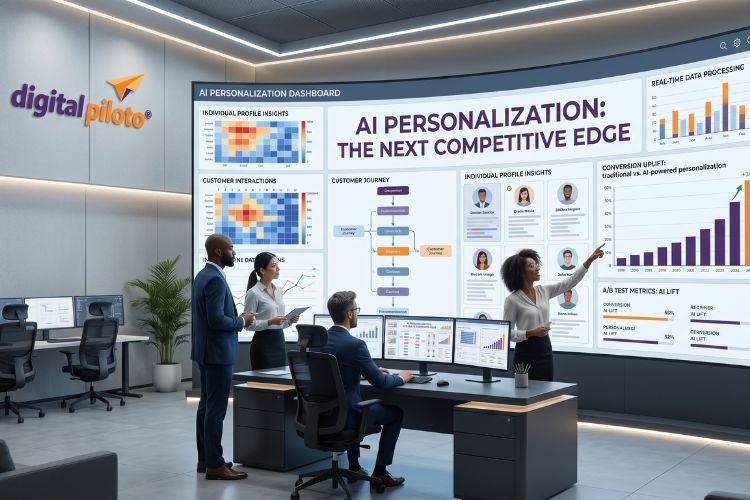
Better Personalisation Without Losing the Human Touch
Personalisation is one of the clearest areas where decision intelligence can make a practical difference.
A customer does not necessarily want a brand to know everything about them. They want the interaction to feel relevant.
That distinction matters.
An AI system might identify that two customers bought the same product but have completely different needs. One may respond to educational content. The other may care about price or delivery speed. Treating both customers identically simply because they share a purchase history wastes the intelligence available in the data.
Good personalisation therefore requires restraint as much as sophistication.
Useful personalisation decisions include:
- Choosing the most relevant message for a customer segment.
- Adjusting content according to customer intent.
- Identifying the appropriate communication frequency.
- Recommending products or services based on meaningful behaviour.
- Suppressing irrelevant campaigns when another customer interaction takes priority.
AI should make marketing feel more helpful, not more intrusive.
Experimentation Becomes More Intelligent
Marketing has always depended on experimentation. The difficulty is deciding what to test next.
AI can analyse previous experiments, audience responses, creative characteristics, landing-page behaviour, and conversion patterns to identify promising hypotheses.
For example, rather than randomly testing five headlines, a decision-intelligence system could identify that customers arriving from a particular search intent respond better to proof-oriented messaging than generic benefit statements.
The marketer still designs the experiment. AI helps make the experiment smarter.
That distinction is important because an algorithm can optimise toward the wrong objective if humans define success poorly.
The Role of Human Judgment
There is a temptation to imagine AI decision intelligence as an autopilot for marketing. That is probably the wrong mental model.
A better analogy is an experienced analyst who never sleeps, can process enormous datasets, and constantly highlights patterns—but still needs a strategist to understand the business context.
Human marketers remain essential for:
- Setting objectives: AI cannot decide whether the business should prioritise profit, market share, retention, awareness, or another goal without human direction.
- Applying context: A sudden sales decline might be caused by seasonality, supply problems, a competitor move, or a pricing decision—not simply a campaign issue.
- Managing risk: Sensitive customer data, biased models, inaccurate recommendations, and automated decisions require oversight.
- Making strategic trade-offs: The highest short-term conversion rate is not automatically the best long-term business decision.
How B2B and B2C Marketing Can Use It Differently
The underlying technology may be similar, but the decision environment differs.
For B2B companies, decision intelligence can help identify high-intent accounts, prioritise leads, understand buying committees, personalise account-based marketing, and coordinate sales and marketing signals.
For B2C brands, the emphasis may fall more heavily on product recommendations, customer segmentation, retention, churn prediction, pricing signals, campaign personalisation, and next-best offers.
In both cases, the objective is the same: turn fragmented signals into better decisions.
What a Practical AI Decision Framework Looks Like
Businesses do not need to transform everything overnight. A measured rollout is usually more sensible.
- Start with one decision: Choose a high-value problem such as lead scoring, campaign allocation, churn prediction, or content prioritisation.
- Audit the data: Identify what information exists, where it lives, and what is missing.
- Define the outcome: Decide what success actually means before introducing the model.
- Test recommendations: Compare AI-supported decisions against the existing process.
- Keep humans involved: Review unusual recommendations and create clear escalation rules.
- Scale carefully: Expand into additional workflows only after the initial system proves useful.
This approach avoids the classic mistake of buying sophisticated technology before identifying the business decision it is supposed to improve.
Why SEO and Decision Intelligence Are Converging
Search teams are increasingly dealing with more than rankings. They have to understand changing user intent, content performance, AI visibility, competitor movements, emerging questions, and conversion behaviour.
An experienced SEO agency Kolkata can therefore play a broader role when SEO data is connected with customer and business intelligence.
Imagine discovering that a page has modest traffic but generates unusually qualified leads. A pure traffic report might suggest deprioritising it. A decision-intelligence layer might recognise its commercial value and recommend expanding the topic instead.
That is the difference between measuring activity and understanding value.
The Future Is Continuous Decision-Making
Marketing is moving toward a model where insight, action, measurement, and optimisation happen in much tighter cycles.
McKinsey’s recent work describes AI-enabled marketing systems that can coordinate decisioning, content, media, personalisation, experimentation, and optimisation. It also documents examples where AI-enabled content workflows substantially reduced production costs and timelines in specific organisational settings. These are case-specific results, not universal guarantees, but they illustrate the direction of travel.
The competitive advantage may therefore shift away from simply having more data or more AI tools. It may belong to companies that build better decision systems around those resources.
Frequently Asked Questions
What is AI decision intelligence in marketing?
AI decision intelligence combines data, analytics, machine learning, generative AI, and business rules to help marketing teams identify patterns, predict outcomes, and make better-informed decisions.
How is decision intelligence different from marketing analytics?
Analytics primarily helps explain what happened and why. Decision intelligence goes further by using those insights to recommend or support what should happen next.
Can small and medium-sized businesses use AI decision intelligence?
Yes. A business does not need an enormous technology stack to begin. It can start with one high-value decision, such as lead prioritisation, campaign optimisation, customer segmentation, or content planning.
Will AI replace marketing decision-makers?
AI can automate analysis and support many decisions, but human oversight remains important for objectives, context, ethics, brand judgement, and strategic trade-offs. The strongest model is generally human expertise supported by intelligent systems.
Final Thoughts
AI decision intelligence is not really about making marketing more automated for its own sake. It is about making the next decision more informed.
The shift is subtle but powerful. Instead of asking only what happened last month, marketing teams can ask what is changing, why it matters, what might happen next, and which action deserves attention now.
That is where AI becomes genuinely strategic. Not when it produces more dashboards or more content, but when it helps people make better decisions with the information already surrounding the business.
Blog Development Credit
Conceptualized by Amlan Maiti, researched with ChatGPT, Gemini and Copilot, then refined for SEO by Digital Piloto Private Limited.