
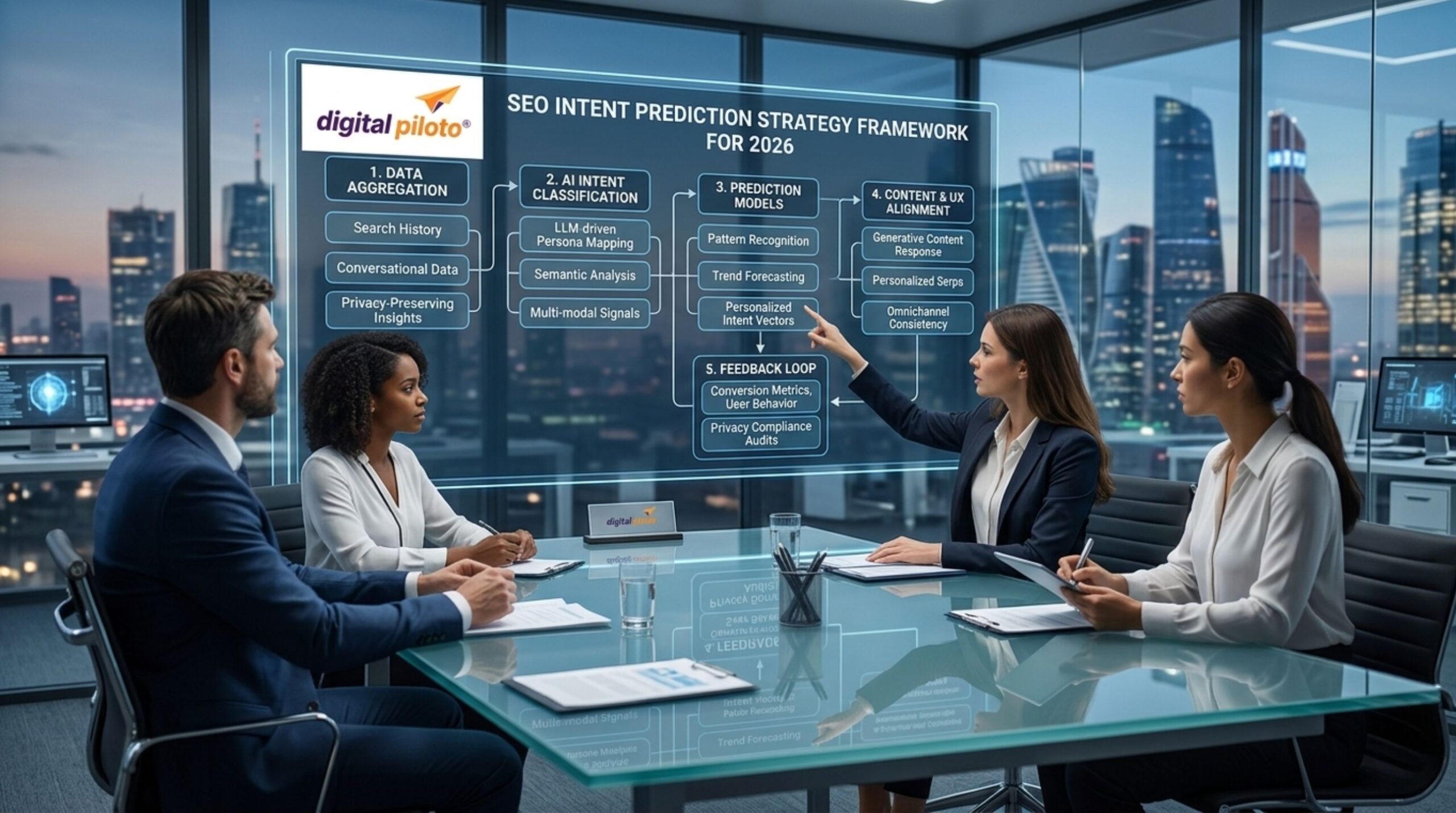
SEO intent prediction in 2026 is no longer about reacting to keywords after they trend. It is about anticipating user needs before demand peaks, mapping evolving search journeys, and creating content that satisfies future intent patterns. Brands that predict search intent accurately will gain stronger rankings, higher conversions, and sustained organic visibility.
Forward-thinking organizations and every modern digital marketing agency are increasingly investing in intent prediction models because traditional keyword research alone no longer captures how users interact with AI-driven search engines, conversational platforms, and personalized SERPs.
What Is SEO Intent Prediction?
Definition: SEO intent prediction is the process of forecasting the future information, transactional, navigational, or commercial needs of users based on historical search data, behavioral signals, AI trends, and market dynamics.
Instead of asking, “What are people searching today?” intent prediction asks, “What will people likely search tomorrow?”
Modern search engines increasingly understand context, entities, and user journeys. Consequently, marketers must optimize content for evolving search behavior rather than isolated keywords.
Why Will Intent Prediction Matter More in 2026?
Search ecosystems are changing rapidly. AI Overviews, conversational assistants, and multimodal search experiences have fundamentally altered user behavior.
- Users ask longer, contextual questions.
- Search sessions occur across multiple platforms.
- AI systems anticipate follow-up questions automatically.
- Buying journeys start earlier and span more touchpoints.
Businesses that identify emerging intent patterns early gain a significant competitive advantage in organic search.
The Four-Layer SEO Intent Prediction Framework
1. Behavioral Signal Layer
The first layer analyzes how audiences interact with digital assets.
Key signals include:
- Search Console query trends
- On-site search behavior
- Scroll depth patterns
- Repeat visitor journeys
- Content abandonment rates
For example, if visitors consistently move from informational guides to pricing pages, future commercial intent can be predicted and optimized proactively.
2. Trend Intelligence Layer
This layer identifies emerging topics before search volume spikes.
Sources may include:
- Industry reports
- Community discussions
- Social listening tools
- Customer support conversations
- Competitor content gaps
In my experience, customer support tickets often reveal future search demand months before traditional SEO tools detect it.
3. Entity and Context Layer
Modern algorithms understand entities rather than exact keywords. A successful framework maps relationships between topics, brands, products, and user problems.
For instance, an SEO company in Kolkata serving SaaS brands should not only target “SEO services” but also related entities such as customer acquisition, revenue attribution, user retention, and AI visibility.
This semantic mapping strengthens topical authority and improves contextual relevance.
4. Predictive Opportunity Layer
The final layer transforms insights into actionable content opportunities.
Questions to ask include:
- Which user needs are emerging?
- What questions will prospects ask next quarter?
- Which topics lack authoritative answers?
- What intent stages remain underserved?
How to Build an SEO Intent Prediction System
Step-by-Step Framework:
Step 1: Consolidate Search Data
Combine data from Search Console, analytics platforms, CRM systems, and customer interactions.
Look beyond impressions and clicks. Focus on behavioral pathways.
Step 2: Segment Queries by Intent
Categorize existing keywords into:
- Informational
- Commercial
- Transactional
- Navigational
- Post-purchase support
This segmentation reveals missing content opportunities.
Step 3: Identify Intent Shifts
Compare search patterns quarterly.
For example, informational searches may gradually evolve into solution-oriented commercial queries. Detecting these shifts early allows marketers to create conversion-focused assets ahead of competitors.
Step 4: Create Predictive Topic Clusters
Build topic ecosystems rather than standalone pages.
Include:
- Pillar content
- Supporting guides
- FAQ resources
- Case studies
- Comparison pages
This strategy significantly strengthens topical authority.
Step 5: Measure and Refine
Intent prediction is not a one-time exercise.
Successful teams continuously monitor SERP changes, user engagement, and conversion paths to improve forecasting accuracy.
How AI Enhances Intent Prediction
Artificial intelligence can uncover relationships that manual analysis often misses.
AI applications include:
- Emerging topic discovery
- Behavioral clustering
- Predictive trend analysis
- Content gap identification
- SERP volatility forecasting
Many organizations also integrate paid search insights from a PPC agency in Kolkata to validate predictive SEO opportunities faster. Paid campaigns often reveal high-converting intent patterns long before organic rankings mature.
Common Mistakes in SEO Intent Prediction
- Relying solely on keyword volume.
- Ignoring customer conversations.
- Treating search intent as static.
- Optimizing only for rankings rather than user outcomes.
- Failing to update content based on behavioral insights.
One of the biggest misconceptions is assuming that today’s search behavior will remain unchanged next year. In reality, AI-driven search experiences are accelerating intent evolution dramatically.
Future-Proofing Your SEO Strategy
Future-ready SEO depends on understanding people, not merely keywords.
Brands should invest in predictive analytics, semantic SEO, audience research, and content intelligence systems. Combining these capabilities creates a resilient organic growth engine capable of adapting to ongoing search disruption.
Frequently Asked Questions
1. What is SEO intent prediction?
SEO intent prediction forecasts future user search behavior and content needs using data, trends, and behavioral analysis.
2. Why is intent prediction important in 2026?
Because AI-powered search engines increasingly prioritize contextual relevance and user satisfaction over exact keyword matching.
3. Which data sources help predict search intent?
Search Console, analytics tools, CRM data, customer feedback, social listening, and SERP trend analysis are valuable sources.
4. Can AI improve intent prediction accuracy?
Yes. AI can identify hidden patterns, emerging topics, and behavioral relationships faster than traditional manual analysis.
5. How often should businesses update intent forecasts?
Most organizations should review intent signals monthly and perform comprehensive forecasting every quarter.
Conclusion
SEO success in 2026 will belong to brands that anticipate user needs rather than simply respond to them. Intent prediction transforms SEO from a reactive discipline into a strategic growth engine, helping businesses stay visible, relevant, and consistently ahead of market demand.
Blog Development Credits:
This article originated from strategic concepts developed by Amlan Maiti. Advanced AI research platforms assisted the drafting process, while final refinement, SEO calibration, and quality enhancements were completed by Digital Piloto Private Limited.