

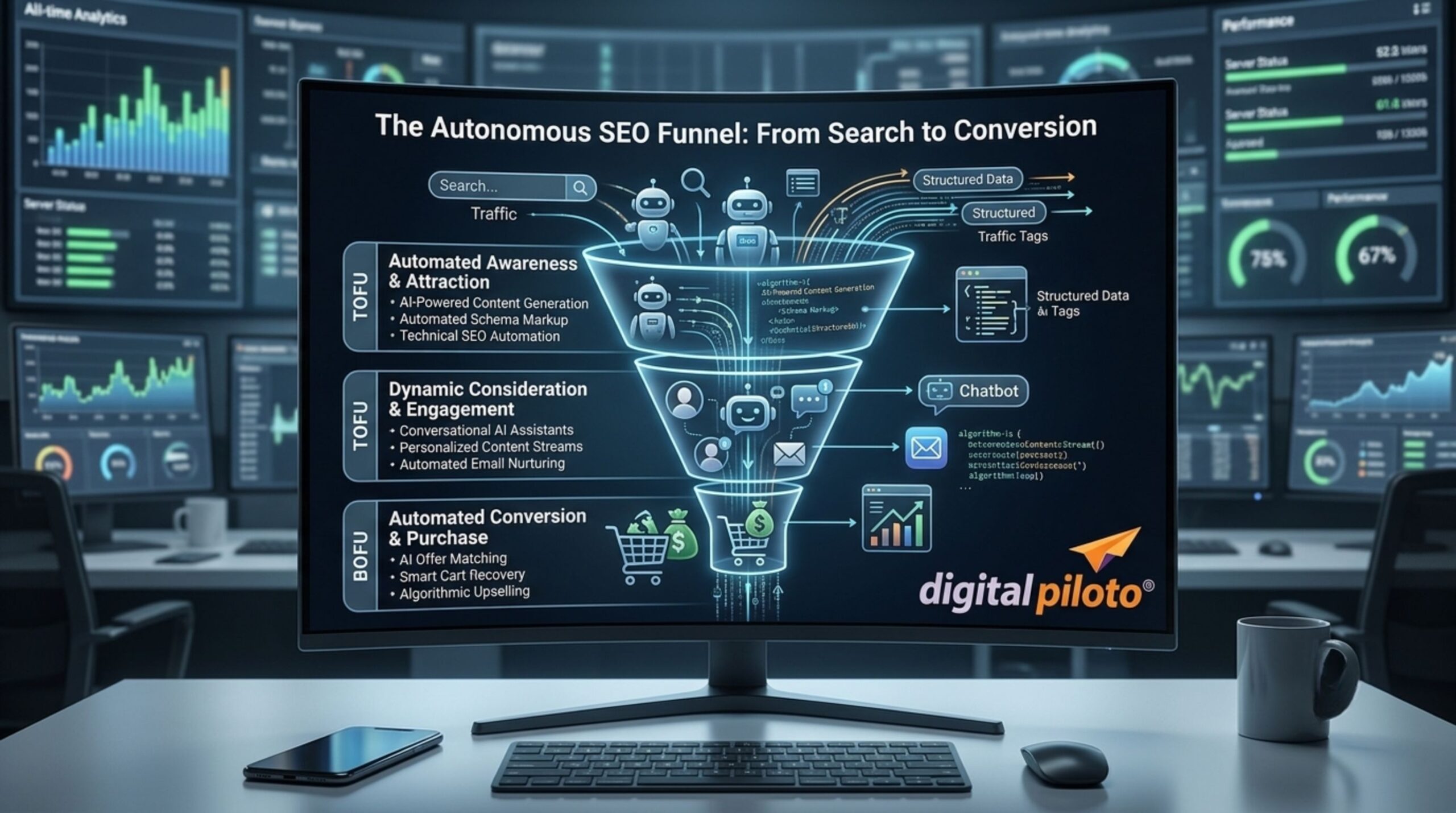
The Autonomous SEO Funnel is a modern search optimization framework that uses AI, automation, and user intent to guide potential customers from their first search to a completed conversion with minimal manual intervention. Instead of treating SEO as a traffic-generation channel alone, this approach creates an intelligent system where discovery, engagement, nurturing, and conversion work together continuously.
Today, every successful digital marketing company understands that search is no longer a linear journey. Users interact with Google, AI assistants, voice search, social platforms, and brand websites before making decisions. Businesses that build autonomous SEO systems create smoother customer experiences while generating higher-quality leads with less manual effort.
What Is an Autonomous SEO Funnel?
Definition
An Autonomous SEO Funnel is an AI-assisted marketing framework that automatically attracts, qualifies, nurtures, and converts organic visitors through optimized content, intelligent automation, behavioral insights, and continuous performance improvements.
Unlike traditional SEO, which focuses primarily on rankings, autonomous SEO optimizes every stage of the customer journey—from search visibility to revenue generation.
Why Traditional SEO Funnels Need an Upgrade
Conventional SEO often ends once a visitor lands on a webpage. Modern users, however, expect personalized experiences, immediate answers, and seamless navigation across multiple touchpoints.
AI-powered search engines are also changing how content is discovered. Instead of displaying only links, they summarize answers, recommend brands, and evaluate content quality before users even visit a website.
That means businesses need optimization strategies that extend beyond rankings into customer experience and intelligent engagement.
How the Autonomous SEO Funnel Works
Step 1: Discover Search Intent
Everything begins with understanding why users are searching—not just what they search for.
Instead of targeting isolated keywords, autonomous SEO identifies:
- Customer problems
- Decision-making questions
- Commercial intent
- Informational needs
- Behavioral search patterns
This creates content that naturally aligns with both search engines and AI-generated answers.
Step 2: Build Topical Authority
AI search systems reward websites that consistently demonstrate expertise across an entire topic rather than isolated pages.
An effective content ecosystem includes:
- Comprehensive pillar pages
- Supporting topic clusters
- Expert insights
- Case studies
- Frequently updated resources
This strengthens semantic relevance and improves long-term search visibility.
Step 3: Deliver Personalized Experiences
Autonomous SEO doesn’t stop after attracting visitors.
It continuously adapts the experience based on user behavior by recommending related articles, relevant services, downloadable resources, or product pages.
These personalized pathways increase engagement while reducing bounce rates.
Key Components of an Autonomous SEO Funnel
- AI-powered keyword intelligence to predict future demand.
- Semantic content optimization for broader topical relevance.
- Behavioral analytics to understand visitor intent.
- Dynamic internal linking that guides users naturally.
- Automated content recommendations based on engagement history.
- Conversion-focused landing pages optimized for search intent.
When combined, these elements create a self-improving marketing ecosystem rather than isolated SEO campaigns.
How AI Makes the Funnel Autonomous
Artificial intelligence continuously analyzes enormous volumes of search, behavioral, and conversion data that would be impossible to process manually.
Modern AI systems automatically identify:
- Emerging search trends
- Content performance gaps
- User engagement signals
- Internal linking opportunities
- Conversion bottlenecks
- Content freshness requirements
Instead of waiting months for manual audits, marketers receive continuous optimization opportunities.
Step-by-Step Framework for Building an Autonomous SEO Funnel
- Research audience intent instead of only keywords.
- Create comprehensive topical clusters around business expertise.
- Implement structured data for AI readability.
- Optimize content for featured snippets and conversational search.
- Connect blog content with service pages using strategic internal links.
- Use AI-powered analytics to monitor visitor behavior.
- Automate lead nurturing through email sequences and CRM workflows.
- Continuously update high-performing content using performance insights.
This systematic process allows SEO to become increasingly efficient over time rather than requiring constant manual intervention.
Connecting SEO with Revenue Generation
Many organizations still measure SEO by rankings alone. However, autonomous SEO focuses on business outcomes such as qualified leads, customer acquisition, revenue, and lifetime value.
For example, an experienced PPC agency Kolkata can combine paid search insights with organic search behavior to identify high-converting customer journeys. These insights help SEO teams prioritize pages that influence purchasing decisions instead of merely increasing traffic.
Similarly, combining autonomous SEO with predictive analytics, AI content optimization, and conversion rate optimization creates a marketing engine that consistently improves itself.
Best Practices for Sustainable Autonomous SEO
- Focus on answering complete user questions rather than individual keywords.
- Create original insights supported by real-world examples.
- Refresh cornerstone content regularly.
- Build strong entity relationships across your website.
- Use structured data wherever appropriate.
- Optimize for both traditional search engines and AI-powered search assistants.
- Track business KPIs alongside SEO metrics.
Businesses investing in SEO service In Kolkata are increasingly adopting these strategies because they improve not only visibility but also measurable business growth.
Frequently Asked Questions
1. What is an Autonomous SEO Funnel?
An Autonomous SEO Funnel is an AI-powered SEO framework that guides users from search discovery to conversion through intelligent content, automation, personalization, and continuous optimization with minimal manual effort.
2. How is autonomous SEO different from traditional SEO?
Traditional SEO mainly focuses on improving rankings and traffic. Autonomous SEO extends beyond rankings by optimizing every stage of the customer journey, including engagement, lead nurturing, and conversions using AI-driven insights.
3. Why is AI important in modern SEO?
AI helps identify search trends, understand user intent, optimize content, recommend internal links, predict keyword opportunities, and automate repetitive optimization tasks, making SEO more efficient and scalable.
4. Can small businesses benefit from an Autonomous SEO Funnel?
Yes. Small businesses can automate repetitive SEO tasks, improve content quality, attract qualified visitors, and increase conversions without dramatically increasing marketing resources.
5. What metrics should businesses track in an Autonomous SEO Funnel?
Instead of focusing only on rankings, businesses should monitor qualified organic traffic, engagement, lead generation, conversion rate, customer acquisition cost, revenue, and customer lifetime value.
Conclusion
The future of SEO is no longer about simply appearing on the first page of search results. It’s about creating an intelligent ecosystem that understands user intent, adapts to changing search behaviors, and continuously guides prospects toward meaningful actions. Organizations that embrace an autonomous SEO funnel today will be better positioned to compete in an increasingly AI-driven search landscape while building sustainable, long-term organic growth.
Blog Development Credits
This article was planned by Amlan Maiti, developed through advanced AI-assisted research using ChatGPT, Google Gemini, and Copilot, and professionally refined with SEO optimization by Digital Piloto Private Limited.