
Shopping online once meant browsing product categories, adding items to a cart, and waiting for delivery. That familiar experience is changing. Artificial intelligence, connected customer data, automation, and predictive technology are turning ordinary online stores into intelligent commerce ecosystems where businesses can understand customers, anticipate demand, and create more meaningful buying experiences.
For companies looking to scale digitally, working with the best digital marketing agency in India is increasingly about more than generating website traffic. The real opportunity lies in connecting discovery, customer engagement, sales, and long-term relationships into one coordinated digital experience.
Why Traditional Online Stores Are No Longer Enough
Traditional ecommerce platforms were primarily designed to display products and process transactions. They offered catalogues, shopping carts, payment gateways, and order management systems. For many years, that was enough to establish a digital sales channel.
But customer expectations have moved forward.
Consider someone shopping for a laptop. They might discover a product through social media, ask an AI assistant for recommendations, compare specifications on an ecommerce website, read customer reviews, and finally purchase through a mobile application.
These interactions happen across different platforms, yet the customer expects a consistent experience throughout the journey.
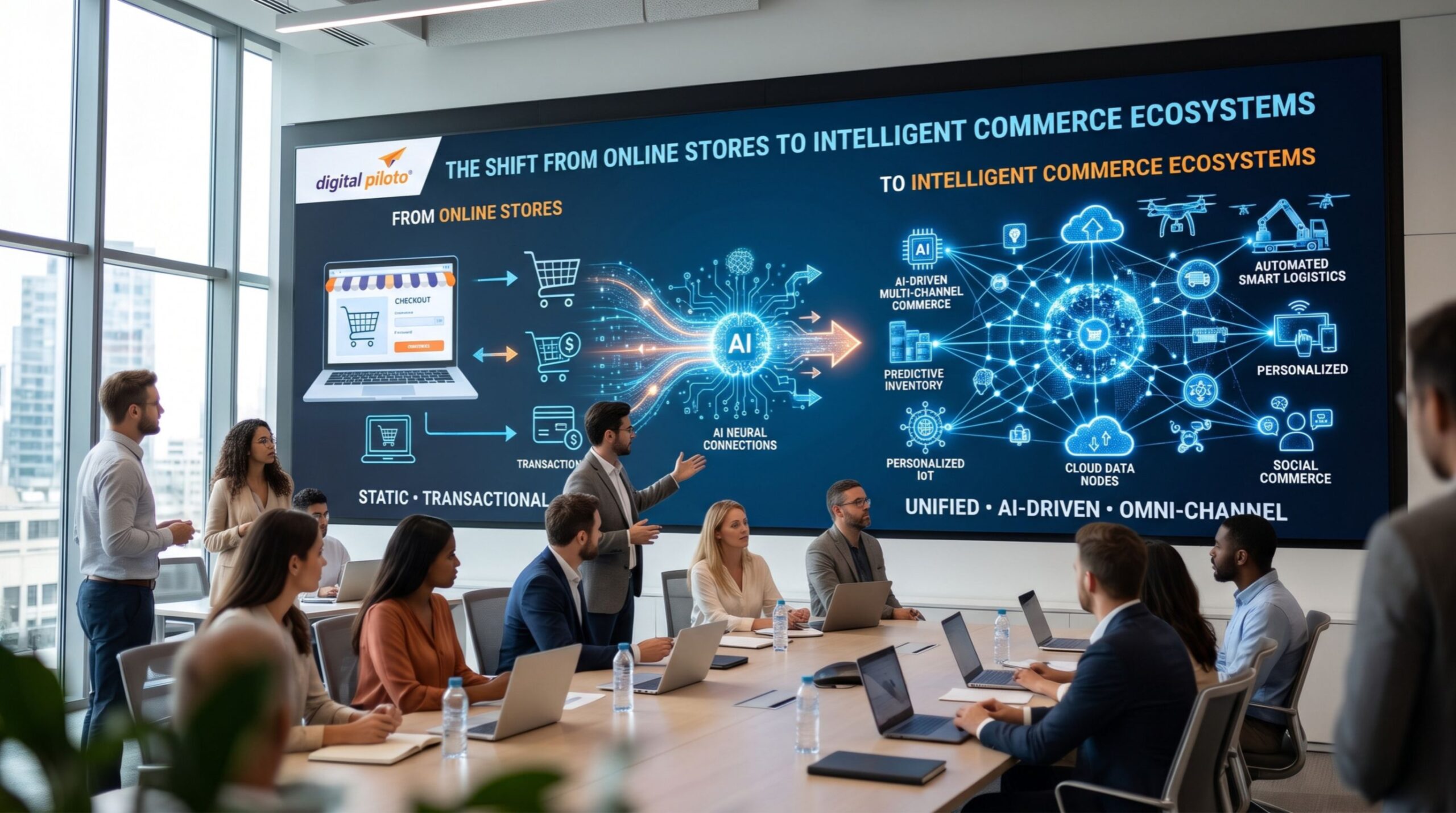
A conventional online store may struggle to connect those moments. An intelligent commerce ecosystem attempts to bring them together using shared data, automation, AI-powered recommendations, and integrated business systems.
In simple terms, an online store sells products. An intelligent commerce ecosystem understands the wider journey that leads to a purchase and continues after the transaction.
What Makes Commerce Ecosystems Intelligent?
An intelligent commerce ecosystem combines digital platforms, customer information, business operations, and AI-driven capabilities to improve how products and services are discovered, purchased, delivered, and supported.
Rather than treating every interaction separately, it connects different parts of the business.
1. AI-Powered Personalization
Imagine two customers visiting the same online store. One regularly purchases premium skincare products, while another is exploring affordable alternatives for the first time.
Showing both customers identical recommendations would be a missed opportunity.
AI-powered personalization can use relevant browsing patterns, purchase history, preferences, and contextual information to recommend products or content that better match individual needs.
The objective is not to display more advertisements. It is to reduce the effort customers spend finding something useful.
2. Connected Customer Data
Commerce ecosystems bring information from multiple touchpoints into a more connected view. Website interactions, CRM records, customer service conversations, and transaction histories can help businesses understand how relationships develop.
For example, a manufacturing company might receive a product enquiry through its website, discuss specifications with a sales representative, share a quotation through email, and eventually process an order through its business system.
When these interactions are connected, teams gain better visibility into the sales journey and can respond more consistently.
3. Intelligent Automation
Automation reduces repetitive work across sales, marketing, inventory, and customer support. AI can further improve these workflows by helping systems interpret information and recommend appropriate next steps.
Examples include automated order updates, abandoned-cart reminders, customer segmentation, lead assignment, and support assistance.
Human teams remain important, particularly when customers have complex requirements or need reassurance before making a decision.
How Different Industries Can Benefit
Intelligent commerce is not limited to businesses selling physical products. Its principles can support several industries, although the implementation will naturally differ.
Manufacturing and B2B
Manufacturing businesses often have longer sales cycles and more complicated buying requirements. Customers may need technical specifications, quotations, product customizations, and discussions with multiple decision-makers.
An intelligent B2B commerce platform can organize product information, automate enquiry management, and connect marketing activities with sales workflows.
This helps manufacturers generate quality leads, get B2B enquiries, and reduce delays between initial interest and meaningful business conversations.
Real Estate
Property buyers rarely make decisions after viewing a single listing. They compare locations, budgets, floor plans, amenities, and investment potential.
Intelligent property platforms can recommend relevant projects based on declared preferences, manage enquiries, schedule visits, and provide timely information to prospective buyers.
For developers, this can improve lead qualification and help sales teams focus on more relevant opportunities.
E-commerce and Retail
This is perhaps the most visible application. Retailers can combine personalized recommendations, intelligent search, inventory visibility, conversational assistance, and flexible checkout experiences.
Instead of relying entirely on customers to navigate product categories, an intelligent platform can help them discover relevant products more naturally.
The business objective is straightforward: increase online sales while creating an experience customers actually want to revisit.
Healthcare and Hospitals
Healthcare commerce requires a different approach because trust, accuracy, and privacy are especially important.
Hospitals and healthcare providers can use connected digital systems for appointment enquiries, service discovery, patient communication, and administrative workflows. AI assistants may help users find relevant information, but clinical decisions must remain under qualified professional oversight.
Education
Educational institutions can use intelligent digital platforms to recommend relevant courses, answer admission-related questions, organize enquiries, and support prospective students throughout the application journey.
FMCG and Consumer Products
FMCG brands operate in competitive markets where customer preferences and purchase frequency matter enormously. Intelligent commerce can support demand forecasting, product recommendations, distributor engagement, and personalized promotional campaigns.
The Technology Behind Intelligent Commerce
An intelligent commerce ecosystem is not a single software product. It is generally a combination of technologies working together.
Some important building blocks include:
- Artificial intelligence and machine learning: Analyze customer patterns, support recommendations, and help forecast demand.
- Customer Relationship Management (CRM): Organize enquiries, sales conversations, customer records, and follow-ups.
- Marketing automation: Coordinate campaigns, customer segmentation, and communication across channels.
- Application Programming Interfaces (APIs): Connect ecommerce platforms with payment systems, inventory software, logistics, and other business applications.
- Predictive analytics: Identify potential trends in customer behaviour, purchasing patterns, and product demand.
Cloud infrastructure and reliable data management provide the foundation that allows these components to communicate effectively.
From Digital Traffic to Measurable Business Growth
One important change in intelligent commerce is the way businesses evaluate digital success.
Getting thousands of website visitors may look impressive, but traffic alone does not necessarily create revenue. What matters is whether the experience moves customers toward meaningful actions.
A well-connected commerce ecosystem can support several practical business objectives:
- Generate quality leads: Identify and organize enquiries based on relevant customer requirements.
- Increase online sales: Reduce unnecessary friction through better product discovery and checkout experiences.
- Get B2B enquiries: Make it easier for business buyers to request specifications, quotations, and consultations.
- Build brand awareness: Maintain consistent communication across search, social media, marketplaces, and digital channels.
- Improve overall ROI: Connect marketing expenditure with measurable enquiries, conversions, and customer value.
For businesses investing in digital growth, a digital solutions company in India can help bring together website development, marketing automation, AI-driven workflows, and conversion optimization.
The important point is integration. A personalized recommendation is less useful if the product is unavailable. A promising lead can be lost if the CRM does not trigger an appropriate follow-up. Intelligent commerce works best when the entire system supports the customer journey.
Why Search and Product Discovery Are Evolving
Another major development is the way customers discover products and services.
Search engines remain important, but people increasingly explore options through conversational interfaces, social platforms, marketplaces, and AI-powered recommendations.
A customer might ask an AI assistant to compare two products rather than search for individual product pages. This means businesses need clear product descriptions, accurate specifications, useful reviews, and consistent brand information across digital platforms.
Search optimization remains part of this process. A strong best SEO services India strategy can help improve product discoverability through technically accessible pages, relevant content, structured product information, and useful internal links.
Businesses should also pay attention to conversational commerce, AI product discovery, and omnichannel customer experience. These areas are becoming increasingly relevant as buying journeys move beyond individual websites.
Challenges Businesses Should Not Ignore
Building an intelligent commerce ecosystem sounds attractive, but successful implementation requires more than purchasing new technology.
Data fragmentation is a common obstacle. Different departments may use disconnected platforms, making it difficult to create a reliable customer view.
There are also concerns around implementation costs, cybersecurity, privacy, employee training, and the accuracy of AI-generated recommendations.
Businesses should begin with a manageable transformation plan rather than attempting to automate everything simultaneously.
A practical starting approach is to:
- Identify the biggest friction points in the existing buying journey.
- Choose one or two business processes where automation could make a measurable difference.
- Connect the most important customer and operational data sources.
- Test the experience with real users and monitor conversion performance.
- Expand the ecosystem gradually based on actual results.
Data privacy deserves particular attention. Businesses should follow applicable data protection requirements, communicate transparently about data usage, and collect only information necessary for legitimate business purposes.
Frequently Asked Questions
What is an intelligent commerce ecosystem?
An intelligent commerce ecosystem is a connected digital environment that combines ecommerce, customer data, AI, automation, and business systems to improve product discovery, purchasing, customer engagement, and operational efficiency.
How is intelligent commerce different from traditional ecommerce?
Traditional ecommerce primarily focuses on displaying products and processing transactions. Intelligent commerce connects the wider customer journey through personalized recommendations, predictive insights, integrated systems, and automated interactions.
Can small businesses implement intelligent commerce?
Yes. Small businesses can begin with practical tools such as CRM software, automated follow-ups, personalized product recommendations, and connected payment and inventory systems. They can expand their capabilities as their requirements grow.
Which industries benefit most from intelligent commerce?
E-commerce, retail, manufacturing, B2B, real estate, healthcare, education, and FMCG businesses can all benefit. The value depends on how effectively intelligent technologies address their particular customer and operational challenges.
Final Thoughts
The future of digital commerce will not be defined simply by how attractive an online store looks or how many products it displays. It will depend on how intelligently businesses connect information, technology, and customer experiences.
Companies that move toward connected commerce ecosystems can create smoother buying journeys, build stronger relationships, and make better business decisions. The transition may take time, but the opportunity is already worth exploring: less disconnected selling, more intelligent customer experiences, and growth built around real value.
Blog Development Credits
Conceived by Amlan Maiti, this article was researched and drafted with ChatGPT, Google Gemini, and Copilot, then refined through SEO optimization by Digital Piloto Private Limited.