

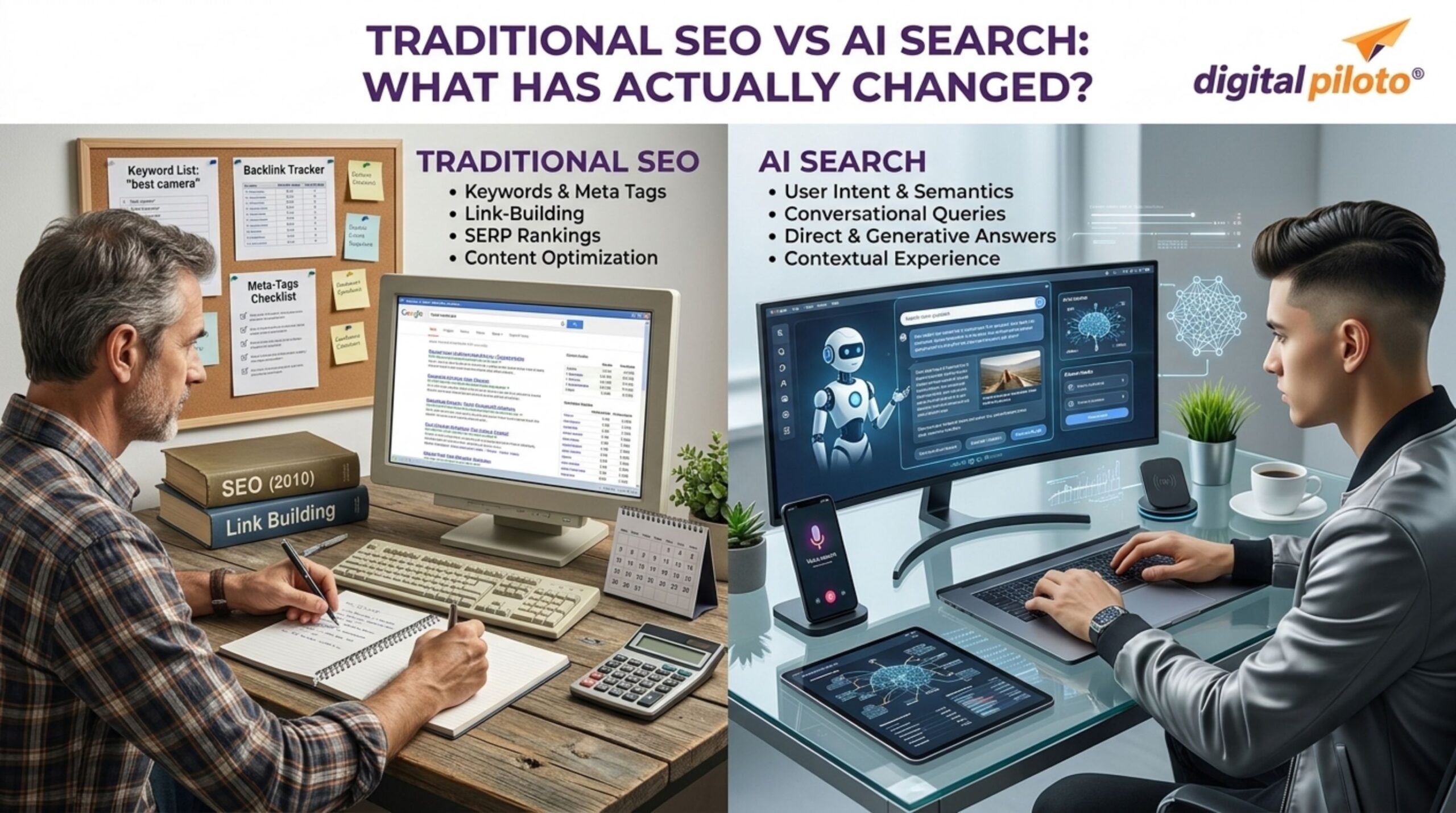
Short answer: Traditional SEO has not disappeared because of AI search. The technical foundations—crawlability, indexability, useful content, internal linking, authority and good page experience—still matter. What has changed is the visibility layer: AI systems can interpret a question, synthesize information from multiple sources and answer the user before a traditional website click happens.
That means businesses now need to think beyond rankings and traffic. Search visibility increasingly includes being discovered, understood, cited, mentioned and trusted across both conventional search results and AI-generated answers.
Traditional SEO vs AI Search: The Difference in One View
| Area | Traditional SEO | AI Search |
|---|---|---|
| Primary objective | Earn visibility in ranked search results | Earn visibility inside synthesized answers and recommendations |
| User interaction | Query → results → click | Question → generated answer → source/citation → optional click |
| Core optimization | Technical SEO, relevance, content, links and authority | The same foundations plus clearer entities, evidence, answer structure and cross-platform visibility |
| Content consumption | User reads the source page | AI may summarize the source before the user sees it |
| Primary measurement | Rankings, impressions, clicks, traffic and conversions | Those metrics plus citations, mentions, AI referrals, assisted conversions and visibility in target prompts |
| Relationship | Foundation | Additional discovery and visibility layer |
The key point is that these are not two completely independent marketing disciplines. Google itself says the SEO best practices used for traditional Search remain relevant to AI Overviews and AI Mode, with no special AI-only technical requirements or schema needed for eligibility.
Is Traditional SEO Still Relevant in 2026?
Yes. Traditional SEO is still relevant because AI search depends heavily on accessible, understandable and trustworthy web content. What has changed is that ranking in a conventional results page is no longer the only way a brand can gain search visibility.
Google’s current guidance states that existing SEO fundamentals remain useful for AI features, including crawlability, internal linking, textual content, page experience and appropriate structured data. Google also says there is no special schema or AI-specific markup required for AI Overviews or AI Mode.
That distinction matters. Businesses should not throw away years of accumulated SEO knowledge simply because the interface has changed.
For example, a company investing in SEO services India should still care about technical health, search intent, useful content, information architecture, authority and conversions. The opportunity is to extend that foundation so the same content can support AI-mediated discovery as well.
What Actually Changed With AI Search?
The biggest change is not a single ranking factor. It is the search journey itself.
Traditional search usually presents a ranked collection of pages. The user evaluates those pages and decides which one to open.
AI search can act as an interpretation layer. The system may understand a complex question, retrieve information, compare sources and generate a synthesized response. The user can then decide whether to inspect the cited sources.
Google’s AI Overviews and AI Mode, as well as conversational search experiences such as ChatGPT Search, illustrate this broader shift toward answer-oriented discovery.
From ranking to being selected as a source
In traditional SEO, a useful question is:
“Can this page rank for the query?”
In AI search, another question becomes important:
“Is this page useful enough, clear enough and trustworthy enough to be selected as a source for the answer?”
The two questions overlap, but they are not identical.
What Has Not Changed?
One of the biggest mistakes in the SEO-versus-AI debate is focusing only on what is new.
Many of the things that made a website strong for search remain important because AI systems also need to discover and interpret information.
- Crawlability: Search systems need access to your content.
- Indexability: Important pages need to be eligible for discovery.
- Useful content: Pages still need to solve real user problems.
- Authority: Reliable sources are more useful than unsupported claims.
- Internal linking: Strong site architecture helps systems discover relationships between pages.
- Technical quality: Performance, accessibility and rendering still matter.
- Search intent: Content must answer what the user is actually trying to accomplish.
- Brand trust: A recognizable and credible entity has advantages over an anonymous source.
Google’s SEO guidance continues to emphasize people-first content, useful information, clear organization, originality and reliable expertise.
What Has Changed in Content Strategy?
AI search increases the value of content that can be understood accurately at both the page and passage level.
1. Answers need to be explicit
Instead of forcing readers to search through five paragraphs for the definition, state the answer clearly and then explain it.
This does not mean writing robotic content. It means removing unnecessary ambiguity.
2. Context matters more
A page should make it obvious:
- who is making the claim,
- what the claim refers to,
- when the information was true,
- what evidence supports it,
- where the information applies, and
- where exceptions exist.
3. Original analysis becomes more valuable
If ten websites repeat the same generic definition, another rewritten definition adds little information gain.
Original comparisons, first-party data, transparent methodologies, expert interpretation, useful examples and clearly sourced evidence give content more reason to be referenced.
4. Topic coverage matters more than isolated keywords
Traditional keyword research remains useful, but AI-mediated discovery makes it increasingly important to understand the broader question behind a query.
A strong resource about technical SEO, for example, should not only target “technical SEO.” It should address crawlability, indexing, rendering, internal linking, site architecture, JavaScript, structured data, page experience and common implementation problems where relevant.
Does GEO Replace SEO?
No. GEO should be treated as an extension of search visibility rather than a replacement for SEO.
Generative Engine Optimization focuses on improving the likelihood that information about a business, topic or product is surfaced accurately within generative answers. In practice, this can involve content clarity, entity consistency, source quality, topical authority, evidence, brand information and monitoring how AI systems represent the business.
For businesses that want to build this additional layer, generative AI search engine optimization can sit alongside conventional SEO rather than replacing it.
There is an important caveat: marketers should be careful about presenting every proposed GEO tactic as an officially confirmed ranking factor. Google currently states that no special AI optimization is required for AI Overviews or AI Mode.
How AI Search Changes the Value of a Click
AI search introduces an uncomfortable possibility for publishers: a user may consume the essential answer without visiting the source.
Pew Research Center analyzed 68,879 unique Google searches from browsing data collected in March 2025. Among searches where an AI-generated summary appeared, users clicked a traditional result on 8% of visits. For searches without an AI summary, traditional-result clicks occurred on 15% of visits. Only 1% of visits with an AI summary resulted in a click on a link within the summary itself.
This does not mean every website will lose 47% of its traffic. It means the relationship between search visibility and website visits is becoming less direct.
That is a crucial strategic distinction.
Why Rankings Alone Are No Longer Enough
Imagine two companies.
Company A ranks #1 for a valuable keyword but is rarely mentioned when potential customers ask AI systems for recommendations.
Company B ranks #4 but is frequently referenced by AI systems when users ask comparison and recommendation questions.
Which company has greater digital visibility?
There is no longer a complete answer if you only look at Google position.
Rankings remain important, but a modern visibility report may need to include:
- organic rankings,
- organic impressions,
- organic clicks,
- non-branded search visibility,
- AI mentions,
- AI citations,
- AI referral traffic,
- assisted conversions,
- brand recommendation frequency, and
- accuracy of AI-generated brand information.
AI Search Creates a New Measurement Problem
Traditional SEO has comparatively mature measurement systems. Search Console can report impressions, clicks, CTR and average position. Analytics can connect visits to engagement and conversions.
AI visibility is more fragmented.
A brand can be mentioned in an AI answer without receiving a visit. It can be cited but not clicked. It can be recommended in one prompt and omitted in another. Different AI systems can also produce different answers.
Therefore, AI visibility should not replace SEO reporting. It should be added to it.
A practical measurement framework
| Layer | KPIs |
|---|---|
| Technical | Crawlability, indexation, Core Web Vitals, rendering and errors |
| Organic search | Rankings, impressions, CTR, clicks and conversions |
| Content | Topic coverage, freshness, engagement and assisted conversions |
| AI visibility | Mentions, citations, source inclusion and recommendation frequency |
| AI traffic | Referral sessions, leads, revenue and conversion rate |
| Brand accuracy | Correct descriptions, products, services, locations and claims |
What Businesses Should Change in Their SEO Strategy
The answer is not “replace SEO with GEO.” A better approach is to expand the operating model.
Step 1: Protect the technical foundation
Audit crawling, indexing, rendering, internal links, canonicalization, structured data, mobile experience and page performance.
Step 2: Strengthen information architecture
Organize content around meaningful topics and entities instead of publishing disconnected keyword pages.
Step 3: Build answer-ready sections
Use descriptive headings, direct definitions, concise explanations, tables and examples where they genuinely improve comprehension.
Step 4: Make evidence visible
Identify sources, dates, methodologies and limitations. Avoid anonymous claims such as “experts say” or “studies prove” without identifying the evidence.
Step 5: Strengthen entity clarity
Make the company’s name, services, products, expertise, locations, authors and relationships consistent across important pages and trusted external sources.
Step 6: Expand question research
Study how customers phrase complex questions, comparisons and recommendations—not only short keyword queries.
Step 7: Monitor AI visibility
Test representative prompts across relevant AI search platforms and record whether the brand appears, which sources are cited and whether the information is accurate.
Step 8: Connect visibility to business outcomes
Do not celebrate an AI mention merely because it exists. Determine whether AI-referred users, branded searches and assisted conversions are increasing.
What Should SEO Teams Stop Doing?
AI search does not make every traditional tactic obsolete. But it does make several outdated habits less defensible.
- Stop writing to a predetermined word count. Write until the user’s question is properly answered.
- Stop treating keyword density as a strategy. Relevance and usefulness matter more than repetition.
- Stop publishing rewritten summaries. Add original analysis or evidence.
- Stop measuring success only by rankings. Connect visibility to qualified traffic and revenue.
- Stop assuming every AI claim is an established ranking factor. Separate documented platform guidance from industry hypotheses.
- Stop treating AI-generated content as a shortcut. Automation without editorial value can create large amounts of interchangeable content.
Google’s people-first content guidance specifically warns against producing content primarily to manipulate search rankings, including large-scale automated content created without sufficient user value.
Traditional SEO vs AI Search: Which One Should You Invest In?
For most businesses, the answer is both—but in the right order.
| Business situation | Priority |
|---|---|
| Website has serious technical SEO problems | Fix SEO fundamentals first |
| Website has little authoritative content | Build useful topical content first |
| Strong organic visibility but weak AI presence | Add AI-visibility monitoring and content/entity improvements |
| High-value B2B or professional-service business | Invest in authority, evidence, expert content and AI visibility together |
| Ecommerce business | Combine technical/ecommerce SEO with product, brand and AI discovery optimization |
| Established brand | Monitor how AI systems describe and recommend the brand |
The right strategy depends on the maturity of the existing search program. A company with broken indexing does not need a fashionable GEO project. It needs its fundamentals fixed.
Where Does Digital Marketing Fit Into the New Search Journey?
Search no longer operates in isolation. A customer may discover a company through Google, encounter its content in an AI answer, watch a video, compare reviews, visit social profiles and finally return through a branded search.
That makes search visibility increasingly connected to the broader digital ecosystem.
For organizations evaluating digital marketing services in India, the more useful question is therefore not simply “How do we rank?” but “How do we become easier to discover, understand and trust throughout the customer’s digital decision journey?”
The Practical 2026 SEO + AI Search Framework
A useful framework is to manage search visibility across five layers:
- Access: Can search and AI systems discover the important content?
- Understanding: Can they accurately understand what the business and page are about?
- Trust: Is there enough evidence, expertise and authority to support the information?
- Selection: Is the content useful enough to rank, cite or recommend?
- Outcome: Does the resulting visibility produce qualified attention and business value?
This model avoids the false choice between SEO and GEO. It treats both as parts of a larger discoverability system.
What Will Probably Change Next?
The following should be treated as professional predictions, not confirmed platform rules.
Search measurement will become more fragmented
Marketers will need to understand visibility across classic results, AI summaries, conversational search, referral traffic and branded demand.
Prompt research will complement keyword research
Understanding how customers ask complex questions will become increasingly useful alongside conventional keyword research.
Brand entities will matter more operationally
Businesses will have greater incentive to keep their public facts, services, authorship, locations and product information consistent across their web presence.
Original evidence will become a stronger differentiator
Generic summaries are easy to reproduce. Proprietary research, transparent methodology, expert analysis and genuinely useful experience are harder to substitute.
SEO and AI-search teams will increasingly converge
Technical SEO, content strategy, brand authority, analytics and AI visibility are likely to become less siloed.
Frequently Asked Questions
Is traditional SEO still worth investing in?
Yes. Traditional SEO remains the foundation for crawlability, indexing, relevance, content
discovery and organic visibility. Google explicitly says existing SEO best practices remain relevant to AI Overviews and AI Mode.
Does GEO replace SEO?
No. GEO adds a focus on visibility within generative answers and AI-mediated discovery. It should generally complement rather than replace technical SEO, content strategy and authority building.
Can a website rank #1 on Google but not appear in AI answers?
Yes. Traditional ranking and inclusion in a particular AI-generated answer are different outcomes. AI systems may select and synthesize sources differently depending on the question and context.
Does AI search reduce website traffic?
It can reduce clicks for some searches, but the impact varies by query, industry and platform. Pew Research found lower traditional-result click rates when Google AI summaries appeared, while independent studies have also found that AI referrals can be relatively small in volume but commercially valuable.
How should businesses measure AI search visibility?
Combine conventional SEO metrics with AI visibility metrics. Track rankings, impressions, clicks and conversions alongside AI mentions, citations, referral traffic, recommendation frequency and the accuracy of information generated about the brand.
Does Google require special GEO schema?
No. Google’s current documentation says there is no special schema or AI-specific markup required for inclusion in AI Overviews or AI Mode. Normal SEO fundamentals remain important.
Final Verdict: SEO Is Not Dead. The Definition of Search Visibility Is Expanding.
The “traditional SEO vs AI search” debate is often framed as a battle between two strategies. That framing is misleading.
AI search changes how information is consumed. It changes how users formulate questions, how answers are assembled, how sources are presented and how often a search leads directly to a website visit.
But the foundations remain familiar.
Your website still needs to be accessible. Your content still needs to be useful. Your claims still need to be credible. Your information architecture still needs to make sense. Your business still needs authority and trust.
The additional requirement is to understand what happens when a search system becomes an intermediary between your content and the customer.
That is the real change.
The future of search is therefore not SEO versus AI search. It is SEO that is designed to survive—and benefit from—AI-mediated discovery.
Ready for the Next Search Era?
If your SEO strategy was built around rankings alone, now is the right time to audit what happens before and after the click.
Review your technical foundation, content authority, entity consistency, search intent coverage and visibility across AI-generated answers. The objective is not to chase every new AI feature. It is to build a digital presence that remains discoverable and credible regardless of whether the customer receives ten blue links or one synthesized answer.