

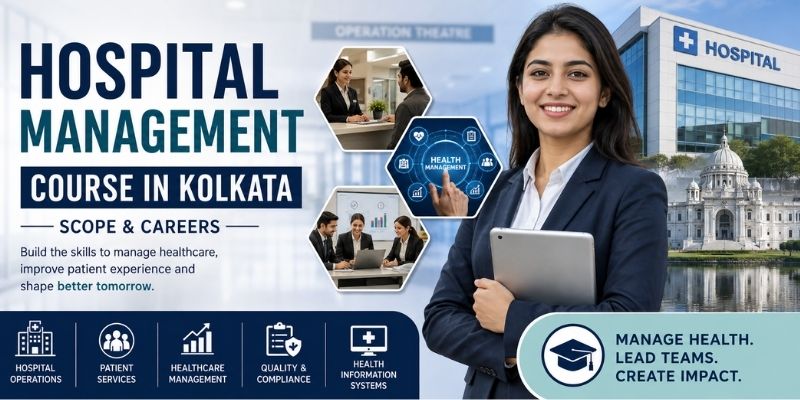
A Hospital Management Course in Kolkata can prepare students for the administrative, operational and managerial side of healthcare. The field is broader than hospital reception or paperwork: modern healthcare organisations need professionals who can coordinate operations, people, finance, patient services, quality systems and technology. That makes hospital management a practical career option for students interested in healthcare without pursuing a clinical profession.
For students comparing programmes, the Hospital Management Course in Kolkata offered by ISHM is one pathway to consider, particularly for graduates looking for management-focused preparation. The institute currently lists a two-year MBA/PGPM programme with eligibility of 10+2+3 in any stream.
What Is Hospital Management?
Hospital management is the discipline of managing the non-clinical and organisational functions that allow healthcare facilities to operate effectively. Hospital managers work around clinical teams rather than replacing them, helping ensure that people, resources, information and processes are coordinated properly.
In practical terms, this can involve patient services, staffing, budgets, procurement, medical records, quality processes, facility operations, communication and healthcare information systems. The exact responsibilities depend on the organisation and the employee’s level of experience.
Why Does Hospital Management Have Career Scope?
The healthcare system is becoming larger and more complex, which increases the importance of capable administrative and management professionals. WHO reports substantial expansion in India’s medical and nursing education infrastructure over the past decade, while also highlighting the need for a skilled, future-ready health workforce.
Healthcare is also becoming increasingly digital. The National Health Authority’s Ayushman Bharat Digital Mission is developing an interoperable digital-health ecosystem involving health facilities, healthcare professionals and technology platforms. For future administrators, this means understanding healthcare processes increasingly includes understanding how information and digital systems support those processes.
What Careers Can You Pursue After Hospital Management?
A hospital management qualification does not lead to one fixed job title. Instead, it can provide entry into several administrative and operational career tracks.
- Hospital administration: Supporting day-to-day administrative functions and coordination.
- Healthcare operations: Monitoring processes, resources, patient flow and departmental coordination.
- Patient services: Improving communication, service delivery and patient-facing processes.
- Healthcare quality: Supporting quality improvement, documentation and process standards.
- Health information management: Working with records, information systems and healthcare data processes.
- Healthcare HR: Supporting workforce administration, recruitment and employee coordination.
- Healthcare consulting: Assisting organisations with operational, strategic or process-related projects.
- Healthcare technology: Exploring roles connected with hospital information systems and digital healthcare operations.
The important point is that career growth usually comes from combining a qualification with practical experience. A degree may open the door, but operational understanding, communication, analytical ability and professional maturity help determine how far someone progresses.
What Skills Should Students Build?
The strongest hospital management students are not necessarily the ones who memorise the most theory. They are the ones who can understand a problem, communicate with different stakeholders and make sensible operational decisions.
1. Healthcare operations
Students should understand how departments interact and how delays in one part of a hospital can affect other services. Even a simple issue such as inefficient appointment scheduling can influence waiting times, staff workload and patient satisfaction.
2. Communication and leadership
Hospital administrators work with doctors, nurses, technicians, patients, vendors, support staff and senior management. Clear communication is therefore not a soft extra; it is a core management skill.
3. Financial understanding
Managers should be comfortable with budgets, costs, procurement, resource allocation and basic financial analysis. They do not need to become accountants, but they need to understand the financial consequences of operational decisions.
4. Digital and analytical skills
Healthcare is increasingly dependent on information systems. Understanding hospital information systems, data handling, reporting and digital workflows can give students a useful advantage as healthcare organisations become more technology-driven.
Which Course Path Is Right After Class 12?
Students completing Class 12 can consider undergraduate programmes such as BBA or BHM in Hospital Management. The objective is to build a foundation in management while learning how those principles apply to healthcare.
For example, ISHM’s current BBA in Hospital Management page lists a three-year bachelor’s degree plus one honours year, with eligibility of 10+2 in any stream. Its stated curriculum areas include healthcare finance, policy and economics, marketing, human resources, quality management and healthcare information systems.
Students should compare the curriculum carefully rather than choosing a programme simply because the course name sounds attractive. The subjects, practical training and exposure to healthcare environments matter more than the title alone.
What About MBA or PGPM in Hospital Management?
Postgraduate hospital management programmes are generally more appropriate for graduates who want advanced management preparation. They can be useful for students aiming towards administrative, operational, strategic or specialist management responsibilities within healthcare.
ISHM currently lists its MBA/PGPM Hospital Management programme as a two-year course for graduates from any stream. The programme description includes healthcare finance, healthcare ethics and law, operations, marketing, information systems and strategic management.
How Should You Choose a Hospital Management Institute in Kolkata?
Do not choose an institute only because it promises a job or advertises a particular salary. A better evaluation is to examine what you will actually learn and how much exposure you will receive before graduation.
- Check the curriculum: Look for operations, finance, HR, quality, healthcare law, information systems and management subjects.
- Look for practical exposure: Ask whether students receive hospital orientation, internships, projects or industry interaction.
- Evaluate faculty and learning support: Good teaching should connect management concepts with healthcare situations.
- Check the programme’s eligibility and duration: Make sure the qualification fits your current academic level and long-term plan.
- Understand career assistance: Examine placement assistance, professional development and industry connections without treating any employment claim as a guarantee.
What Is the Future of Hospital Management?
The future of hospital management is likely to be increasingly connected with digital systems, data, patient experience and operational efficiency. ABDM’s development of health-facility registries, digital health infrastructure and interoperable systems illustrates how technology is becoming part of the wider healthcare operating environment.
That does not mean every hospital manager needs to become a technology specialist. It means future managers should be comfortable working with technology-enabled processes and communicating effectively between clinical, administrative and technical teams.
Is Hospital Management a Good Career Choice?
It can be a strong choice for students who are interested in healthcare but want to work on the management side rather than in clinical practice. The field suits people who enjoy organisation, communication, problem-solving, coordination and responsibility.
However, students should enter the field with realistic expectations. Senior management positions normally require experience, and career progression is not determined by the qualification alone. Practical exposure, professional behaviour, analytical ability and continuous learning remain important throughout the career.
Frequently Asked Questions
What is the scope of a Hospital Management Course in Kolkata?
The scope includes hospital administration, healthcare operations, patient services, quality management, health information management, healthcare HR, consulting and healthcare technology-related functions.
Can I study hospital management after Class 12?
Yes. Undergraduate programmes such as BBA or BHM in Hospital Management are designed for students entering higher education after Class 12. Eligibility varies by institution.
Can a graduate pursue hospital management?
Yes. Graduates can consider postgraduate programmes such as MBA, PGPM, MHA or related healthcare-management qualifications, depending on the institute’s eligibility requirements.
Is hospital management a medical course?
No. Hospital management focuses primarily on administration, operations and management rather than diagnosing or treating patients. Students may nevertheless learn healthcare terminology, systems, ethics and organisational processes.
What skills are important for hospital administration?
Communication, leadership, operational thinking, financial awareness, analytical ability, problem-solving, digital literacy and an understanding of patient-centred service are particularly useful.
Conclusion
Hospital management is best understood as the operational backbone of healthcare. The people working in these roles may not provide clinical treatment, but they help create the systems through which healthcare services are organised and delivered. For students considering this career in Kolkata, the smartest starting point is to choose a programme that combines management fundamentals with genuine healthcare context, practical exposure and the ability to adapt to a changing digital healthcare environment.
Also Read: Skills You Develop at the Top Aviation Colleges in Kolkata
Blog Development Credits:
This blog was created through a collaborative effort. The idea was initiated by Soumyajit Sardar, with content support from AI tools like ChatGPT and Google Gemini, and refined by an experienced ISHM faculty member for clarity, SEO, and engagement.