

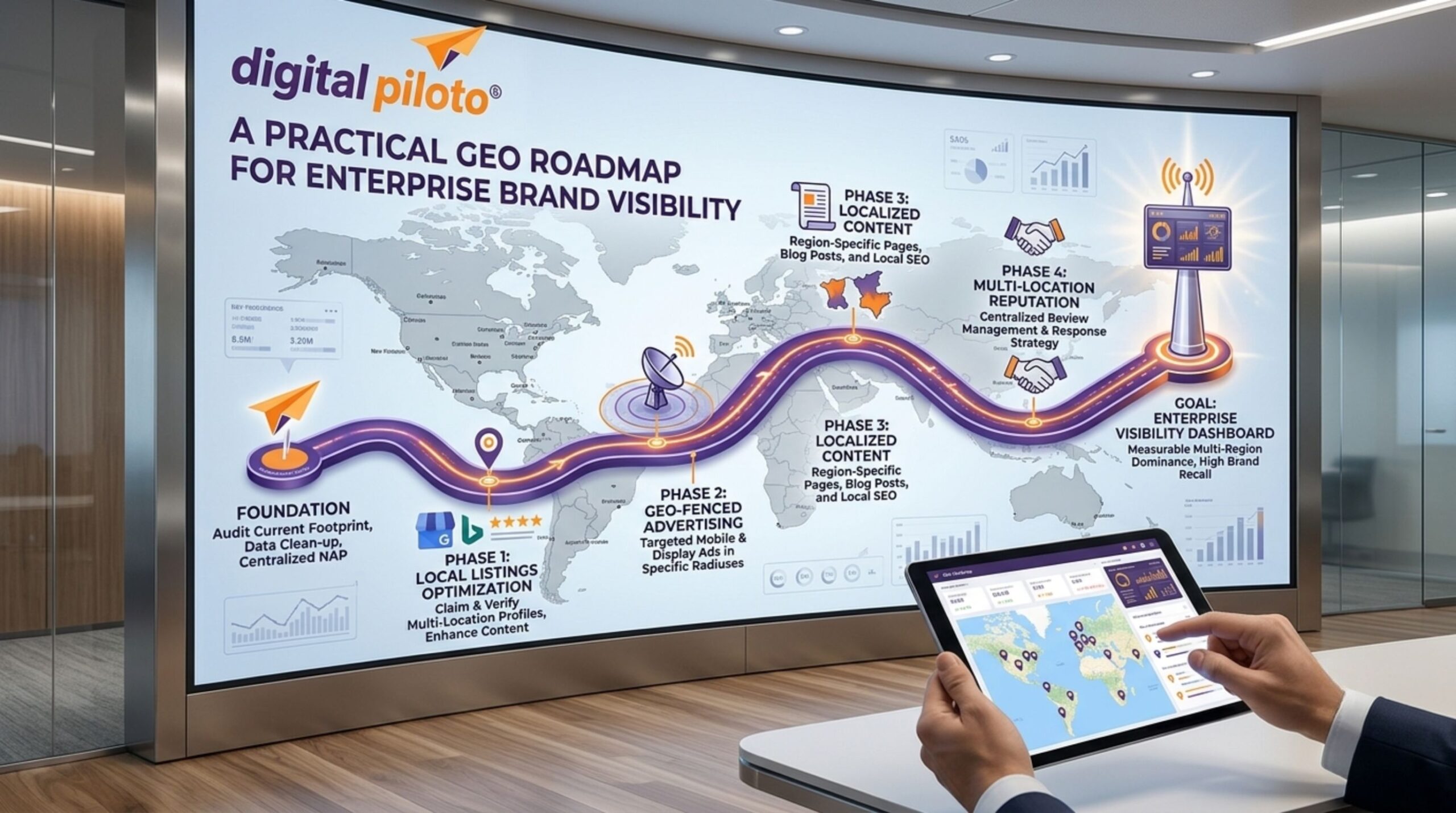
Enterprise brands have spent years building search visibility through rankings, content and authority. AI search changes the playing field without making those foundations obsolete. The challenge now is broader: how can a large organization become consistently understandable, useful and citable when customers ask complex questions through AI-powered search? A practical GEO roadmap starts there.
For a modern digital marketing agency, this means moving beyond isolated content optimization. Enterprise visibility increasingly depends on connected entities, trustworthy information, technical accessibility, first-hand expertise, structured content and consistent brand signals across a very large digital footprint.
Why Enterprise GEO Needs a Roadmap
Generative Engine Optimization, or GEO, is often discussed as though it were a checklist: add FAQs, write conversational content, publish more pages and hope an AI system mentions the brand.
Enterprise organizations quickly discover that reality is messier.
A global company may have thousands of URLs, multiple product lines, regional websites, different teams publishing content, separate technology stacks and dozens of external profiles. One department may describe a product differently from another. A regional page may contain information that conflicts with the corporate site. A useful research report may be buried three levels deep.
AI search makes those inconsistencies more noticeable because modern search experiences can interpret questions, combine information from multiple sources and present synthesized answers rather than simply displaying ten blue links.
Google reported in 2026 that AI Overviews had passed 2.5 billion monthly active users, while AI Mode had surpassed one billion monthly users. Google also said AI Mode queries had more than doubled every quarter since launch.
That scale does not mean every enterprise query happens inside an AI answer. It does mean that AI-assisted discovery has become too significant for large brands to treat as a side experiment.
GEO Starts With an Enterprise Visibility Audit
The first mistake is jumping directly into content production.
Before creating anything new, find out how the brand is already understood. Search for the company, major products, executives, service categories and important customer questions across conventional search and relevant AI search environments.
The objective is not to chase every answer generated by an AI system. Instead, look for patterns.
- Recognition: Does the system correctly identify the brand and its products?
- Context: Does it understand the industries, audiences and problems the company serves?
- Accuracy: Are product features, locations, pricing or business facts represented correctly?
- Evidence: Are authoritative and original sources available to support important claims?
- Competitor context: In which questions does the brand appear, disappear or get misunderstood?
This baseline becomes important later. Without it, an enterprise can spend months producing content without knowing whether its actual visibility problem has changed.
Step 1: Build a Strong Brand Entity
AI systems need more than individual pages. They need context.
Imagine a customer asking, “Which companies provide enterprise cybersecurity solutions for financial institutions?” A useful answer requires the system to understand relationships between a company, its products, industries, locations, expertise and reputation.
That is why enterprise entity SEO should sit near the beginning of a GEO program.
Review the organization’s digital identity across:
- Corporate information: company name, subsidiaries, locations, leadership and official descriptions.
- Product relationships: product names, categories, use cases, industries and customer segments.
- Structured data: relevant Organization, Product, LocalBusiness and other appropriate schema implementations.
- External references: reputable publications, industry organizations, partners, analyst sources and other credible mentions.
- Consistency: descriptions, names, facts and terminology across websites and important third-party profiles.
The goal is straightforward: reduce ambiguity.
A strong enterprise entity foundation gives search systems a clearer picture of what the organization actually represents.
Step 2: Turn Expertise Into Searchable Evidence
Enterprise websites often contain enormous amounts of information but surprisingly little evidence of first-hand expertise.
There may be hundreds of generic articles about an industry, yet very few original studies, technical explanations, implementation guides, customer insights or expert commentary.
That is a missed opportunity.
Google has increasingly emphasized original content and first-hand perspectives in its AI-search experiences. Its 2026 updates also introduced features designed to help users discover original content and relevant websites within generative search.
For an enterprise, the practical lesson is not “publish more.” It is “publish things only your organization is particularly qualified to explain.”
Examples of high-value evidence
- Original research and proprietary data.
- Detailed implementation experiences.
- Technical documentation written by subject-matter experts.
- Customer case studies with meaningful business context.
- Executive or specialist commentary on emerging industry problems.
- Original frameworks, benchmarks, calculators or research methodologies.
These assets give AI systems something more useful to discover than another generic summary of information already available everywhere.
Step 3: Redesign Content Around Customer Questions
Traditional enterprise content planning often begins with keyword groups. GEO requires a wider view of the customer’s information journey.
Instead of building a content calendar around isolated phrases, map the questions people ask before, during and after a buying decision.
For example, a technology buyer might move through questions such as:
“What is this technology?”
“How does it compare with alternatives?”
“Is it suitable for my industry?”
“What does implementation involve?”
“What risks should I consider?”
“What does it cost?”
“Which vendors have relevant experience?”
Each question represents a different information need.
This is particularly important because AI search encourages longer and more conversational queries. Google has described users as asking increasingly complex and multimodal questions through its newer Search experiences.
Enterprise content should therefore be organized around decisions, not merely keywords.
Step 4: Build an AI-Readable Content Architecture
Excellent content can still underperform if important information is difficult to access or interpret.
Large websites should review technical fundamentals before assuming the problem is content quality. Google continues to state that its foundational SEO practices remain relevant for AI features, including making pages accessible to search systems and eligible for normal Search visibility.
A GEO-focused technical review should examine:
- Indexability and crawl accessibility.
- Internal linking between related products, services and expertise pages.
- Clear headings and logical content hierarchy.
- Structured data where appropriate.
- Canonicalization and duplicate-content control.
- Regional and multilingual content consistency.
- Page experience and mobile accessibility.
- Whether important information is hidden behind unnecessary interaction barriers.
There is also a useful strategic principle here: do not create technical complexity simply because AI is involved. Google’s 2026 documentation specifically clarified that llms.txt is not required for Google Search and does not provide a positive or negative ranking effect there.
Step 5: Connect GEO With Traditional SEO
GEO should not become a separate marketing island.
An enterprise SEO company or internal search team already manages many of the foundations that GEO depends on: technical accessibility, information architecture, content quality, internal linking and authority.
The difference is the optimization objective.
Traditional SEO often asks, “Can this page rank for a relevant search?”
GEO adds another question: “Can the information on this page contribute meaningfully to an AI-generated answer when the customer asks a related question?”
Those objectives overlap considerably, but they are not identical.
A page can rank for a narrow keyword yet provide little useful context for a complex question. Conversely, a deeply useful research page may support AI discovery even when it was not created around one obvious keyword.
The strongest enterprise strategy therefore combines both.
Step 6: Develop a Generative AI Search Optimization Layer
Once the technical and content foundations are established, the enterprise can introduce a dedicated generative AI search engine optimization layer.
This layer should focus on the information that matters most to business visibility:
- Which questions matter commercially?
- Which product and service facts need stronger evidence?
- Which pages answer high-value questions directly?
- Which external sources reinforce the brand’s expertise?
- Where are AI-generated descriptions inaccurate or incomplete?
- Which content assets deserve updating or deeper development?
The key word is layer. GEO should strengthen the existing digital ecosystem rather than create an entirely separate content machine.
Step 7: Create an Enterprise Measurement Framework
Measurement is where many GEO programs become vague.
“Our brand appeared in an AI answer” sounds useful, but it is not enough to build an enterprise reporting system around one observation.
Instead, track multiple signals.
Visibility signals can include brand mentions, product mentions, relevant question coverage and citation presence.
Quality signals can include factual accuracy, source quality, correct product descriptions and appropriate positioning.
Business signals should connect AI-assisted discovery with branded searches, referral traffic where measurable, assisted conversions, qualified leads and revenue.
Google introduced new Search Console capabilities in 2026 to give website owners more insight into performance within its generative AI Search experiences.
That matters because enterprise GEO should eventually become measurable enough for marketing, product and executive teams to discuss in business terms—not just screenshots of AI answers.
Step 8: Add Governance Before Scaling
Enterprise GEO eventually touches brand claims, product information, legal language, regional content and potentially sensitive business data. Governance cannot be an afterthought.
McKinsey’s 2026 AI Trust Maturity research identified security and risk concerns as the leading barrier to scaling agentic AI, with inaccuracy and cybersecurity among frequently cited risks. It also found that clear accountability was associated with stronger responsible-AI maturity.
For GEO, governance can include:
- Approved terminology for products, services and corporate entities.
- Owners for high-value content and factual claims.
- Review workflows for regulated or sensitive industries.
- Processes for correcting inaccurate information.
- Clear rules for AI-assisted content production.
- Regular monitoring of brand representation across important search environments.
This is especially important at enterprise scale. A small factual inconsistency on one page may be harmless. The same inconsistency replicated across hundreds of regional pages can become a genuine brand problem.
The 90-Day Enterprise GEO Roadmap
For organizations that want a practical starting point, the first 90 days can be divided into three phases.
Days 1–30: Diagnose
Audit brand and product visibility, identify important customer questions, review technical accessibility, map entities and relationships, inventory existing evidence, and establish baseline AI-search observations.
Days 31–60: Strengthen
Fix inconsistent business information, improve priority pages, strengthen internal linking, publish or update high-value evidence, improve structured data and create answer-focused content around important customer decisions.
Days 61–90: Measure and Scale
Monitor visibility patterns, validate factual accuracy, compare priority topics over time, connect observations with business metrics and determine which improvements should be rolled out across regions, products or business units.
This phased approach is deliberately unglamorous. That is a feature, not a weakness. Enterprise GEO is infrastructure work as much as it is content work.
What the Future Enterprise Search Strategy Looks Like
AI search will continue to evolve, so no enterprise should build a strategy around one platform’s current interface.
The more durable approach is to build a brand that is easy to understand across systems.
That means clear entities. Useful content. Original evidence. Accessible websites. Consistent terminology. Strong internal relationships between information. Credible external references. And measurement that connects visibility with actual customer behavior.
McKinsey’s 2026 research found that 44% of surveyed organizations reported AI scaling across the enterprise, up from 38% a year earlier. At larger organizations, 54% reported enterprise-wide AI scaling compared with one-third among smaller organizations.
That broader AI adoption matters for GEO because enterprise search visibility will increasingly sit inside a wider AI-enabled customer journey. Discovery, research, comparison, recommendation and even action may become connected.
The brands prepared for that environment will not necessarily be those that publish the most. They will be the ones whose information is the clearest, most credible and most useful when an intelligent system needs to explain them.
Frequently Asked Questions
What is GEO for enterprise brands?
GEO, or Generative Engine Optimization, is the practice of improving a brand’s digital information so it can be better understood, retrieved, referenced and represented in AI-powered search and answer environments. It complements rather than replaces traditional SEO.
Is GEO different from enterprise SEO?
Yes, although the two overlap. Enterprise SEO focuses heavily on organic search visibility, technical accessibility, rankings and traffic. GEO adds greater emphasis on entity clarity, answer readiness, evidence, AI-generated representations and visibility across conversational search experiences.
How long does an enterprise GEO strategy take?
There is no universal timeline. Large organizations can establish a baseline and begin priority improvements within a few months, but meaningful enterprise-wide change usually requires ongoing technical, content, governance and measurement work.
Can a company guarantee AI citations through GEO?
No. AI search systems use changing retrieval, ranking and generation processes, and no legitimate GEO method can guarantee a particular citation or recommendation. The practical objective is to make authoritative, useful and well-supported information easier for relevant systems to discover and use.
Final Thoughts
Enterprise GEO is not about finding a secret formula for appearing inside an AI answer. It is about making the organization itself easier to understand. When technical foundations, entity clarity, original expertise, useful content, trustworthy evidence and measurement work together, AI-search visibility becomes part of a stronger digital ecosystem—not another isolated marketing tactic.
Blog Development Credits
This article was conceptualized by Amlan Maiti, developed through AI-assisted research and writing, and finally refined and SEO-optimized by Digital Piloto Private Limited.