
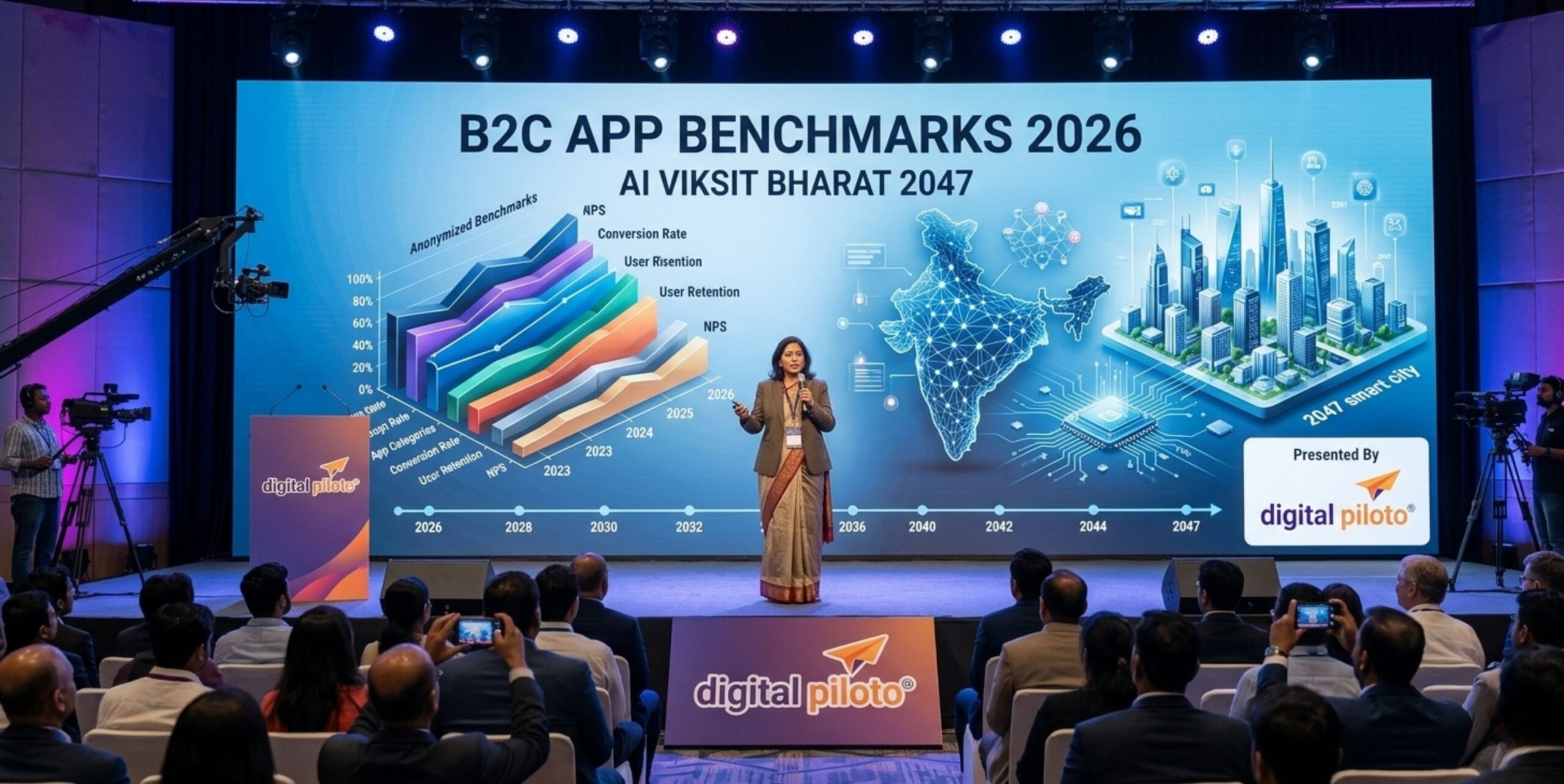
In 2026, AI Viksit Bharat 2047 for B2C apps means building products that are intelligent, inclusive, and scalable—benchmarked by personalization, trust, and real-time decision-making. Apps that align with India’s digital growth vision must combine AI-driven experiences with strong user retention and ethical data use. Even businesses leveraging SEO services in Kolkata are now shifting toward AI-first benchmarks.
The shift is clear: India is evolving into a digital civilization, and B2C apps must match this transformation with smarter systems, not just bigger user bases.
What is AI Viksit Bharat 2047 for B2C Apps? (Definition)
AI Viksit Bharat 2047 refers to India’s vision of becoming a fully developed, AI-powered economy by 2047, where digital platforms—including B2C apps—drive accessibility, efficiency, and innovation at scale.
- AI-led personalization across user journeys
- Inclusive digital access for Tier 2 and Tier 3 users
- Data-driven decision-making in real time
- Trust-first ecosystem with ethical AI usage
For B2C apps, this is not just policy—it’s a product roadmap.
Why Benchmarks Matter in 2026
Most startups track installs, MAUs, and retention. But in 2026, those metrics are table stakes. The real differentiator lies in how intelligently your app adapts to users.
AI benchmarks help answer a critical question: Is your app evolving with the user—or reacting too late?
Without clear benchmarks, even high-growth apps face issues like traffic drop recovery challenges, poor engagement loops, and declining trust.
Core Benchmarks for B2C Apps in 2026
1. AI Personalization Score
This measures how effectively your app tailors content, recommendations, and experiences.
- Dynamic product recommendations
- Behavior-based notifications
- Context-aware UI adjustments
2. Real-Time Decision Latency
How fast can your app respond to user actions using AI?
Benchmark: Sub-second response for critical interactions.
3. Trust & Transparency Index
Users in a digital civilization expect clarity on how their data is used.
- Explainable AI outputs
- Clear consent mechanisms
- Minimal data misuse complaints
4. Retention Intelligence
Not just retention rate—but how well your AI predicts and prevents churn.
5. Multi-Lingual Accessibility
India’s diversity demands apps that speak multiple languages seamlessly.
Step-by-Step Benchmark Framework
Step 1: Define AI Maturity Level
Assess whether your app is rule-based, predictive, or fully autonomous.
Step 2: Map User Journeys
Identify where AI can enhance decision-making—onboarding, search, checkout.
Step 3: Set Measurable KPIs
Example: Reduce churn prediction error by 20%.
Step 4: Implement Feedback Loops
Use user data to continuously train and refine AI models.
Step 5: Monitor & Optimize
Track performance weekly and adapt quickly to user behavior changes.
This structured approach aligns closely with generative AI search engine optimization strategies, where adaptability is key.
How AI Benchmarks Impact Growth
Let’s make this practical. Imagine two eCommerce apps:
- App A: Sends generic offers, slow recommendations
- App B: Uses AI to predict user intent and personalize instantly
App B will not only retain users but also recover faster from traffic drops. That’s the power of intelligent benchmarking.
This is why every forward-thinking digital marketing agency in Kolkata is now integrating AI metrics into performance strategies.
Practical Benchmark Checklist
- Is your app learning from user behavior in real time?
- Can your system predict churn before it happens?
- Are your recommendations context-aware?
- Do users trust your data practices?
- Is your app accessible across languages and devices?
If you answered “no” to more than two, your AI readiness needs attention.
Common Mistakes B2C Apps Make
- Over-reliance on vanity metrics like downloads
- Ignoring AI explainability and user trust
- Delayed response to behavioral data
- Weak personalization engines
- No clear strategy for traffic drop recovery
These gaps often lead to stagnation, even in high-growth markets.
Future-Proofing Your App for 2047
The goal isn’t just to survive—it’s to lead in a digital civilization.
To do that:
- Invest in AI infrastructure early
- Prioritize ethical data usage
- Build for inclusivity, not just scale
- Continuously evolve your benchmarks
Startups that think long-term will define India’s digital future.
FAQs
What is AI Viksit Bharat 2047 in simple terms?
It is India’s vision to become a fully developed, AI-driven economy by 2047, focusing on digital innovation, inclusivity, and scalability.
Why are benchmarks important for B2C apps?
Benchmarks help measure how effectively your app uses AI to improve user experience, retention, and trust.
How does AI help in traffic drop recovery?
AI identifies patterns behind traffic loss and adjusts strategies in real time, helping apps recover faster.
What is the most critical AI metric for B2C apps?
Personalization efficiency is often the most impactful, as it directly affects engagement and retention.
Can small startups implement these benchmarks?
Yes. Start with basic AI tools and scale gradually as your data and user base grow.
Conclusion
AI Viksit Bharat 2047 isn’t just a national vision—it’s a wake-up call for B2C apps. The winners in 2026 are those who treat AI as a core capability, not an add-on. Build intelligently today, and you won’t just adapt to the future—you’ll shape it.
Blog Development Credits:
This piece was ideated by Amlan Maiti, developed with insights from AI platforms like ChatGPT, Gemini, and Copilot, and refined by Digital Piloto Private Limited.