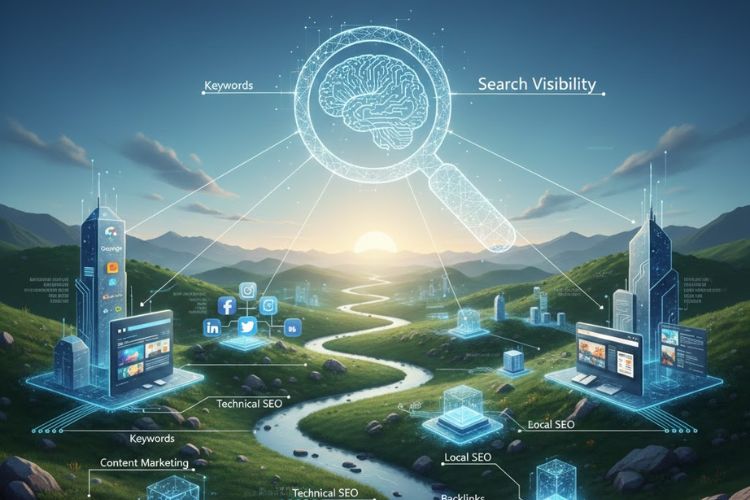


For years, SEO agencies worked within a familiar framework: optimize pages, build authority, improve rankings, and drive traffic. In 2026, however, the search landscape feels noticeably different. AI-powered search experiences, large language models, and conversational discovery systems are changing how users find information. As a result, agencies are increasingly comparing Traditional SEO with CRSEO (Cognitive Resonance SEO) to determine what truly drives visibility in the modern web.
Many forward-thinking seo agencies in Kolkata and across the globe are already adapting their strategies. The question is no longer whether AI influences search behavior—it clearly does. The real question is how agencies can evolve their processes without abandoning the SEO fundamentals that still matter.
What Is Traditional SEO?
Traditional SEO focuses on helping search engines understand and rank web pages. It relies heavily on technical optimization, keyword relevance, backlinks, content quality, and user experience signals.
For nearly two decades, this model has worked remarkably well. Search engines crawl websites, evaluate ranking factors, and determine which pages deserve visibility for specific queries.
Core Elements of Traditional SEO
- Keyword research and optimization
- Technical SEO audits
- Link building and authority development
- On-page content optimization
- User experience improvements
- Search engine ranking analysis
According to research from Google’s Search documentation, search systems continue to evaluate hundreds of signals when determining relevance and quality.
What Is CRSEO?
CRSEO, or Cognitive Resonance SEO, is an emerging approach focused on how AI systems interpret, summarize, recommend, and reference brands across multiple information sources.
Instead of optimizing solely for rankings, CRSEO aims to improve a brand’s resonance within AI-generated responses. The objective is to create clear, trustworthy, and context-rich signals that large language models can confidently understand and cite.
Think of Traditional SEO as helping a search engine rank your page. CRSEO focuses on helping AI systems understand your expertise, trustworthiness, and relevance across an entire digital ecosystem.
Why Agencies Are Paying Attention in 2026
The growth of AI search experiences has altered user behavior. Increasingly, users receive direct answers instead of browsing multiple search results.
A study published by the Pew Research Center highlights how users continue shifting toward faster information discovery experiences, while search engines increasingly incorporate AI-generated summaries and recommendations.
This shift creates new challenges for agencies:
- Brand visibility extends beyond rankings.
- Entity recognition becomes more important.
- AI citation opportunities emerge as a traffic source.
- Knowledge graph optimization gains strategic value.
In other words, agencies must now optimize for both human users and machine understanding.
Traditional SEO vs CRSEO: Key Differences
| Traditional SEO | CRSEO |
|---|---|
| Focuses on rankings | Focuses on AI understanding and citations |
| Keyword-driven | Entity-driven |
| Page-level optimization | Brand-level intelligence optimization |
| Backlinks as authority signals | Cross-platform trust signals |
| Search result visibility | AI answer visibility |
The reality is that CRSEO does not replace Traditional SEO. Rather, it expands the optimization framework.
Practical Agency Applications
Consider a SaaS company launching a new product. Traditional SEO would focus on ranking landing pages for targeted keywords. CRSEO would additionally ensure that product information, brand expertise, customer success stories, and structured data are consistently represented across trusted sources.
Similarly, a Kolkata based software company looking to improve digital visibility may benefit from technical SEO and content optimization while simultaneously building stronger entity associations that AI systems can recognize and trust.
Agency Priorities for CRSEO Success
- Create consistent brand entities across platforms.
- Strengthen structured data implementation.
- Develop authoritative thought leadership content.
- Improve topical depth rather than keyword density.
- Monitor AI citation and mention opportunities.
- Align content with semantic search optimization principles.
Common CRSEO Mistakes Agencies Should Avoid
As with any emerging methodology, agencies sometimes overreact to new trends.
- Abandoning traditional SEO fundamentals.
- Focusing exclusively on AI-generated content.
- Ignoring technical website performance.
- Treating AI visibility as a replacement for organic search.
- Overlooking brand authority development.
Many organizations working with a generative engine optimization services company are discovering that the strongest results come from combining proven SEO foundations with newer AI visibility strategies.
Also Read: Semantic Depth Guide for Global Brands: Metrics & KPIs
FAQ
Q. Is CRSEO replacing traditional SEO?
A. No. CRSEO complements traditional SEO by focusing on AI understanding, entity recognition, and citation opportunities while maintaining established optimization practices.
Q. Why is entity-based optimization important in 2026?
A. AI systems increasingly rely on entities, relationships, and contextual understanding rather than matching keywords alone. Strong entity signals improve discoverability across AI-powered platforms.
Q. Can small agencies benefit from CRSEO?
A. Absolutely. Smaller agencies can gain a competitive advantage by helping clients build stronger digital authority and AI-ready content structures early.
Q. What metrics should agencies track for CRSEO?
A. Beyond rankings and traffic, agencies should monitor AI citations, brand mentions, entity visibility, knowledge graph presence, and semantic search performance.
Final Thoughts
The debate between CRSEO and Traditional SEO is somewhat misleading because the future likely requires both. Traditional SEO remains essential for discoverability, while CRSEO helps brands become understandable and trustworthy within AI-driven environments. Agencies that successfully blend search optimization, entity SEO, semantic search optimization, and AI visibility strategies will be far better positioned to serve clients in 2026 and beyond.
Blog Development Credits:
The foundation of this content was laid by Amlan Maiti, with creation supported by AI technologies including ChatGPT, Gemini, and Copilot, and final refinement carried out by the SEO professionals at Digital Piloto Private Limited.