

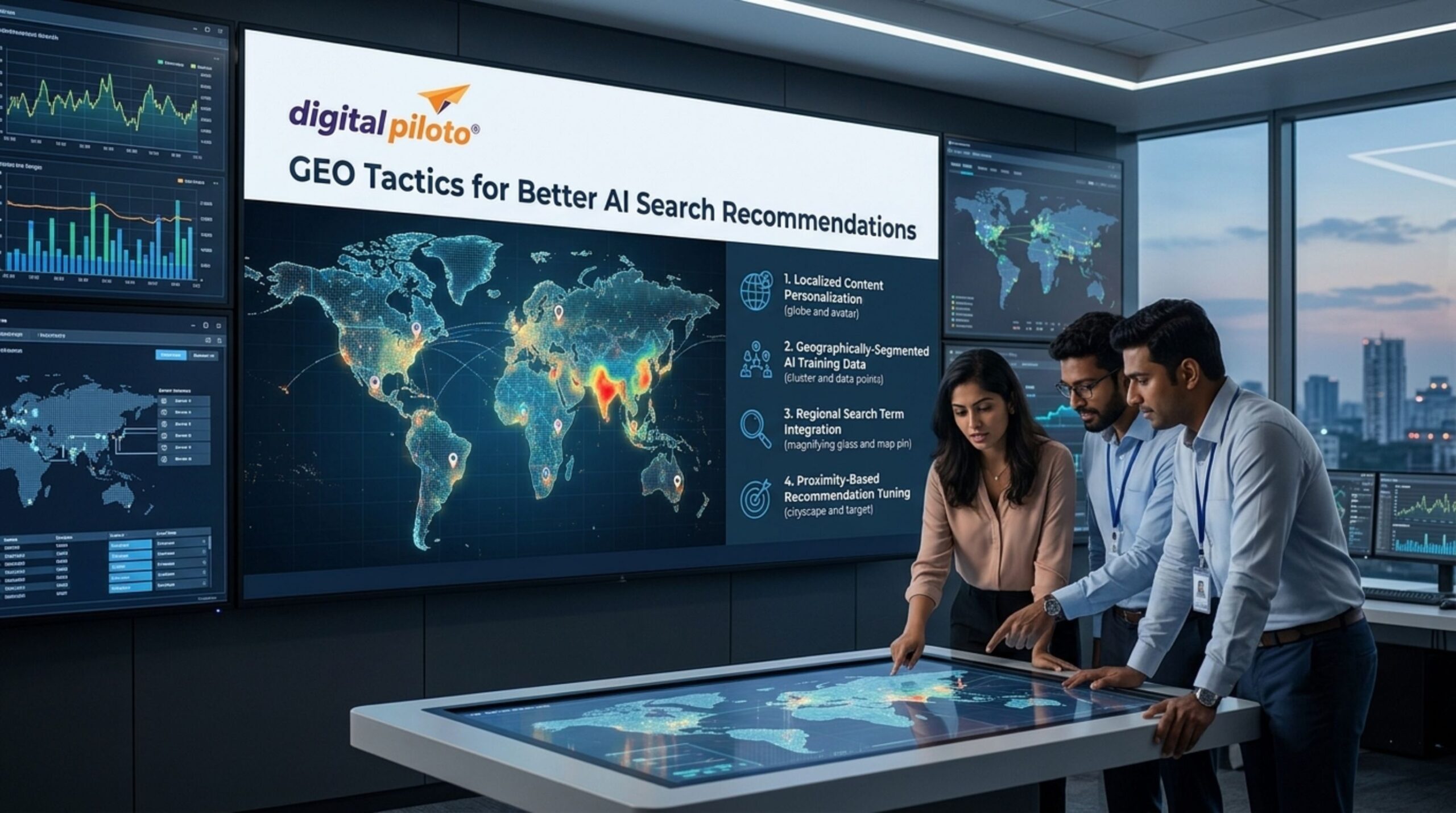
When customers ask an AI assistant, “Which company should I choose?”, your website is no longer competing only for a blue-link position. It is competing to become part of the answer. That changes the game. The practical goal of GEO is not to trick AI systems, but to make your brand easier to discover, understand, verify and recommend.
For businesses already investing in digital marketing companies in India, this shift creates a useful question: is your current SEO strategy helping an AI system understand why your business deserves consideration?
What Is GEO for AI Search Recommendations?
Generative Engine Optimization (GEO) is the practice of improving a brand’s content and broader web presence so that generative AI systems can discover, understand, cite and potentially recommend it when answering relevant questions.
That sounds similar to SEO—and there is considerable overlap. In fact, Google says its generative AI search experiences are rooted in core Search ranking and quality systems, meaning fundamental SEO remains important. Google also says there are no special requirements, AI-specific files or special schema needed to appear in AI Overviews or AI Mode.
The difference is largely in the outcome you are watching. Traditional SEO asks, “Where does my page rank?” GEO adds another question: “When a potential customer asks an AI system for a recommendation, is my brand part of the answer—and is it described correctly?”
Why AI Recommendations Matter More Now
Recommendation-style searches are particularly important because they often happen closer to a decision. Someone asking, “What is SEO?” is exploring. Someone asking, “Which SEO agency should a SaaS company consider?” is evaluating options.
That distinction matters.
BrightLocal’s 2026 consumer research found that 45% of surveyed consumers had used AI tools for local-business recommendations during the previous year, compared with 6% in its previous year’s research. The research was conducted in the United States, so the figure should not be treated as a worldwide adoption rate. Still, it provides a useful signal: AI-assisted recommendations are moving into real consumer decision-making.
There is another interesting wrinkle. BrightLocal found that many consumers still verify AI recommendations through reviews and other sources. In other words, an AI recommendation can open the door, but evidence still helps close the sale.
The AI Recommendation Stack
A useful way to approach GEO is to think of your online presence as a stack. If the lower layers are weak, polishing the top layer will not save you.
- Accessibility: Can search systems crawl and retrieve your important pages?
- Entity clarity: Is it obvious who you are, what you offer and who you serve?
- Answerability: Can your content directly answer the questions buyers ask?
- Evidence: Do you provide facts, comparisons, specifications, methodology and original insight?
- Corroboration: Do credible independent sources support your positioning?
- Freshness: Are important facts, products, pricing and company information current?
- Measurement: Are you testing whether AI systems actually mention or cite you?
This is much more sustainable than trying to discover a secret “GEO hack.”
1. Make Your Brand Entity Crystal Clear
AI systems need to understand relationships. A company is not merely a collection of keywords; it is an entity connected to services, locations, industries, people, products and external references.
Your website should make those relationships obvious.
For example, a B2B software company should clearly communicate its product category, ideal customer, major use cases, integrations, pricing model and differentiators. A professional-services firm should clearly establish its services, expertise, locations, industries and leadership.
Avoid making visitors—and search systems—piece together your identity from scattered fragments.
A simple entity-clarity test
- What exactly does the company sell?
- Who is the product or service for?
- Which problems does it solve?
- What makes it meaningfully different?
- Where does it operate?
- Which people, products or organizations are associated with it?
If a human can answer these questions in seconds, you have already made your brand easier to understand.
2. Build Pages Around Real Recommendation Questions
One of the most practical GEO tactics is surprisingly ordinary: create genuinely useful pages around the questions customers actually ask.
Do not stop at broad keywords such as “CRM software” or “digital marketing agency.” Think about the questions that appear later in the decision journey:
- Which CRM is best for a growing B2B sales team?
- What should an ecommerce brand look for in an SEO agency?
- Which payment platform is suitable for international subscriptions?
- What are the alternatives to a particular product?
- How much does this service typically cost?
- Which solution is better for a small company versus an enterprise?
These questions naturally create comparison, evaluation and recommendation contexts—the environments where AI-generated answers can become commercially interesting.
3. Give AI Systems Something Worth Recommending
Generic content is easy to produce. That is precisely why it is becoming less valuable.
Google’s current generative-AI guidance emphasizes valuable, unique and non-commodity content. It specifically encourages original viewpoints, useful expert perspectives and information that goes beyond material that could easily be reproduced from existing sources.
That principle is powerful for GEO because recommendation systems need reasons to distinguish one option from another.
Instead of writing another generic article about “10 Benefits of Digital Marketing,” consider publishing:
- Original research from your own legitimate data.
- Detailed product or service comparisons.
- Transparent methodology pages.
- Real implementation guides.
- Original industry benchmarks where the underlying data is genuine.
- Detailed explanations of unusual problems your audience faces.
The objective is not to manufacture authority. It is to publish information that actually deserves to be referenced.
4. Optimize for Evidence, Not Just Keywords
Keywords tell a search engine what a page discusses. Evidence helps establish why the information should be trusted.
Consider a company that claims to be “the best solution for enterprise ecommerce.” That statement alone is weak. A stronger page could explain supported platforms, implementation requirements, integrations, security capabilities, geographic availability, customer segments, limitations and comparison criteria.
Now the page contains useful decision material.
That is the direction businesses should take with generative AI search engine optimization: make important claims easier to verify rather than simply repeating promotional language.
5. Earn Independent Corroboration
Your own website controls your narrative. It does not automatically make every claim credible.
AI systems can draw on information from across the web, and current research suggests that the broader information environment around a brand can influence how that brand is represented.
This is where digital PR, expert contributions, industry publications, reputable directories, reviews, partnerships, interviews and other legitimate third-party references can become useful.
The important word is legitimate.
Buying hundreds of low-quality mentions simply to create the appearance of authority is not a durable strategy. Neither is manufacturing reviews or publishing fake “expert” commentary.
A better question is: Where would a knowledgeable buyer expect to see evidence that this company is credible?
6. Keep Commercial Facts Consistent
AI recommendations become awkward when the web contains contradictory information.
Imagine your website says a product supports ten integrations, an industry directory lists seven, an old article says five, and a third-party review uses outdated pricing. Even if an AI system finds your brand, it has a messy evidence environment to interpret.
Review important facts across your website and major external profiles:
- Company name and description
- Products and services
- Locations
- Contact information
- Pricing information
- Product specifications
- Leadership and expertise
- Business hours where relevant
For local businesses, this consistency becomes even more important because consumers often use multiple channels before making a decision.
7. Make Your Pages Easy to Retrieve and Understand
GEO does not remove the need for technical SEO. It makes technical clarity more important.
Google recommends allowing crawling, using internal links to make content discoverable, providing important information in textual form, maintaining good page experience and ensuring structured data matches visible page content.
OpenAI separately states that websites seeking inclusion in ChatGPT Search should allow OAI-SearchBot to crawl the relevant content and ensure hosting or CDN infrastructure does not block it.
So before spending money on an elaborate GEO campaign, check the basics.
Technical GEO checklist
- Important pages are indexable.
- Robots.txt does not accidentally block useful content.
- Internal links connect related topics.
- Important information is available as crawlable text.
- Structured data accurately reflects visible information.
- Website security layers do not unintentionally block legitimate crawlers.
- Outdated pages and duplicate versions are reviewed.
8. Test AI Recommendations Like a Search Campaign
One of the biggest mistakes in GEO is assuming that a page is optimized simply because it looks good.
Test it.
Create a controlled list of realistic buyer prompts and run them periodically across the AI platforms relevant to your audience. Look beyond whether your brand appears.
Record:
- Presence: Was the brand mentioned?
- Position: Was it presented as a leading option or a minor alternative?
- Context: Why was it recommended?
- Accuracy: Were the description and facts correct?
- Sources: Which websites or pages supported the answer?
- Competition: Which brands appeared instead?
- Action: Did the answer contain a useful path toward evaluation?
This turns GEO from a vague concept into an observable research process.
9. Measure More Than AI Mentions
A mention can be interesting. It is not necessarily valuable.
For a business, the measurement hierarchy should move from visibility toward commercial impact:
AI presence → citations → qualified referral traffic → branded searches → enquiries → opportunities → revenue.
Google has made this measurement environment more concrete. Its Search Console generative-AI performance reports provide dedicated visibility into impressions from generative AI features such as AI Overviews and AI Mode, with reporting around pages, countries, devices and dates.
That does not measure every AI platform or every recommendation. But it is an important step toward separating speculation from observable search performance.
10. Connect GEO With Traditional SEO
GEO should not become a parallel marketing universe.
A strong technical foundation, useful content, internal linking, authoritative references and clear information can support both conventional search and AI discovery. Google’s own guidance makes this overlap explicit.
For companies investing in SEO services in India, the opportunity is therefore less about replacing SEO with GEO and more about expanding the definition of search visibility.
One page can rank in Google, appear as a supporting source in an AI Overview, be referenced by an AI assistant, and influence a branded search later. Those are different outcomes—but they can originate from the same strong information architecture.
What GEO Tactics Should You Avoid?
Not every tactic marketed as “AI optimization” deserves your budget.
- Do not create hundreds of near-identical AI pages. More pages do not automatically create more authority.
- Do not invent statistics or expert opinions. AI visibility built on unreliable information is fragile.
- Do not chase fake mentions. Quantity is a poor substitute for genuine corroboration.
- Do not obsess over special AI files. Google explicitly says special AI files are not required for AI Overviews or AI Mode.
- Do not measure GEO only by mentions. A mention with an inaccurate description may be worse than no mention.
Google’s current guidance specifically warns against producing content variations primarily to manipulate rankings or generative responses and emphasizes helpful, people-first, non-commodity content.
A Practical 90-Day GEO Roadmap
Days 1–30: Establish the foundation
Audit crawlability, indexation, internal linking, structured data, brand information and important commercial pages. Build a list of realistic recommendation prompts and establish a baseline for AI visibility.
Days 31–60: Build recommendation-ready content
Improve priority service and product pages. Create useful comparison, alternative, pricing, use-case and problem-solving content. Add genuine evidence and strengthen relevant internal links.
Days 61–90: Expand authority and measure
Identify gaps where competitors are being cited or recommended. Develop legitimate third-party visibility, update outdated information, repeat prompt testing and compare AI visibility with organic search and business outcomes.
The Bigger Strategic Shift
The most important change is conceptual.
For years, businesses asked, “How do I rank for this keyword?” Increasingly, they also need to ask, “How does the digital ecosystem describe my company when someone asks for a solution like mine?”
That second question is bigger than on-page SEO. It includes your website, content, reputation, product information, third-party references, technical accessibility and the clarity of your positioning.
And there is no guaranteed shortcut. AI systems change, their sources change, and their answers can vary from one query to another. Even OpenAI says ChatGPT Search placement cannot be guaranteed.
That is why the most durable GEO strategy is not about manipulating an answer engine. It is about building a business that has enough useful, verifiable information around it for answer engines to understand what the business is, why it matters and when it is genuinely relevant.
Frequently Asked Questions
What is the best GEO tactic for AI search recommendations?
Start with clear entity information and genuinely useful, evidence-rich content. Then strengthen technical accessibility, internal linking, credible third-party corroboration and ongoing AI prompt testing. There is no single tactic that guarantees recommendations.
Does SEO help a brand appear in AI recommendations?
Yes, particularly as a foundation. Google states that its generative AI search features are rooted in core Search ranking and quality systems, so crawlability, useful content, internal links and other SEO fundamentals remain relevant.
How can I get my company recommended by ChatGPT?
There is no guaranteed submission or ranking formula. OpenAI says websites should allow OAI-SearchBot to crawl relevant content for eligibility in ChatGPT Search. Beyond accessibility, businesses should build clear, useful and credible web information that genuinely supports their relevance to customer questions.
Should businesses create separate content specifically for GEO?
Not necessarily. Strong SEO content can often serve both traditional search and AI discovery. Create separate resources only when they address a genuine audience need rather than producing duplicate pages simply to target different AI prompts.
Final Thoughts
AI search recommendations are changing the meaning of online visibility. A business can no longer think only about where a page ranks; it also needs to consider whether its brand is understandable, credible and useful enough to enter an AI-generated answer.
The smartest GEO tactics are therefore surprisingly human: explain things clearly, publish something worth referencing, prove important claims, keep information current, earn genuine recognition and make your website technically accessible. Do those things consistently, and you are not merely optimizing for today’s AI search interface—you are building a stronger digital presence for whatever comes next.
Blog Development Credit
Conceptualized by Amlan Maiti, with research and content development supported by AI-assisted analysis; final SEO and GEO refinement was completed by the Digital Piloto Team.