

AI development is no longer an experimental technology reserved for large enterprises or research labs. Today, artificial intelligence is helping businesses automate decisions, improve customer experiences, predict outcomes, and create entirely new digital products. The most successful AI projects solve specific business problems rather than simply adding intelligence for the sake of innovation.
From healthcare and retail to finance and logistics, organizations are integrating AI into daily operations to improve efficiency and scalability. Businesses investing in modern digital solutions, including Android App Development, are increasingly exploring how AI can create smarter and more adaptive applications.
What Is AI Development?
Definition
AI development is the process of designing, training, and deploying software systems that can learn from data, recognize patterns, make predictions, and support decision-making.
Unlike traditional software that follows fixed instructions, AI systems improve their outputs by analyzing information and adapting over time.
This ability to learn is what makes AI particularly valuable in complex business environments where rules constantly change.
How Is AI Used in Healthcare?
Healthcare has become one of the fastest-growing sectors for AI adoption.
AI systems assist doctors by analyzing medical images, identifying anomalies, and helping prioritize patient cases based on urgency.
Common healthcare applications include:
- Medical imaging analysis.
- Predictive patient monitoring.
- Clinical documentation support.
- Appointment scheduling automation.
- Drug discovery assistance.
AI is not replacing medical professionals. It is helping them make faster and better-informed decisions.
How Does AI Improve Retail Experiences?
Retail businesses use AI to understand customer behavior in ways that were previously impossible.
Recommendation engines, personalized promotions, and dynamic pricing systems are now common across both physical stores and online platforms.
AI can analyze browsing history, purchase patterns, seasonal trends, and inventory data to create highly personalized experiences.
The result is often improved customer satisfaction and stronger conversion rates.
Why Is AI Important in Financial Services?
Financial institutions process enormous amounts of data every second.
AI systems can identify fraud patterns, monitor transactions, assess credit risk, and automate customer support more efficiently than traditional systems.
Financial AI solutions frequently include:
- Fraud detection systems.
- Credit scoring models.
- Algorithmic trading tools.
- Risk management platforms.
- Financial forecasting systems.
Speed matters in finance, and AI often delivers insights faster than manual analysis can achieve.
How Is AI Transforming Manufacturing?
Manufacturers increasingly use AI to reduce downtime and improve production quality.
Predictive maintenance systems analyze sensor data to identify potential equipment failures before they happen.
This approach reduces unexpected disruptions and lowers maintenance costs.
Quality inspection systems powered by computer vision can also detect defects more consistently than manual inspections.
What Role Does AI Play in Customer Service?
Customer expectations have changed dramatically over the last decade.
Businesses are expected to provide support quickly, consistently, and across multiple channels.
AI-powered assistants help organizations meet these expectations by handling routine requests and escalating complex issues when necessary.
Step-by-step customer support workflow:
- Receive customer inquiries.
- Identify intent using natural language processing.
- Provide immediate responses for common questions.
- Retrieve account information if required.
- Transfer unresolved cases to human agents.
This balance between automation and human expertise often creates the best customer experience.
AI Development in Smart Applications
Modern applications are becoming increasingly intelligent.
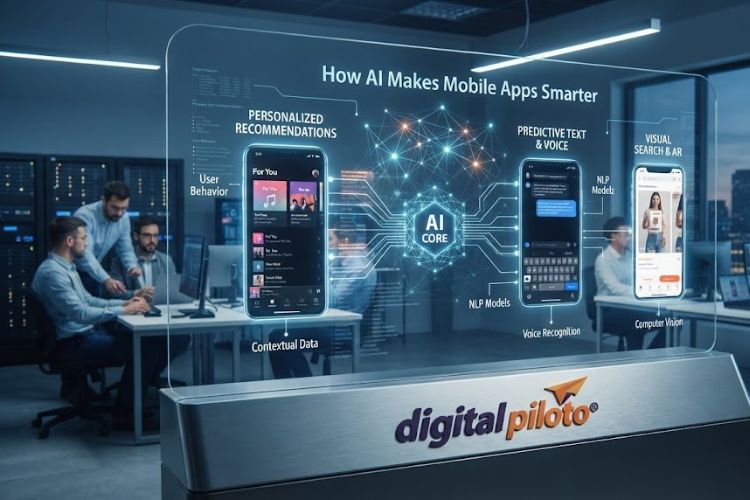
Features such as voice assistants, image recognition, predictive recommendations, and conversational interfaces are now expected rather than exceptional.
Organizations investing in AI Software Development are using these capabilities to create products that continuously learn from user interactions and improve over time.
This is particularly important in sectors such as education technology, logistics, and business productivity platforms.
What Makes an AI Project Successful?
Technology alone rarely guarantees results.
Successful AI projects usually share several characteristics:
- A clearly defined business problem.
- Access to high-quality data.
- Measurable performance goals.
- Human oversight and governance.
- Continuous model improvement.
In practice, organizations often fail not because the algorithms are weak but because the business objective was unclear from the beginning.
Frequently Asked Questions
What are real-world applications of AI development?
AI is used in healthcare, finance, retail, manufacturing, logistics, education, and customer support to improve efficiency and decision-making.
Can small businesses use AI solutions?
Yes. Many cloud-based AI tools are affordable and scalable for businesses of all sizes.
Is AI development only for large enterprises?
No. Startups and medium-sized businesses increasingly use AI for automation, analytics, and customer engagement.
What industries benefit most from AI?
Healthcare, finance, manufacturing, retail, and logistics are currently among the largest adopters of AI technologies.
Does AI replace human employees?
Most organizations use AI to augment employees by automating repetitive tasks and supporting better decisions.
Conclusion
The most interesting thing about AI development is not that machines are becoming smarter. It is that businesses are becoming more capable because of the tools they now have access to. The organizations that focus on practical applications rather than hype are likely to see the greatest long-term value.
Blog development Credits
This article was developed through the strategic direction of Amlan Maiti, informed by insights from advanced AI research platforms, and refined through optimization expertise from Digital Piloto.