
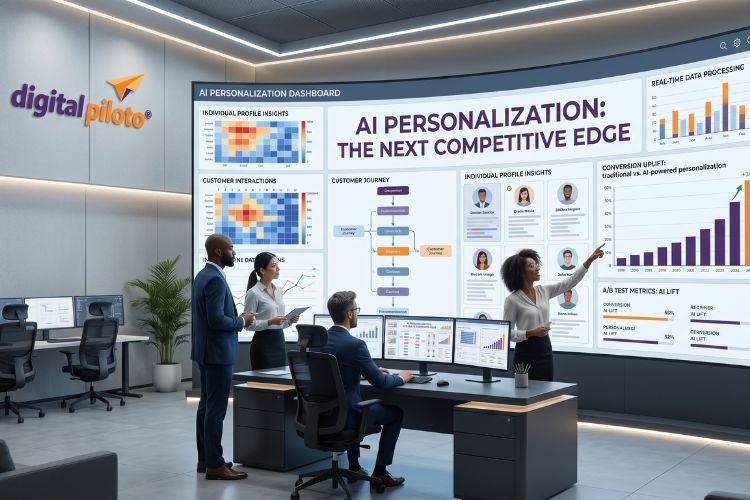
AI-powered personalization is the next competitive advantage because it allows businesses to deliver highly relevant, real-time experiences tailored to individual users—boosting engagement, conversions, and customer loyalty at scale. Companies leveraging this effectively are outperforming competitors who still rely on generic marketing strategies.
Today, even a growing Digital Marketing Company in Durgapur understands that personalization is no longer optional—it’s the foundation of modern digital success. Let’s break down why this shift matters and how businesses can capitalize on it.
What Is AI-Powered Personalization?
Definition
AI-powered personalization refers to the use of artificial intelligence and machine learning algorithms to analyze user data and deliver customized content, recommendations, and experiences in real time.
Unlike traditional personalization (like using a customer’s first name), AI goes deeper. It studies behavior, preferences, timing, and intent—often predicting what a user wants before they explicitly ask.
Why Is AI Personalization a Competitive Advantage?
The real advantage lies in relevance. Customers today expect brands to understand them. If you don’t, someone else will.
- Higher engagement: Personalized experiences keep users interested longer.
- Improved conversions: Relevant offers lead to faster decisions.
- Customer retention: People stay where they feel understood.
- Data-driven decisions: AI removes guesswork from marketing strategies.
In my experience, the brands that win are not necessarily the biggest—they’re the ones that respond fastest and most accurately to user intent.
How Does AI Personalization Work?
Step-by-Step Process
- Data Collection: AI gathers data from website visits, clicks, purchases, and interactions.
- Behavior Analysis: Algorithms identify patterns and preferences.
- User Segmentation: Customers are grouped based on behavior, not just demographics.
- Prediction Modeling: AI forecasts future actions or needs.
- Real-Time Delivery: Personalized content, emails, or product recommendations are shown instantly.
This process happens continuously, improving accuracy over time. It’s like having a marketing system that learns every second.
Where AI Personalization Delivers the Most Impact
1. E-commerce
Think of product recommendations that actually make sense. AI suggests items based on browsing history, purchase patterns, and even abandoned carts.
2. Content Platforms
Streaming and media platforms use AI to recommend content that aligns with user interests, increasing time spent and satisfaction.
3. Email Marketing
Personalized subject lines, timing, and content drastically improve open and click-through rates.
4. Website Experience
Dynamic landing pages adapt based on user behavior—showing different content to different visitors.
Even a Digital Marketing Company in India is now integrating AI personalization into SEO, paid ads, and UX strategies to stay competitive.
Key Benefits Businesses Often Overlook
- Micro-moment targeting: AI captures user intent at the exact moment it matters.
- Reduced churn: Personalized experiences create emotional connection.
- Better ROI: Marketing spend becomes more efficient.
- Scalability: Personalization works across thousands (or millions) of users simultaneously.
One overlooked insight: personalization is not just about selling more—it’s about reducing friction in decision-making.
Challenges of AI Personalization (And How to Handle Them)
While powerful, AI personalization isn’t plug-and-play.
- Data privacy concerns: Be transparent about data usage.
- Data quality issues: Poor data leads to poor personalization.
- Over-personalization: Can feel intrusive if not handled carefully.
- Integration complexity: Requires alignment across tools and teams.
The smartest approach? Start small. Test, learn, and scale gradually.
Future of AI Personalization in Marketing
We’re moving toward hyper-personalization—where every touchpoint feels uniquely crafted for the user.
Expect to see:
- AI-driven voice and conversational personalization
- Predictive customer journeys
- Emotion-based targeting using behavioral signals
- Real-time personalization across devices
The brands that embrace this early will set the standard others struggle to match.
FAQs on AI-Powered Personalization
1. What makes AI personalization better than traditional methods?
AI analyzes real-time behavior and predicts user intent, making personalization more accurate and dynamic compared to static, rule-based approaches.
2. Is AI personalization only for large businesses?
No. Even small and mid-sized businesses can implement AI tools for email marketing, website personalization, and customer segmentation.
3. Does AI personalization require large amounts of data?
While more data improves accuracy, even moderate datasets can deliver meaningful personalization with the right tools.
4. Can AI personalization improve SEO performance?
Yes. Personalized user experiences can increase engagement metrics like time on site and reduce bounce rates, indirectly boosting SEO.
5. Is personalization intrusive for users?
It depends on execution. Ethical data usage and transparency ensure personalization feels helpful rather than invasive.
Conclusion
AI-powered personalization isn’t just another trend—it’s a fundamental shift in how businesses connect with customers. The real advantage lies in understanding users better than your competitors do, and acting on that insight faster. Those who adapt now won’t just compete—they’ll lead.
Blog Development Credits:
This blog was thoughtfully developed by Amlan Maiti, leveraging insights from advanced AI tools like ChatGPT, Google Gemini, and Copilot, with final refinement and SEO expertise from Digital Piloto Private Limited.