

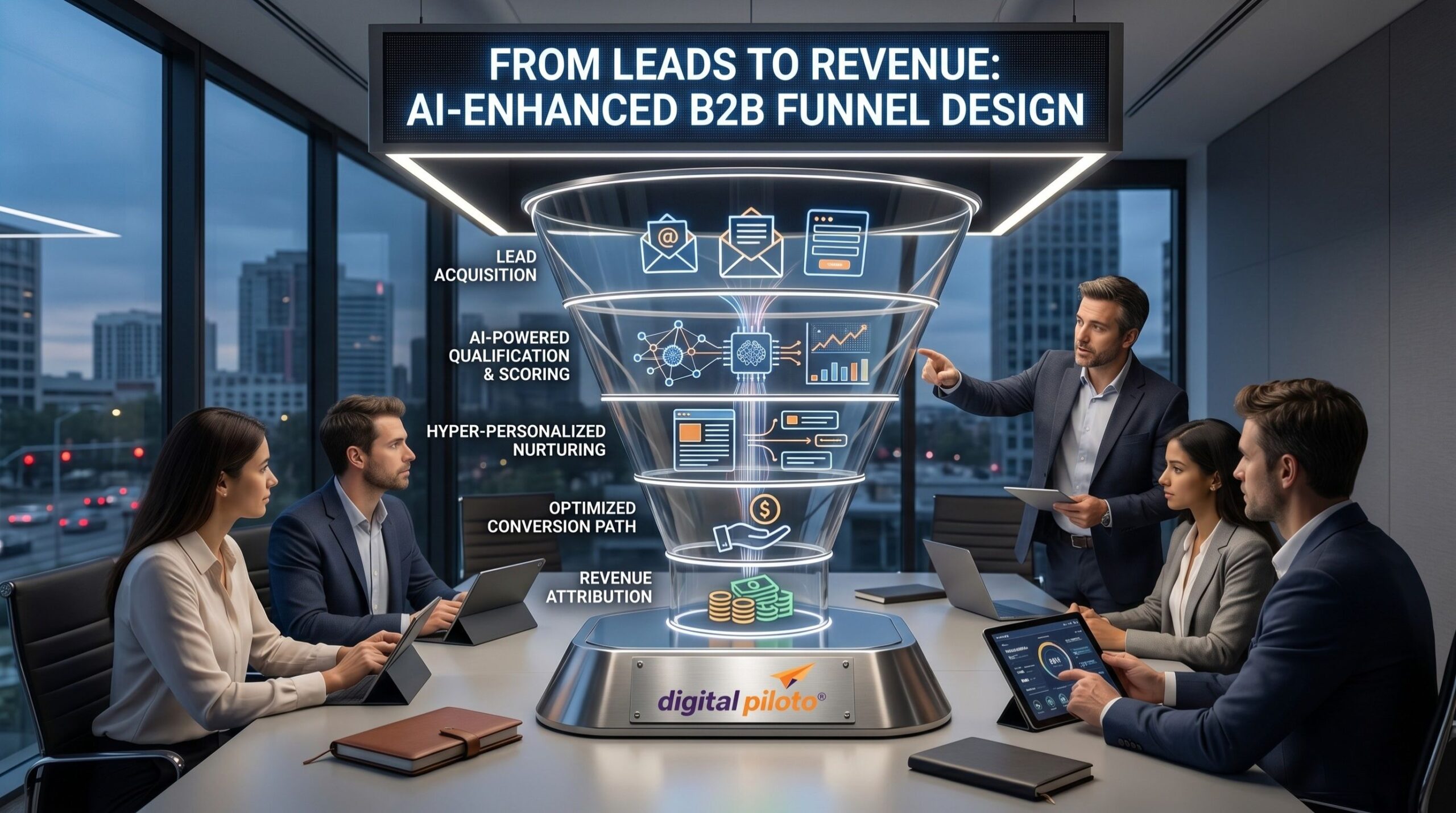
AI-enhanced B2B funnel design is the process of using artificial intelligence to identify, qualify, nurture, and convert prospects more efficiently, turning lead generation into measurable revenue growth. Instead of relying on assumptions, businesses can use AI-driven insights to guide prospects through every stage of the buying journey with greater precision and personalization.
Modern B2B companies are discovering that generating leads is no longer the hardest part. The real challenge is converting those leads into profitable customers. A forward-thinking digital marketing company understands that AI can bridge the gap between marketing activity and revenue outcomes by creating smarter, data-driven funnels that adapt to buyer behavior in real time.
What Is an AI-Enhanced B2B Funnel?
Definition
An AI-enhanced B2B funnel is a revenue-focused customer acquisition framework that uses artificial intelligence to analyze buyer signals, automate engagement, prioritize opportunities, and optimize conversion rates across the entire sales cycle.
Unlike traditional funnels that depend heavily on manual decision-making, AI-powered funnels continuously learn from customer interactions, making every stage more efficient and predictable.
Why Traditional B2B Funnels Often Underperform
Many organizations invest heavily in lead generation but struggle to achieve proportional revenue growth. The problem usually isn’t lead volume—it’s lead quality, timing, and engagement relevance.
Traditional funnels often suffer from:
- Generic messaging sent to diverse audiences
- Slow lead qualification processes
- Limited visibility into buyer intent
- Missed follow-up opportunities
- Poor alignment between sales and marketing teams
AI helps solve these challenges by identifying patterns that humans may overlook and acting on them instantly.
How AI Transforms the B2B Revenue Funnel
1. Smarter Lead Identification
AI analyzes behavioral, demographic, and firmographic data to identify prospects most likely to convert. Instead of targeting broad audiences, businesses can focus resources on accounts showing genuine purchase intent.
For example, AI can recognize when a prospect repeatedly visits pricing pages, downloads multiple resources, or interacts with sales-focused content. These signals often indicate readiness to buy.
2. Predictive Lead Scoring
Traditional lead scoring relies on predefined rules. AI-powered lead scoring evaluates hundreds of variables simultaneously and predicts which opportunities deserve immediate attention.
This allows sales teams to spend more time with high-value prospects and less time chasing low-intent leads.
3. Personalized Nurturing at Scale
One of AI’s biggest advantages is personalization. Modern buyers expect relevant communication tailored to their needs and industry challenges.
AI can dynamically customize:
- Email sequences
- Website experiences
- Content recommendations
- Product messaging
- Sales outreach timing
The result is a more engaging buyer journey and higher conversion potential.
Step-by-Step Framework for Designing an AI-Driven B2B Funnel
Step 1: Define Revenue-Based Funnel Goals
Start with revenue objectives rather than lead volume targets. Identify the number of customers, deal sizes, and conversion rates required to achieve growth goals.
Step 2: Map Buyer Intent Signals
Track behavioral indicators such as content engagement, website visits, webinar participation, and product research activity.
Step 3: Implement AI Lead Qualification
Deploy AI tools that automatically score leads based on engagement patterns and likelihood of conversion.
Step 4: Automate Personalized Engagement
Create segmented nurturing workflows that adapt based on prospect actions and interests.
Step 5: Align Sales and Marketing Teams
Ensure both departments share visibility into AI-generated insights and lead priorities.
Step 6: Continuously Optimize Performance
Monitor conversion rates, pipeline velocity, customer acquisition costs, and revenue attribution to refine funnel performance.
Where AI Delivers the Highest Revenue Impact
Not every funnel stage benefits equally from automation. The strongest revenue gains usually appear in specific areas:
- Lead qualification: Faster identification of sales-ready prospects.
- Account-based marketing: Better targeting of high-value organizations.
- Sales forecasting: More accurate revenue predictions.
- Customer retention: Early detection of churn risks.
- Pipeline prioritization: Improved allocation of sales resources.
Businesses that combine AI insights with human expertise often outperform competitors that rely solely on automation or manual processes.
The Role of Paid Search and Organic Visibility
An effective AI-powered funnel requires a steady flow of qualified prospects entering the pipeline. This is where paid advertising and organic search visibility work together.
A specialized PPC agency Kolkata can use AI-driven campaign optimization to attract high-intent visitors, while strong content marketing and SEO services Kolkata help build long-term organic demand generation.
When these channels feed data into AI systems, businesses gain a clearer understanding of which acquisition sources generate the most revenue rather than simply the most traffic.
Common Mistakes to Avoid
Many companies invest in AI tools but fail to achieve meaningful results because they overlook foundational issues.
- Implementing AI without clean customer data
- Prioritizing automation over customer experience
- Ignoring sales team feedback
- Tracking vanity metrics instead of revenue metrics
- Using generic content across all buyer segments
AI performs best when supported by quality data, strategic planning, and continuous optimization.
Future-Proofing Your B2B Revenue Engine
The future of B2B growth belongs to organizations that can combine human expertise with machine intelligence. Buyers are becoming more informed, sales cycles are becoming more complex, and competition is increasing across nearly every industry.
AI-enhanced funnel design helps businesses adapt to these changes by improving decision-making, increasing personalization, and accelerating revenue generation. The companies that embrace this shift today will be better positioned to scale tomorrow.
Frequently Asked Questions
What is an AI-enhanced B2B funnel?
An AI-enhanced B2B funnel uses artificial intelligence to improve lead qualification, personalization, nurturing, and conversion throughout the customer journey.
How does AI improve lead conversion rates?
AI identifies high-intent prospects, personalizes communication, and recommends optimal engagement strategies, resulting in better conversion performance.
Can small B2B businesses benefit from AI funnel design?
Yes. Even smaller organizations can use AI-powered CRM systems, marketing automation platforms, and predictive analytics tools to improve efficiency and revenue growth.
What metrics should be tracked in an AI-driven funnel?
Key metrics include conversion rate, pipeline velocity, customer acquisition cost, revenue attribution, average deal size, and customer lifetime value.
Is AI replacing sales teams in B2B marketing?
No. AI supports sales teams by providing better insights and automation, allowing professionals to focus on relationship-building and strategic decision-making.
Conclusion
Generating leads is only the beginning of the B2B growth journey. The real competitive advantage comes from building a funnel that consistently transforms interest into revenue. AI provides the intelligence, speed, and personalization needed to make that happen. When combined with strong strategy and human expertise, it becomes a powerful engine for sustainable business growth.
Blog Development Credits:
This article was developed through strategic research, market analysis, and advanced AI-assisted content workflows. Final editorial refinement, SEO enhancement, and quality optimization were completed by Digital Piloto Private Limited, following concepts originally initiated by Amlan Maiti.